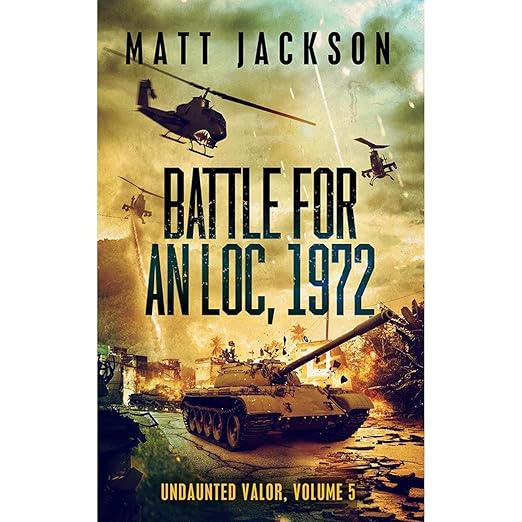
Highway 13, running north from Saigon toward the Cambodian border, was known during the Vietnam War as 'Thunder Road.' In April 1972, it became the main axis of one of the most sustained and violent battles of the entire conflict. Battle For An Loc, 1972 by Matt Jackson, narrated by Virtual Voice and the fifth entry in the Undaunted Valor series, puts the audiobook listener at the center of that fight with the kind of operational specificity that distinguishes serious military history from the genre's more dramatic but less rigorous alternatives.
The 1972 Easter Offensive, a four-prong North Vietnamese assault into South Vietnam, targeted An Loc precisely because of its position on Highway 13. Seize An Loc, cut the highway, and Saigon is exposed. A handful of US Army Advisors embedded with South Vietnamese defenders understood that calculus, and what Jackson documents over more than twelve hours is their determination to deny the North Vietnamese Army three full divisions of advancing force. The scale of that mismatch is part of what makes the account compelling from the opening chapters.
From Forward Air Controllers to B-52 Arc Light
Jackson's organizational approach is to reconstruct the battle in sequence, following the action as it actually unfolded rather than imposing retrospective narrative logic onto events that were, at the time, experienced as confusion and crisis. That choice produces a different reading experience than the typical military history that packages chaos into clean arcs. Listeners who want to understand what it actually felt like to defend An Loc in the spring of 1972 will find this method more illuminating than more curated accounts. The conversations Jackson includes are reconstructed from circumstance and testimony rather than transcribed from record, and he makes that methodology transparent, crediting participants honestly.
The air power dimension of the battle receives extensive and justified attention. US Air Force involvement, from O-2 Forward Air Controllers coordinating at low altitude to B-52 Arc Light strikes reshaping the battlefield, was the decisive American contribution to An Loc's survival. Jackson documents those relationships, between advisors on the ground, Forward Air Controllers overhead, and attack helicopters and bombers operating across the engagement area, with the operational specificity that only comes from serious research. One reviewer who served in Vietnam described the book as 'extremely well researched,' and that assessment holds across the battle narrative.
AI Avoids the Stumbling a Human Narrator Might
Virtual Voice narration handles the dense military nomenclature of this audiobook with reasonable consistency. Aircraft designations, unit identifiers, Vietnamese place names, and weapons system vocabulary all present challenges for any narrator, and AI-generated narration at least avoids the stumbling over unfamiliar terms that some human narrators experience with highly technical military material. The twelve-hour runtime is substantial, and the narration's consistency matters for sustained listening engagement.
The book's focus on the US Army Advisors as its human center is a deliberate structural choice. These were not combat troops in the conventional sense but embedded specialists whose influence depended entirely on their ability to rally South Vietnamese units under conditions of extreme pressure. Jackson portrays that advisory relationship honestly, including the tensions and limitations, rather than simply casting the advisors as heroes imposing American effectiveness on reluctant allies. A Vietnam veteran reviewer noted some friction with the book's portrayal of ARVN forces, which reflects the genuine complexity of that advisory relationship during the 1972 offensive.
As the fifth entry in the Undaunted Valor series, Battle For An Loc assumes some familiarity with Jackson's approach and the broader Vietnam War context he has been documenting across the series. New listeners can enter here, but the cumulative effect of reading the series in order will give the An Loc account additional historical weight. The series approach, documenting specific battles and operations with this level of operational detail, fills a real gap in popular military history coverage of the Vietnam War's later phases.
Puts You in the Middle of the Battle
Jackson's transparency about reconstructed dialogue is both an honesty and a limitation. When conversations are described as 'what would have been said under the circumstances,' readers are getting informed reconstruction rather than documented record. For a battle this recent, with surviving participants, the methodology is defensible, but it means listeners should hold the specific dialogue with appropriate awareness of its reconstructed nature. The operational facts appear to be solidly documented; the interpersonal texture is more speculative.
The book's perspective is primarily that of the US Advisors and the South Vietnamese units they worked with. The North Vietnamese perspective, their planning, their experience of the battle's reversals, their own acts of determination and courage, receives limited treatment. Jackson is not writing a balanced history of the Easter Offensive but a focused account of An Loc's defense, and that focus necessarily shapes what gets included. Readers wanting the full operational picture of the 1972 offensive will need to supplement this with broader histories of the period.
For listeners who served during this period, the book carries dimensions that general readers will not fully access. The Vietnam veteran reviewer who said the book 'puts you in the middle of the battle' was speaking from experience that gives the operational narrative a different kind of weight. That authenticity is both the book's greatest strength and a reminder that military history of this kind is always, on some level, a form of memorial as well as scholarship.
Start With Broader Histories Before Tackling This
Military history readers with interest in the Vietnam War's later phases, particularly the 1972 Easter Offensive, will find this the most operationally detailed account of An Loc currently available in audiobook form. Veterans of the conflict, particularly those with advisory or air support backgrounds, will find the technical and operational specificity resonant. Series followers who have tracked Undaunted Valor from the beginning will find the cumulative historical framework deepens this entry. General listeners approaching Vietnam War history for the first time should consider starting with broader operational histories before tackling this level of detail.
Quick Take
- Read by: Virtual Voice handles the dense military nomenclature and Vietnamese place names with reasonable consistency, though the AI delivery lacks the inflection that would lift the most intense operational passages.
- At its heart: Determination under overwhelming odds, the US advisor role in Vietnam, air power as decisive force, the human cost of a forgotten battle
- Vibe: Operationally precise and sustained, with the weight of recent history pressing against the detail
- Short version: The most detailed audiobook account of the An Loc battle available, rewarding listeners who want operational specificity over dramatic narrative packaging.
Before You Listen
Is Battle For An Loc, 1972 accessible to listeners without deep Vietnam War knowledge?
The operational context is established within the audiobook, but the density of military detail rewards some prior familiarity with the Vietnam War's overall timeline. New listeners may want to pair this with a broader history of the 1972 Easter Offensive to situate An Loc within the larger campaign.
How does Virtual Voice narration handle the technical military vocabulary in this audiobook?
Better than many human narrators manage with unfamiliar technical material. Aircraft designations, unit identifiers, and weapons system vocabulary are handled with consistency, though the AI delivery does not bring the inflective range that experienced military history narrators develop over many titles.
Does the audiobook address the South Vietnamese perspective on the Battle of An Loc?
Primarily through the advisory relationship lens. The South Vietnamese defenders are present as the forces the US Advisors worked with and attempted to rally, but the internal South Vietnamese command perspective receives limited treatment. The book is primarily the advisors' story.
Is this audiobook best as a standalone or as part of the Undaunted Valor series?
It functions as a standalone for the An Loc battle specifically, but Jackson's series approach benefits from cumulative reading. Listeners who have followed the earlier Undaunted Valor entries will find the An Loc account gains additional historical weight from that context.