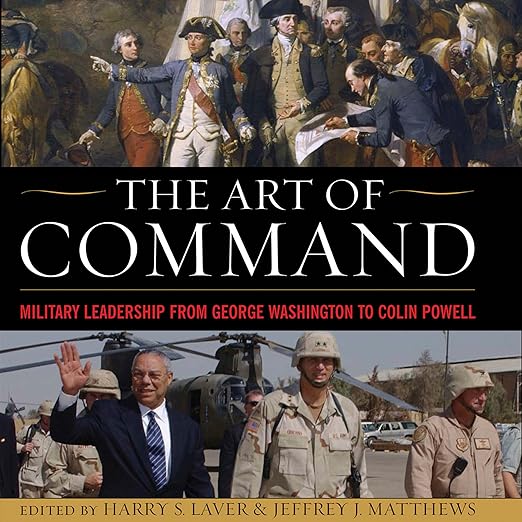
Nine commanders, nine qualities, one chapter apiece: that is the whole architecture of this audiobook, and the shape is worth knowing before the first hour, because the shape determines everything the book can and cannot do. Seven hours and fifty-one minutes carries integrity, determination, vision and charisma among the nine traits, each attached to a figure from American military history, from George Washington at one end to Colin Powell at the other. Scott Laurence Peterson reads it for a university press imprint, and the structure being read is not the one the byline implies.
A Buyer Who Expects a Single Voice
Start with authorship, because the record and the description disagree. The byline holds one name, Harry S. Laver. The description holds three attributions: Laver, Jeffrey J. Matthews, and what it calls the other contributing authors, drawn from military, academic and professional circles. This is an edited collection with a chapter-per-contributor design, and a buyer who expects a single voice across seven hours is buying something else. The listing never resolves it, so treat the byline as the editor of record and expect the prose to change hands as the commanders change.
That design produces the book's central trade-off, and an October 2015 entry states it more honestly than the copy does. The stories, it reports, glossed over quite a bit, and anyone wanting the full account should go and get the biography. Correct on both counts. Each chapter is compressed into whatever illustrates its assigned trait, which makes the collection efficient and makes it partial. The argument underneath is that great commanders became great through deliberate effort, and effort includes surmounting personal shortcomings, so the failures do get their space alongside the achievements.
One Steady Register Across Nine Prose Styles
Trait-first organization is what distinguishes this from the crowded shelf of military leadership titles. Most of them run chronologically and let the lessons emerge; this one names the lesson, then selects the career that demonstrates it. An August 2016 entry captures the effect exactly, describing a book that dives just enough into each leader and the leadership characteristic that leader carries. Just enough is the operating principle. You get the portion of a career that proves the point, and you get it at a pace that keeps a seven-hour file moving.
Audio suits this better than most academic collections. Chapters are self-contained, which means a listener can take one commander per commute without losing the thread, and the traits work as memorable headers in a way that dense biography does not. The contributors also come from mixed backgrounds, so the analytical register shifts between the military and the academic, and the diversity of approach the description advertises is genuinely audible in how the arguments are built.
Scott Laurence Peterson carries the whole thing, and the job here is specific: hold one steady register across nine separate prose styles so the collection reads as a book and not as a conference program. University press audio tends toward the plain and the clear, which is the right instinct for material where the ideas are the attraction and the sentences are not trying to be literature.
Bought for OCS, Read to Satisfy a Paper
Chronology is the first thing here that does not fit. A three-star from September 2014 explains that the copy was bought to use at Officer Candidate School in 2009, three years before this recording reached the catalog in August 2012, and that the reading was done mostly to satisfy a required paper. That same entry offers the sharpest criticism available: it does not think the book carries the literary weight of The Art of War, a comparison the title invites and does not survive. Both observations describe a printed textbook bought under obligation.
Watch the middle sections, too. The compression that makes early chapters brisk becomes a burden when a chapter reaches the long institutional years of a career, and the book has nine such stretches to get through. This is the natural failure mode of the trait-per-chapter design: the trait is established early, the career keeps going, and the material between the demonstration and the legacy has to be covered anyway.
Set expectations about scope as well. Nine figures across roughly two centuries of American command is a thin sampling, and the selection is built to fit the nine chosen qualities and not to represent the period. The further reading one entry recommends is a search you will have to run yourself, since no bibliography ever reaches a listener.
The Art of War Comparison Does Not Survive
The clearest signal about the real audience comes from a July 2015 entry, filed by somebody who bought the book for a spouse taking an army college course and states plainly that they did not read it themselves. Three of the five visible responses describe purchases made for a class, a course or a required paper. This is a set text, and set texts have a particular virtue: they are built to be taught, argued with and quoted, which makes them unusually clean listening for anybody studying leadership formally.
Choose it if you are working through a professional military education program, teaching a leadership unit, or looking for a structured vocabulary of command qualities you can actually apply at work. Pass if you want narrative history, a deep biography of any single commander, or a book that will surprise you about figures you already know well. And if you came for The Art of War in modern dress, that comparison has already been tested on this page and it does not survive.
Questions Listeners Ask
Is this audiobook written by one author or several?
Several. The byline shows Harry S. Laver alone, while the description names Jeffrey J. Matthews and further contributing authors from military, academic and professional backgrounds. Expect one chapter per commander with the prose changing hands, and treat the single name on the record as the editorial credit rather than the writing credit.
How much detail does each commander actually get across the seven hours?
Enough to establish one assigned quality and little beyond it. A four-star response found the long middle stretches of each career monotonous and wished those years had been summarized harder. Chapters run to roughly fifty minutes each, which buys you the formative period and the decisive episode, and not a life.
Which nine leadership qualities does the audiobook cover?
The description picks out four of the nine by name: integrity and determination, then vision and charisma. Each is matched to a commander whose career demonstrates it, and the full run stretches from George Washington through Dwight D. Eisenhower to Colin Powell, so about two hundred years of command get sampled.