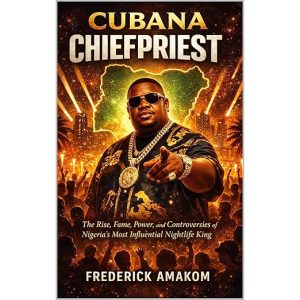
A nightlife promoter from Owerri becomes a national name, and this audiobook tries to explain how in two hours and twenty-four minutes. Frederick Amakom's subject is Pascal Chibuike Okechukwu, known across Nigeria and well beyond it by the name on the cover, and the description is upfront about scale: it calls itself a concise biography and does not pretend otherwise. Independently published in March 2026, the recording promises the early years, the Malaysia story, the Obi Cubana connection, the Mercy Eke moment, the friendship with Davido, and the arguments about wealth and nightlife culture that follow all of it.
Two Hours, Eight Subjects, and No Sourcing Given
Two hours and twenty-four minutes to cover eight listed subjects works out to roughly eighteen minutes each, and the honest way to describe the result is a briefing rather than a biography. That is not automatically a criticism. A reader who knows the name from Instagram and nothing else, or who has followed Afrobeats and keeps encountering this figure at the edge of it, is served better by a compact orientation than by four hundred pages.
Framing is where the book starts well. How does a nightlife promoter from southeastern Nigeria become one of the most recognizable personalities in the country, and was it networking, digital influence, or a handful of cultural moments that caught fire? Those three explanations are genuinely different, and the modern celebrity career usually runs on all three at once. A book that keeps them separate long enough to weigh them would be worth reading at any length.
Whether this one does that is harder to establish from the record, because the description never says where any of it comes from. No interviews are mentioned, no archival work, no indication of whether the subject or anyone close to him participated. For a living public figure whose career includes contested episodes, the sourcing question is not academic, and the copy answers it by describing the book as balanced and moving on.
A Generation Redefining Success in the Digital Age
Genuine underdocumentation is the strongest argument in its favor. Nigerian celebrity culture has produced an enormous amount of coverage in the last decade and very little of it is retrospective, so a narrative that connects Owerri nightlife, the rise of the Cubana hospitality business, a Big Brother Naija win and an Afrobeats superstar friendship into one sequence is filling a real gap even at this length.
Amakom's thesis in the closing lines is more interesting than the celebrity material preceding it. The claim is that this is not the story of one man but of a generation redefining what success looks like in the digital age, and that framing has legs. A promoter who turns social presence into hospitality equity and then into national recognition is describing a career path that did not exist twenty years ago, and treating it as an economic story rather than a gossip story is the right instinct.
Length works in its favor for that specific purpose. A hundred and forty-four minutes is a single sitting or two commutes, which is proportionate to what an orientation should cost, and the compression forces the book to stay on the through-line instead of wandering into anecdote. If the aim is to understand who this person is and why he matters to people who follow Nigerian entertainment, the runtime is defensible.
Synthetic Narration Across All 144 Minutes
No human reader appears on this recording. The narrator credit on this record reads Virtual Voice, which means synthetic delivery across the full 144 minutes, and the disclosure appears in the credit line rather than buried, which is the right way to handle it. Anyone who buys audio for interpretation, accent or emphasis should treat that as the deciding fact. A book about a Nigerian public figure read without a Nigerian voice also loses something the text cannot supply.
Smaller inconsistencies sit elsewhere on the record. The title field is set entirely in capitals while the description uses ordinary case throughout, so the same book appears under two different names depending on where you look. The category tag reads Art, which matches nothing in the contents, and the copy repeatedly addresses readers rather than listeners, a sign that the audio edition was produced from print copy without adjustment.
Buyers approaching this one get no star average and no rating count to lean on, and no posted response anywhere on the listing. Five months on sale have produced nothing. That places the entire weight of the purchase on the description, which is written in the register of promotional copy and promises the truth behind an episode it declines to summarize. Go in expecting a summary of public record rather than disclosure.
Afrobeats Followers Get the Connective Tissue Here
Followers of Nigerian entertainment or Afrobeats get the most out of this, because what it offers is connective tissue: how the hospitality business, the reality television moment and the celebrity friendships fit together into one career rather than a series of headlines. It also suits anyone interested in influence as a business model, since that generational argument in the closing lines is the most transferable thing here and works even if the specific names mean nothing to you.
Skip it if you want investigative reporting, named sources or a documented account of the controversies, because nothing on the record indicates any of those. Synthetic narration will be a deal-breaker for some buyers. And if you already follow this story closely, two hours built on public information is unlikely to tell you something you did not have.
Key Details
- Themes: Nigerian nightlife and hospitality business, social media influence as a career, celebrity friendship networks, wealth and its critics.
- Mood: Brisk, promotional and admiring.
- Verdict: A serviceable two-hour orientation to a figure most coverage assumes you already know, with no sourcing on show.
A Few Questions About CUBANA CHIEFPRIEST
Who narrates the audiobook?
No human reader is credited. The narrator field reads Virtual Voice, meaning synthetic delivery across the full runtime, disclosed openly in the credit line. Buyers who choose audio for performance should factor that in, particularly on a book about a Nigerian public figure where accent and cadence carry real information.
Do I need to know Nigerian entertainment to follow the audiobook?
Some familiarity helps considerably. Obi Cubana, Mercy Eke, Big Brother Naija and Davido all appear as reference points the book assumes rather than introduces, and 144 minutes leaves no room to explain them from scratch. Newcomers will follow the shape of the career and miss most of the significance.