Quick Take
- Narration: Virtual Voice AI narration handles survey history acceptably but flattens the Aboriginal mythology section entirely, Dreamtime stories told without breath, cadence, or presence lose something essential.
- Themes: Indigenous cosmology, colonial encounter, cultural continuity
- Mood: Educational and organized, with a built-in mismatch between content and delivery
- Verdict: The historical content holds up as a two-in-one orientation; the mythology section, which by its nature requires a human voice steeped in the tradition, deserves a better format than this one provides.
There is a structural tension at the heart of this audiobook that no amount of solid writing can resolve: one of the two manuscripts bound together here is oral tradition. Aboriginal Dreamtime stories are not just stories. They are navigational tools, embedded in landscape, transmitted across generations through song lines and the act of telling. The act of telling matters. When that material is fed through AI text-to-speech generation, which is what Virtual Voice represents, something irreducible is lost before the listener hears the first word.
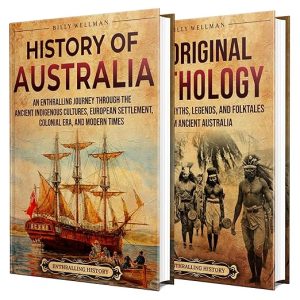
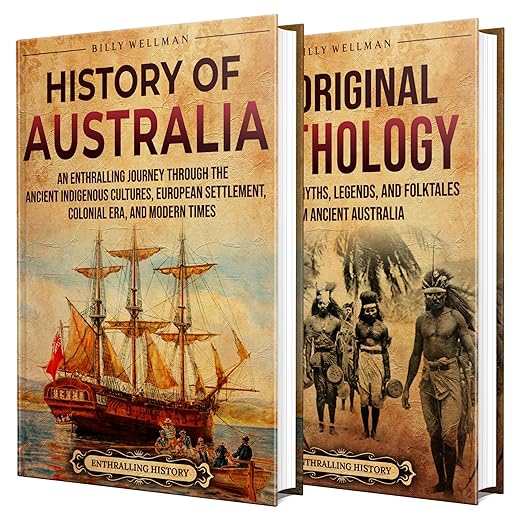
I want to be careful here because the historical manuscript, History of Australia: An Enthralling Journey through the Ancient Indigenous Cultures, European Settlement, Colonial Era, and Modern Times, does its job reasonably well. It covers paleolithic habitation through the Gold Rush, federation, and the World Wars with the organized, accessible tone that the Exploring the Past series deploys consistently. The factual content is solid. A listener new to Australian history will come away with a coherent framework. For survey history that moves efficiently from ancient cultures through modern Australia, the Virtual Voice narration is a limitation but not a disqualification.
Where Synthetic Narration Meets Sacred Material
The second manuscript is where the format choice becomes genuinely problematic. Aboriginal Mythology: Enthralling Myths, Legends, and Folktales from Ancient Australia covers the Rainbow Serpent, Baiame, the creator beings of the Dreaming, song lines, and tales of resistance and bravery from pre-colonial Indigenous life. This is material from the world’s oldest continuous living culture whose proper transmission depends on the particularity of a human voice, the pauses, the emphasis on certain names, the presence that suggests these stories belong to someone who carries them.
Virtual Voice is an AI-generated text-to-speech system. It processes the words at a consistent, synthetic pace that is phonetically accurate and emotionally absent. For historical survey material, lists of dates, descriptions of colonial policies, summaries of major events, this is a workable trade-off. For Dreamtime cosmology, it is a mismatch that makes itself felt from the first story. When the Rainbow Serpent is mentioned, the name arrives the same way “Governor Macquarie” arrives: as information. Oral tradition deserves a different relationship with its listener.
What the Two-Volume Structure Offers
Setting aside the narration question, the two-in-one design is actually a thoughtful choice for the material. Australian colonial history cannot be understood without the Indigenous history that predates and surrounds it, and that Indigenous history cannot be understood without some engagement with the cosmological framework through which Aboriginal Australians understand their relationship to country. Binding the political history and the mythological tradition together in a single volume encourages readers to hold both frameworks simultaneously rather than treating them as separate subjects.
The historical section does acknowledge the depth of Indigenous Australian cultures before European contact, and the section on the Gold Rush, federation, and the World Wars is covered with sufficient breadth for a first encounter. The synthesis of ancient and modern, Indigenous and colonial, is the subject, and the survey manages to keep that synthesis in view.
There is also a meaningful structural argument in putting these two manuscripts side by side. European histories of Australia have consistently treated Aboriginal culture as prelude, as the thing that was there before the real story started. Placing the Aboriginal mythology section not as an appendix but as co-equal with the colonial history inverts that hierarchy in a small but legible way. Whether the AI narration allows that inversion to land as it should is the question the format raises and cannot fully answer.
What the Imagery Promise Means in Audio
The synopsis emphasizes “fascinating images that bring every story to life”, this is a print-origin book, and the visual apparatus is entirely inaccessible in audio format. The images of Dreamtime beings, the landscape photographs, the historical illustrations: none of these transfer. Listeners should be aware that the audio version is a stripped-down experience relative to the print original, and the visual components were clearly part of how the publisher intended the mythology section to land.
At five hours and fifty-three minutes for two manuscripts, the pace through each is necessarily brisk. The 30 ratings at a 4.4 average suggest an audience largely satisfied, or largely arriving from print-formatted expectations. The most honest use case for this audiobook is as background listening where the survey historical content works well and the mythology section functions as an introduction to names and concepts rather than as an encounter with the tradition itself.
For the Curious Generalist and the Dreamtime Seeker
Listen to this if you want a broad orientation to Australian history and Indigenous culture and understand that the mythology section will read as introduction rather than transmission. As background research for a trip or a starting point for further reading, it delivers reasonable value at the runtime.
Skip this if you want genuine engagement with Aboriginal Dreamtime traditions. For that, seek out recordings by Aboriginal storytellers, or, reviewed elsewhere on this site, Munya Andrews’s self-narrated Journey Into Dreamtime, which represents exactly what this book’s mythology section needed: a human voice that carries the tradition from inside it.
Frequently Asked Questions
Is the Virtual Voice narration a significant barrier to enjoying this audiobook?
For the historical survey sections, it is a limitation but manageable, the content carries the work. For the Aboriginal mythology sections, the AI narration strips away something the material requires to land properly. Oral tradition depends on voice as transmission, not just delivery, and synthetic narration cannot replicate that relationship. Listeners sensitive to this distinction will find the mythology sections significantly diminished relative to what the content deserves.
Does the book cover the Stolen Generations and other dark chapters of Australian colonial history?
The historical manuscript covers the broad arc of European settlement, colonial policy, and the impact on Indigenous Australians, including reference to the displacement and cultural suppression that defines that history. It is a survey treatment rather than a deep investigation, for a thorough account of the Stolen Generations specifically, you would need a dedicated work.
Are the two manuscripts clearly separated or does the content blend together?
The two manuscripts are structured as distinct sections rather than integrated throughout. The historical survey runs first, followed by the Aboriginal mythology collection. The transition between them is clear, which means listeners can approach each on its own terms.
How does this compare to Munya Andrews’s Journey Into Dreamtime for learning about Aboriginal spirituality?
Andrews’s self-narrated work is the more powerful choice for anyone whose primary interest is the Dreamtime tradition. Andrews is an Aboriginal elder narrating her own culture’s knowledge, the authority and intimacy of that delivery cannot be replicated. This two-in-one volume is the better choice for someone who wants the historical context alongside the mythology, and is willing to accept the limitations of AI narration for the mythological content.