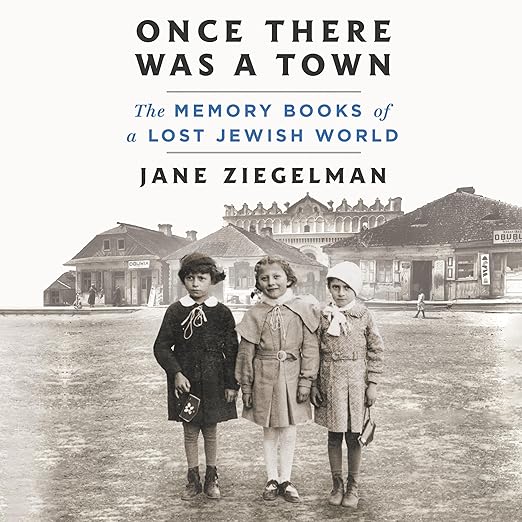
Survivors wrote books, and that fact is where this audiobook starts. After 1945, Jewish communities that had been erased from the map reassembled on paper: people who had escaped gathered in groups and produced yizkor books, memorial volumes recording the towns, the trades, the arguments and the ordinary weekday mornings of a world that no longer existed. Jane Ziegelman has spent six hours and six minutes moving through that largely uncharted body of writing, and the result is neither a Holocaust history nor a family memoir, though it borrows the machinery of both. Lisa Cordileone reads it.
Yizkor Books Remember What Archives Cannot
Nothing about the premise is as academic as it sounds. Yizkor books were written by amateurs, in grief, often decades after the events, and they contain exactly what people remember rather than what an archive would preserve: which shop stood next to which, who was insufferable at the study house, what the market smelled like. Ziegelman treats them as a body of literature rather than as a set of footnotes, and Ziegelman's case is that the accumulated detail constitutes a form of testimony that official history has no method for handling.
Luboml Is the Fixed Point in the Search
One grader supplies the etymology the book turns on and the family history behind it. Yizkor comes from the Hebrew lizkor, to remember. That same four-star entry describes the author's grandmother and three brothers emigrating from a town in Poland called Luboml, and reports the evasive formula the family used ever afterward, saying they got out rather than naming a year of departure. A book built on that kind of silence has a clear reason to go looking in other people's memorial volumes.
Luboml is where the book keeps returning. The description is explicit that of all the towns on Ziegelman's itinerary she circles back to her family's ancestral shtetl, which gives a survey of a whole genre a single fixed point. That structure does two things at once: it keeps a vast subject legible, and it makes the case that any one of these towns, examined closely enough, contains the whole loss.
Lisa Cordileone Moves Through Untranslated Terms
Specificity is what makes it bearable. Rather than statistics, the book offers market squares where Jewish merchants served local farmers, study houses where men recited Torah, kitchens where homemakers baked twenty-pound loaves of bread, cemeteries where mourners spoke to the dead, and wooded groves where young couples met at night. Detail at that resolution does something an argument cannot: it puts a listener inside a functioning place, which is the only position from which its disappearance registers as more than a number.
Six hours and six minutes is short for this material, and the compression is deliberate rather than thin. The book covers many towns while returning to one, and at this length it works as a single sustained sitting or a few evenings. That matters for a subject most listeners approach in small doses. A twenty-hour version of this book would be read by specialists; a six-hour version reaches the people the yizkor writers were addressing, which was everybody who came after.
Lisa Cordileone takes the reading credit on a text assembled largely from other people's testimony, which is a specific challenge rather than a general one. The prose moves between Ziegelman's own voice, quoted memorial writing, and Hebrew and Yiddish terms that arrive without translation the second time. Sampling the recording for how those transitions are handled is a more useful test than sampling it for tone.
Photographs From the Print Edition Don't Transfer
One grader restores the subtitle this listing has dropped: Once There Was a Town: The Memory Books of a Lost Jewish World. The same entry describes a gifted advance copy received through NetGalley and thanks St. Martin's Press, while this record's publisher field reads G and D Media, so shoppers comparing editions have two names to reconcile. That entry also gives the best instruction anyone has offered for this book, which is that it asks you to slow down and listen rather than skim, and to stop reading with one eye on the clock.
Another response, filed after publication, describes finishing the book in a single afternoon and mentions the photographs that show the author's family connection to Luboml. That is a print feature. No image file or companion PDF is advertised alongside the audio, so the visual evidence that grader found persuasive is not part of what you are buying, and for a book about a vanished place the loss is not trivial.
Three written responses sit under thirty ratings, which is a thin column to draw conclusions from, and two of the three were posted almost a month before the February 18, 2026 audio release. The record also files the book under history and religion with a single tag reading Modern, an odd shelf for a study of Holocaust memory and one that will keep it away from the readers most likely to want it.
Existence Comes First, Destruction Stays the Horizon
Readers of Jewish history and of memory studies are the obvious audience, and so is anyone drawn to books about how communities record themselves when no institution will do it for them. Listeners who have worked with oral history, genealogy or family archives will recognize the method and the frustrations behind it. The description places the book in conversation with I. B. Singer and Roman Vishniac, and that is a fair signal of register: this belongs beside the literary and photographic portraits of the same world rather than beside the war histories.
This is not the book for a listener seeking an account of the Holocaust itself. The destruction is the horizon rather than the subject, and the pages are spent on what existed before it. Anyone wanting military, political or camp history should start elsewhere and come here afterward, when the question of what exactly was lost stops being abstract.
What is a yizkor book, and do I need to know before starting the audiobook?
Yizkor books are memorial volumes compiled by survivors to record the communities that were destroyed, written by the people who lived in them rather than by historians. No prior knowledge is needed. The book explains the tradition as it goes, since introducing that body of writing is its whole purpose.
How long is the audiobook, and who released it?
Six hours and six minutes, published on February 18, 2026 by G and D Media. That is short for a work of history and makes it feasible in a couple of sittings, though the material rewards being spread out rather than taken in one run.