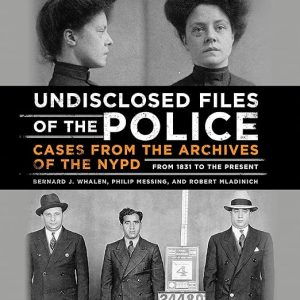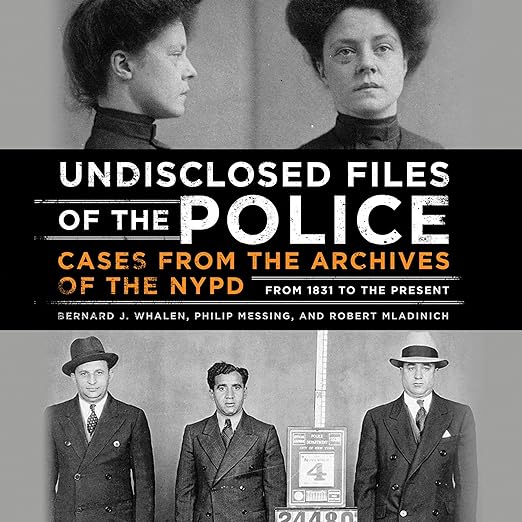
More than 500 photographs and 175 years of New York City crime sit behind this audiobook's title, and that number alone tells you something important before a single chapter starts: Undisclosed Files of the Police was built as much to be looked at as to be read. Bernard Whalen, writing with a second NYPD veteran and a New York crime reporter, moves from crimes before the department's 1845 founding through the September 11 attacks and into the present, covering more than 80 real cases along the way.
The case roster reads like a syllabus of American true crime touchstones handled with an insider's specificity: architect Stanford White's shooting at Madison Square Garden, the 1920 Wall Street bombing that killed 39 people, mobster Arnold Rothstein's 1928 killing at the Park Sheraton, Kitty Genovese's 1964 murder, and the parking ticket that finally caught Son of Sam. This is not a general true-crime anthology borrowing New York as a backdrop; it is written from inside the department that worked these cases.
Two of Three Writers Are NYPD Veterans
What distinguishes this audiobook from a standard true-crime survey is authorship. Two of the three credited writers are NYPD veterans themselves, which shows up in details a purely journalistic account would likely miss, the procedural texture of how a case actually got worked, not just how it eventually got solved. Reviewer Scott C calls the book 'Top notch New York photographic journalistic history' and praises 'Bernie Whalen, truly one of New York's Finest,' using the department's own honorific for its officers, a small detail that signals how thoroughly this reads as an inside account rather than an outside retelling.
Narrator Peter Ganim takes on a genuinely wide chronological and tonal range in a single listen, from Gilded Age scandal through Prohibition-era gangland violence to a modern terrorist attack, and none of the three attached reviews comment specifically on his narration, focusing instead entirely on the book's content and photographs. That silence is itself useful information: this audiobook is being evaluated by its listeners on the strength of Whalen's reporting and case selection, not on any particular vocal performance carrying the material.
Ganim Spans Gilded Age to Modern Terror, Unremarked
The Kitty Genovese case earns a special place in this book's roster of eighty-plus crimes because of what happened after the murder itself. The widely reported account of dozens of bystanders failing to intervene became a foundational case study in social psychology, giving rise to the term bystander effect that is still taught in introductory psychology courses today. Whalen's insider account of the actual NYPD investigation offers a different vantage point than the psychology-textbook version most listeners already know, grounding an often-abstracted case study back in the specific, documented police work behind it.
The Stanford White case alone spans the kind of scandal-driven true crime that predates modern tabloid culture by a century: an architect's very public death at his own celebrated venue, tied to a young chorus girl and a jealous husband, covered obsessively by contemporary newspapers in a way that anticipates exactly the kind of media frenzy true crime podcasts now generate for a new case every few months. Whalen including it alongside twentieth and twenty-first century cases makes the point implicitly rather than explicitly: New York's appetite for a scandalous, thoroughly documented crime did not start with true crime as a modern genre label.
Positioned for Fans of Serial and Making of a Murderer
Reviewer B. McKee describes the experience as 'a guided tour of crime in New York City,' a phrase that captures the book's actual structure well: chronological, geographically specific, and organized around real locations a listener could walk to today. For anyone who has ever wondered what stood on a given corner before it became a landmark, or how a specific precinct handled a case that later became national news, this audiobook supplies that texture in a way a general American true-crime survey could not.
The synopsis positions this explicitly for 'fans of Serial and Making of a Murderer,' and the comparison holds up reasonably well for the case narratives themselves: procedural detail, real names, real dates, and an insider's willingness to note where investigations went wrong as well as where they succeeded. A rating of 4.4 across 102 reviews suggests a smaller but consistently satisfied audience, the profile of a well-regarded niche history title rather than a mass-market crossover hit.
A three-author structure, two working NYPD veterans alongside a professional crime reporter, is a genuinely useful combination for this kind of book, and it shows in the case selection itself. A purely journalistic true-crime anthology tends to gravitate toward the most sensational or media-saturated cases; an account co-written by officers who worked inside the department has room to include cases that mattered institutionally, changed procedure, or shaped precinct-level practice, even when they never became national headlines the way Son of Sam or the Wall Street bombing did.
An 1802 Date That Contradicts the Book's Own 1845
The single biggest thing to understand before choosing the audio edition is that this book was built around more than 500 photographs, and the audio format cannot reproduce a single one of them. Reviewer A customer notes the print edition's 'pages are thick,' a detail that only makes sense for a heavily illustrated volume, and the synopsis itself leads with the visual archive rather than treating it as a bonus. The text, the case narratives, the procedural detail, all survive intact in audio, but the visual archive that gives the print edition its distinctive character does not travel with it.
B. McKee's review also mentions the police force's formation happening in 1802, a date that does not match the synopsis's own stated 1845 founding. Rather than resolve that discrepancy, it is worth simply noting it exists and trusting the book's own stated timeline, since earlier informal watch systems predating an organized force are a common source of exactly this kind of date confusion in New York policing history.
The 1920 Wall Street bombing gets a particularly striking entry in the book's case list, thirty-nine people killed and hundreds injured by a horse-drawn wagon packed with explosives and shrapnel, and it remains, more than a century later, formally unsolved. Investigators at the time suspected anarchist retaliation but never secured a conviction, and Whalen including an unsolved case alongside the book's many closed ones is itself a small, honest signal that this history does not sand down every rough edge into a satisfying resolution.
Photography Enthusiasts Should Reach for Print Instead
True crime listeners who want procedural depth and real institutional perspective, New York City history buffs, and readers who enjoyed Serial or Making a Murderer and want a book-length, multi-case version of that same appetite for documented detail are the clear audience here. The case selection spans enough decades and enough different types of crime, financial, political, serial, that almost any true-crime sub-interest finds at least one chapter worth the price of admission.
Photography enthusiasts and anyone drawn to this specifically as a coffee-table or reference object should reach for the print edition instead, since the audiobook cannot carry a single one of the 500-plus images that reviewers repeatedly cite as central to the book's identity. Listeners who only care about the written case narratives, and do not need the visual archive, lose comparatively little in the audio switch.
Quick Take
- Narration: Peter Ganim handles a wide historical and tonal range competently; no attached review comments on his performance specifically.
- Themes: NYPD institutional history, landmark New York City crimes, true crime spanning nearly two centuries.
- Mood: Procedural and matter-of-fact, closer to an insider's case file than a sensationalized retelling.
- Verdict: A strong pick for true crime and NYC history fans who accept losing the print edition's 500-plus photographs in the audio switch.
Good to Know
Does this audiobook include the photographs described in the print edition?
No. The print edition is built around more than 500 photographs, but none of them carry over into the audio format, which contains only the narrated text of the case histories.
Is this audiobook narrated in a dramatized true-crime style?
No. Narrator Peter Ganim delivers the case histories in a measured, procedural register consistent with the book's insider, documentary tone rather than a sensationalized dramatization.