The Short Version
- Performance: Anna Castiglioni handles the bilingual instructional format competently, though one reviewer found her delivery monotone during extended listening; the content itself compensates.
- What it covers: conversational fluency over academic grammar, naturalistic Spanish usage, English-speaker perspective
- Feel: Practical and direct, accessible to intermediate learners
- Our call: This audiobook fills a real gap for English speakers who have studied Spanish but cannot bridge the gap to natural conversation, and its focus on usage over grammar rules makes it genuinely actionable.
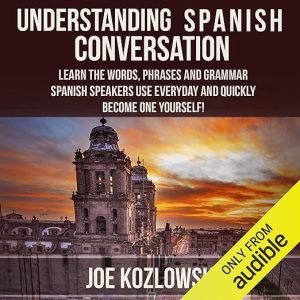
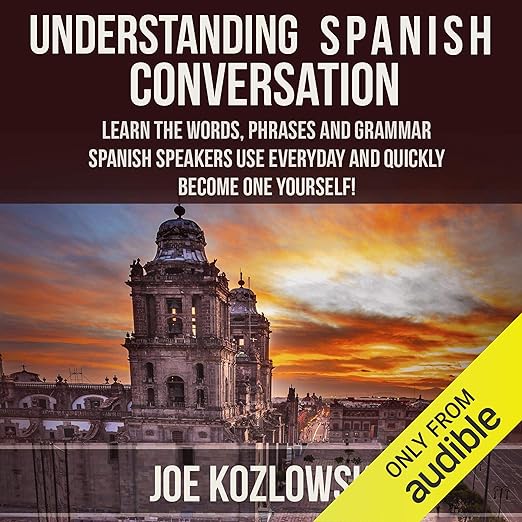
The plateau between functional Spanish and genuinely natural Spanish conversation is one of the most frustrating places a language learner can occupy, and it is remarkably underserved by the existing market. You can conjugate. You can order food and ask for directions. But the moment a native speaker starts talking at normal speed, using the contractions and connective phrases and structural shortcuts that characterize actual speech, you are lost. Joe Kozlowski's Understanding Spanish Conversation, narrated by Anna Castiglioni, is specifically designed for this gap. As an audiobook, it has an obvious structural advantage: the audio format allows listeners to hear the phrases and constructions they are learning rather than simply reading about them, which is precisely what this kind of practical language instruction requires.
Kozlowski is explicit about what this audiobook is not. It does not teach academic Spanish. It does not organize itself around grammatical rules or paradigm tables. Instead, it focuses on the connective tissue of real conversation: the words and phrases that allow a speaker to sound less robotic, to handle pauses and transitions and expressions of uncertainty and agreement the way native speakers do. At 2 hours and 26 minutes, the audiobook is short enough to revisit sections as needed, which is exactly how a language resource should be used. Kozlowski writes from the experience of having navigated this plateau himself, and that personal authority gives the audiobook a practical credibility that theory-focused language learning content rarely achieves.
Castiglioni's Monotone Delivery Still Clarifies Real Phrases
Castiglioni's narration has drawn one significant piece of critical feedback: a reviewer noted that the delivery is very monotone, which made it hard to listen to for long periods. This is a legitimate concern for an audiobook whose content requires repeated listening and careful attention to pronunciation. Language instruction audio requires a narrator who can maintain consistent engagement across what is essentially a series of examples and explanations, and a flat delivery compounds the difficulty. Listeners who plan extended listening sessions in a single sitting may find this a real limitation.
That said, the same reviewer acknowledged that the content itself was helpful, noting that many of the phrases that previously could not be understood became clear through the audiobook. This tension between content quality and delivery quality is worth weighing honestly. Kozlowski's material has been praised as clearly written and very practical by multiple reviewers, and for listeners who use the audiobook in shorter focused sessions rather than marathon listens, the monotone delivery becomes a more manageable drawback. The 2-hour-26-minute runtime naturally supports a divided listening approach.
Kozlowski Targets the Sticking Points English Speakers Hit
Kozlowski's decision to write explicitly from the perspective of a native English speaker who experienced the same frustrations his readers face is one of the audiobook's genuine assets. Language instruction produced by people for whom the target language is native often fails to account for the specific sticking points that trip up English speakers, the false cognates, the structural inversions, the idiomatic uses that have no English parallel. Kozlowski knows which concepts are genuinely difficult and addresses them directly rather than treating them as self-explanatory.
The audiobook's argument, that immersion is the absolute best way to learn a language and that learning to speak naturally is the path to immersion, is both correct and practically actionable. By teaching listeners how to sound less robotic in their Spanish production, the audiobook creates the conditions for the kind of native-speaker engagement that accelerates real learning. This is a more sophisticated pedagogical argument than most language instruction products make explicit, and it frames the audio format as particularly well-suited to the goal: you cannot fully internalize conversational rhythm from a printed page. Hearing the patterns modeled directly, even in a relatively flat delivery, does work that printed explanations cannot replicate.
This Audiobook Rewards Repeated, Targeted Listening
The most valuable sections of the audiobook are the ones that address specific conversational mechanisms: how to handle the transition between thoughts, how to express uncertainty in natural Spanish rather than the academic hedging phrases most textbooks teach, and how to use filler and connector words the way native speakers do rather than leaving them out entirely. These are the sections that reviewers who praise the audiobook as excellent consistently single out as transformative for their spoken Spanish.
Listen with the expectation of returning to specific sections repeatedly. Unlike a narrative audiobook, which builds meaning through accumulated experience, this audiobook is a reference resource in audio form. The material consolidates through repetition and practice rather than through a single sustained listen. Castiglioni's monotone delivery, paradoxically, may make the content easier to extract on repeat listens since there is less expressive variation to attend to.
Intermediate Spanish Speakers Stuck in Robotic Mode
This audiobook is designed for intermediate Spanish learners, specifically those who have formal study behind them but have not yet crossed into natural conversational fluency. Complete beginners will find some of the conceptual content more useful than others, but the audiobook assumes familiarity with basic Spanish structures. Advanced speakers who are already conversationally fluent will find little here they do not already know. The audiobook works best for learners who are actively seeking Spanish conversation opportunities and want to prepare for them by improving the naturalness of their output. Anyone learning Spanish primarily for travel and basic communication who is satisfied with tourist Spanish is not the target listener. For the significant population of English speakers who studied Spanish formally and are now stuck at the robotic-but-correct stage, this audiobook offers one of the more direct routes forward available in the language learning catalog.