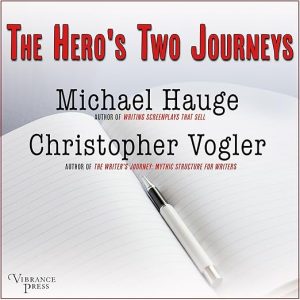
Screenwriting education has produced a genuinely large library of audio content, and most of it converges on the same canonical sources: Joseph Campbell's monomyth, Syd Field's three-act structure, Christopher Vogler's Hero's Journey adaptation for Hollywood. The Hero's Two Journeys audiobook is valuable precisely because it puts Michael Hauge and Christopher Vogler in conversation with each other rather than presenting either framework in isolation. At three hours and nine minutes, this is a workshop recording rather than a narrated book, and the distinction matters for how you should listen to it.
Hauge and Vogler are both working Hollywood script consultants with extensive professional track records, and they approach the same fundamental material, how stories work and why some fail, from sufficiently different angles to generate genuine productive tension rather than echo chamber agreement. Vogler's framework derives from Campbell and emphasizes the universal mythic pattern underlying the hero's journey. Hauge's framework is more character-psychologically oriented, focusing on the gap between a character's protective identity and their true essence. The workshop's central argument is that these two frameworks address different levels of the same story, and that the most compelling narratives operate on both levels simultaneously.
Hauge Narrates More Than Campbell 101
Michael Hauge narrates his own workshop material and the authorial delivery is a genuine asset here. The nuances of the identity-versus-essence distinction that anchors Hauge's framework are easier to convey from someone who has spent years testing this language in rooms full of working writers. Reviewer Ken specifically highlights that this is not "Joseph Campbell 101" but a practical treatment of how writers can apply Campbell's insights, and that description is accurate to the listening experience. The workshop assumes basic familiarity with story concepts, addresses the limits of that familiarity, and then pushes into more precise territory.
The point-and-counterpoint structure between Hauge and Vogler prevents the workshop from settling into the kind of unchallenged assertion that makes a lot of craft audio feel less credible than it should. When the two frameworks converge on the same example, the convergence is instructive. When they diverge, the divergence is more instructive. Reviewer Miroslav notes that the material is useful even for non-screenwriters, which reflects the fact that the underlying principles of story structure and character arc apply across fiction formats. Novelists, playwrights, and game designers are all included in the stated audience, and the examples are varied enough to support that breadth.
The Gap Between Protective Identity and Essence
The workshop is organized around two major frameworks applied in sequence. First, the outer journey: the structural principles that drive every successful plot. Story structure, character arc, and commercial appeal are each addressed in turn. Second, the inner journey: the deeper character transformation that makes a story resonate beyond its plot mechanics. Hauge and Vogler present their distinct views on the inner journey and the discussion that results is the most intellectually substantial portion of the audiobook. Hauge's formulation of the protective identity, the persona a character has built to avoid pain, against the true essence that the story's events force into the open, is particularly useful because it is specific enough to apply during the drafting process rather than only in retrospect.
The specific examples drawn from film throughout the workshop give the abstract principles concrete grounding. This is audio that works better with a pen and notepad nearby than as passive background listening. The density of usable concept per minute is high, and the three-hour runtime reflects genuine compression rather than skimpy treatment. Reviewer hut10 calls it "another great writer's tool," which undersells it slightly. The framework for understanding how external and internal story structure interlock is something most writing guides address separately, and the workshop's integration of both levels within a single three-hour session is a more efficient use of listening time than the alternatives.
Dense Enough to Reward a Second Listen
The workshop format means listeners should expect a dynamic that is different from a conventionally narrated audiobook. Hauge and Vogler are in dialogue throughout, and that dialogue occasionally moves faster than a listener encountering these frameworks for the first time can easily absorb. The audiobook rewards a second listen more than most craft audio does, particularly the inner journey sections where the frameworks are most differentiated. Listeners who want to extract maximum value should plan to revisit the workshop segments that address the identity-essence distinction and Vogler's conception of the hero's invisible inner need.
The commercial appeal thread that runs through the workshop is genuine and practical rather than cynical. Hauge and Vogler are working in an industry where commercial viability matters, and they address it without apologizing for the constraint. The framework they present is not "write what sells" but rather "understand the structural reasons why some stories connect more broadly than others." That is a more nuanced and useful frame than either pure commercial calculation or pure artistic aspiration, and it makes the workshop relevant for writers working across the full spectrum from independent literary fiction to genre commercial projects.
Not a Starting Point for Story Craft
Writers at any stage who want to understand the relationship between plot structure and character transformation as interlocking systems rather than parallel tracks will find this three-hour workshop among the most efficiently structured resources available in audio format. Screenwriters will find the Hollywood-specific examples immediately applicable. Novelists, playwrights, and game designers will find the underlying principles transferable with minimal adaptation. The workshop is particularly useful for writers who have a solid working knowledge of three-act structure and the Hero's Journey separately but have not integrated them at the level of individual scene-by-scene work.
Listeners looking for a basic introduction to story craft should start with more introductory resources before approaching this audiobook. The workshop assumes enough familiarity with craft concepts to build on them productively. It is also not a complete replacement for reading either Hauge's or Vogler's longer works, which develop their respective frameworks at greater length. The audiobook functions best as a synthesis and integration of ideas that these two teachers have each spent careers developing, heard in the specific context of their direct dialogue with each other.
Before You Press Play
- Voice: Michael Hauge narrates his own workshop, delivering the material with the authority of someone who has taught these concepts professionally for decades, and the conversational dynamic between Hauge and Christopher Vogler is the audiobook's primary asset.
- Big ideas: Story structure as outer journey, character arc as inner journey, commercial appeal and artistic depth unified
- Atmosphere: Intellectually stimulating and practical
- Worth it?: An essential three-hour workshop for writers at any stage who want to understand how external plot structure and internal character transformation function as two interlocking systems.
Before You Listen
Is The Hero's Two Journeys audiobook useful for novelists, or is it primarily for screenwriters?
Both Hauge and Vogler explicitly address writers across formats, and the workshop's stated audience includes novelists, playwrights, game designers, and storytellers. The examples are film-heavy, reflecting both teachers' professional contexts, but the underlying principles apply across fiction formats with minimal adaptation required.
How does Michael Hauge's narration of his own workshop compare to hearing these ideas in a conventional audiobook format?
The self-narration is a significant asset. Hauge's delivery carries the authority of a working professional who has taught these frameworks for decades, and the live workshop dynamic between him and Vogler produces exchanges that a conventionally narrated adaptation of the material would not replicate. The audiobook sounds like a workshop rather than a book reading, which is precisely what it is.