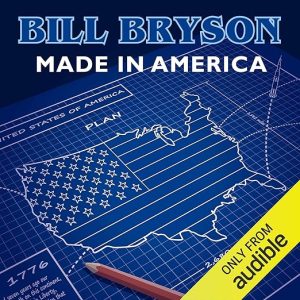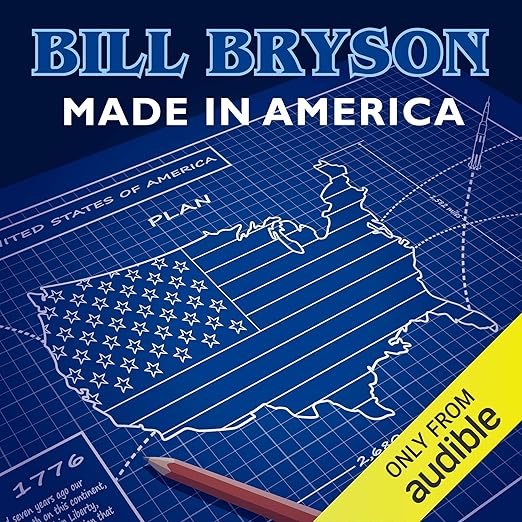
Bill Bryson built a career on noticing what everyone else had stopped noticing, and Made in America turns that habit on his own country. The audiobook runs eighteen hours and ten minutes, read by William Roberts, and the publisher's description amounts to a list of things you did not know you wanted explained: how 'a dusty hamlet with neither woods nor holly' became Hollywood, how the Wild West was not actually won, why the American mouth produces 'lootenant' and 'Toosday', how junk food was being eaten long before anyone coined a name for it, and, in the copy's own phrasing, 'the true origins of the G-string, the original $64,000 question, and Dr Kellogg of cornflakes fame.'
Historical Events First, Dialect a Distant Second
The most useful sentence on this listing comes from a reviewer who loved the book. Eric DiPier, who found it only after reading everything else Bryson had written, warns that 'the title is a little bit misleading, because it's really only partly about the English language.' The review starts to say what it is mostly about and then breaks off mid-word: 'fascinating, usually fu' and no further. The point survives the truncation. This listing carries a words and grammar tag, and a buyer arriving on the strength of that tag expecting a book about etymology will get one, but only intermittently. The language is Bryson's route into the subject rather than the subject itself.
Patrick C describes the actual shape more precisely, calling it 'a fascinating and often entertaining overview of the historical events and influences that turned American English into such a unique dialect.' Historical events first, dialect second. That ordering is the honest one. What you get across eighteen hours is a social history of the United States conducted through the back door of vocabulary, where a word is the pretext for a story about food, advertising, migration, invention, or self-mythology, and the story is usually the payload. Anyone who has enjoyed Bryson elsewhere will recognize the move immediately, since it is the same one he performs on landscapes and on science.
Nobody Mentions William Roberts by Name
Briar Patch, the only reviewer on this page to withhold a star, spends the review defending the book against complaints made by other people. Those other reviewers, the review reports, 'complain that the book lacks scholarship and similar pedantic complaints have missed the point,' and the counter-case is worth quoting because it doubles as an accurate description of what Bryson does: he is 'a writer, a storyteller, and man of wide interests who can churn out charming, remarkably well researched books at a satisfying rate.' Note what that defense concedes. The scholarship complaint exists and is not invented, and a listener who wants sourcing, apparatus and argument rather than a well-read raconteur should factor it in.
The pleasures on offer are granular and they arrive constantly. A hamlet with no woods and no holly turning into the name of an industry, a president's dinner habits, the invented pedigree of a phrase everyone uses without thinking: each of these is a self-contained two-minute unit, and eighteen hours of them adds up to something closer to a very long, very well-briefed conversation than to a book with a thesis. That format is unusually forgiving in audio. You can drop in cold at hour eleven and lose nothing, which is precisely the wrong thing to say about most eighteen-hour listens.
The narration situation on this listing is worth stating plainly, because it is the one thing the reviews leave alone entirely. All three of them praise Bryson: his storytelling, his interests, his rate of production, his charm. Not one of them mentions William Roberts, who is the person actually credited with speaking those sentences aloud. That gap matters more here than it would on most books, since the appeal of Bryson on the page is a voice, a very particular tone of amused, well-mannered incredulity, and an audio edition either transmits that tone or flattens it. Nobody on this page has told us which happened, so the sample is doing all the work.
Lootenant and Toosday Lose Their Visual Joke
The format tension nobody flags is the spelling. A substantial part of this book concerns how words look and how they are pronounced, and the description makes the point for me by rendering two of its examples as 'lootenant' and 'Toosday', respellings built to be seen rather than heard. On a page the joke lives in the letters. A narrator reading them aloud simply says the words, which is the whole joke and also the end of it. Every passage about orthography, silent letters, transatlantic spelling divergence or a printer's error frozen into standard usage loses a dimension in audio. The historical anecdotes survive the transfer completely intact. The strictly typographic material does not.
Length is the other consideration. Eighteen hours of accumulated anecdote with no narrative spine is a lot of book, and the same quality that makes it easy to dip into makes it easy to stop. I would treat this as a listen to run alongside something else over a couple of months rather than a project to finish in a fortnight. And the ratings tally on this listing is tiny, small enough that it sits oddly next to the written reviews on the same page, so I would put no weight on the average in either direction and read the three reviews instead.
Wrongly Filed Under Travel, With No Itinerary
Existing Bryson readers are the obvious constituency, and one reviewer here is exactly that: someone who worked through the whole catalogue, missed this one, and calls the eventual discovery wonderful. Beyond them, this suits listeners who like American social history delivered sideways, anyone who enjoys knowing where a phrase came from, and people who want a long companionable listen for commutes and chores rather than a book demanding continuous attention. Curiosity about advertising, food, invention and national self-image will be rewarded more consistently than curiosity about grammar.
Two groups should look elsewhere. Anyone wanting a rigorous linguistic history with citations will run into precisely the objection Briar Patch was defending against, and a defense is not a refutation. And anyone drawn here by the travel category should note that this is not a journey narrative at all: no route, no itinerary, no arrival. Listeners who love the printed textures of language, the look of an obsolete spelling on the page, may also find that a chunk of the appeal has quietly evaporated in transfer, in which case the print edition remains the better purchase.