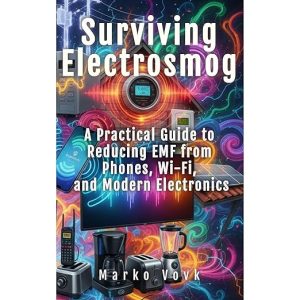
Two different titles sit on this one product page, and sorting that out comes before any decision about whether the audiobook deserves an afternoon of your attention. The listing is called Surviving Electrosmog. The description, twice, calls the book Living in Electrosmog. Marko Vovk is credited either way, and the subject is identical either way: the electromagnetic emissions coming off phones, wireless routers, smart meters and ordinary appliances, and what a household can practically do about them.
This Practitioner's Pitch Overpromises on Sleep and Mood
Enough specifics survive in the pitch to evaluate it, which is more than most books in this corner of publishing offer. It promises hands-on investigation, real case studies, and solutions requiring no technical background: clear steps for reducing exposure, guides for measuring hot spots, and strategies for making a room calmer. The claimed authority is decades of real-life inspections rather than a literature review, and the copy explicitly positions the book against oversized technical manuals and against jargon. That is a practitioner's framing, and a practitioner's book on this subject is a genuinely useful thing to have.
The register does not hold steady, though. Alongside the measured language about steps and measurements sits a promise of direct answers to urgent questions about sleep, energy, mood and long-term wellness, and a closing line about finally feeling safe at home. Sleep, energy and mood have a great many inputs, and a book offering direct answers on all four from a single environmental variable is making a substantially larger claim than one about finding the noisy corner of a bedroom. Which of those two books you are actually buying is nowhere resolved on the page, and the description moves between them without acknowledging the distance.
This Briefing Format Suits Household Case Studies
Length is the strongest argument for the audio edition. At three hours and twenty-five minutes this is a briefing rather than a manual to work through, and the description effectively concedes as much when it contrasts itself with oversized technical volumes and promises fast facts plus myth-busting tips at the end of every chapter. A short, structured orientation to an unfamiliar subject is a good use of audio: run it once, come away with the vocabulary and the shape of the argument, then decide whether the topic has earned more of your time and money.
Case-study material should transfer well for the same reason. An account of walking into a specific house, finding a specific source of exposure and doing something about it is a story, and stories survive being heard. If the claim of decades of inspections is accurate, the book's most persuasive content will be exactly this: particular homes, particular readings, particular changes and what followed. That is also the content least likely to require a page, which makes the audio edition a fair representation of at least half of what the description promises.
Chapter-end summaries also transfer better than most reference formats do. A list of myths with their corrections is recitable by design; you can hear one and retain its shape without needing the page. What transfers badly is the measuring. Guides for locating hot spots and protocols for working through a house room by room are written to be consulted with a meter in one hand, and audio is close to the worst medium available for consulting anything. You will hear a method once, at a fixed pace, with no way to scan back to step four.
Synthetic Narration Cannot Slow for Key Steps
Establish the reading credit next. Virtual Voice holds it, which is to say software produced the audio and no human reader was engaged at all. On a book of procedures, thresholds and numbers, that carries a practical consequence beyond questions of taste: synthetic reading does not slow at the places a person would slow, so a sequence of steps arrives at exactly the same pace as a paragraph of jacket copy. For a text you might want to act on rather than absorb, that flattening costs real comprehension.
Then the public record, which does not yet exist. No average, no vote tally, no written responses of any kind. That is ordinary for a March 2026 release and it does mean every claim on this page currently stands unverified by anyone outside the operation. The expertise is asserted rather than demonstrated: decades of inspections, evidence-based advice, the most user-friendly and results-focused guide available. Nobody has yet reported back on whether any of that holds up across the whole recording.
Miscategorized Under Sports, Away From Its Real Readers
Category placement is wrong in one respect that will affect discovery. This is filed under education and learning, which is defensible, and simultaneously under sports and outdoors, which is not. Nothing in the description touches sport or the outdoors at any point; the entire subject is the interior of a house and the devices humming inside it. Anyone browsing outdoor titles has no use for this, and the people who would want it are not looking there. Given that the page also carries a second title, discovery is working against this book from two directions at once.
A last uncertainty belongs to the subject itself rather than to the listing. Household exposure guidance is contested territory, and the description sets its own terms by promising myth-busting rather than evidence review, which signals a book confident about which claims are wrong. That confidence may be earned by long experience in the trade. It may also foreclose questions a cautious listener would want left open. With no independent account anywhere on the page, the only way to find out which is to spend the time and judge it for yourself.
Skeptics Will Find This Framing Hard to Accept
This suits people who have already decided the subject matters to them and want an orientation rather than a case for the prosecution. Parents wanting a considered position on household wireless, anyone with unexplained sleep trouble looking to eliminate a variable, and homeowners who have just had a smart meter fitted and would like to understand what it does. A promise of practical steps at a modest length is the right shape for all three, and the commitment is small enough that a wasted session costs very little.
Skeptics will find the framing hard going, and anyone who wants trial data should note that what the description offers is case studies and inspection experience rather than controlled research. One practical note before you buy: because the measuring guides are precisely the part that does not survive a listen, treat this recording as the introduction and expect to want a written copy alongside it if you decide to act on anything in it.
In Brief
- Subjects: Household electromagnetic exposure, wireless devices and smart meters, practical risk reduction, sleep and wellness claims
- Tone: Brisk, plain-spoken, faintly alarmed
- Bottom line: A short practitioner's briefing worth an afternoon, provided you accept that its most practical material does not survive the transfer to audio.
Good to Know
Why does the description call this book Living in Electrosmog when the audiobook is titled Surviving Electrosmog?
No explanation appears on the page. The listing title and the title used twice inside the description simply disagree, which usually points to a retitling that never reached the sales copy. Author, subject and publisher stay consistent across both, so this reads as a cataloguing slip rather than two separate books.
Who narrates the Surviving Electrosmog audiobook?
No human reader was engaged. The credit line says Virtual Voice, meaning software generated the audio from the text. On a book built around step-by-step household procedures, the absence of a person to place emphasis and pause between steps is worth factoring into the decision.
Does this book require any technical or scientific background?
The description says no, and positions itself explicitly against jargon and against oversized technical manuals. The promised material is measurement guidance, room-by-room strategy and chapter-end myth correction, all pitched at families rather than engineers. Nothing suggests prior knowledge of the physics is assumed.
Can you follow the room-measuring instructions by listening alone?
Not easily. Locating a hot spot is a procedure you carry out with a device in hand, and a linear recording offers no way to jump back to whichever step you lost. Concepts and myth corrections work fine by ear; the practical protocols really want a page in front of you.