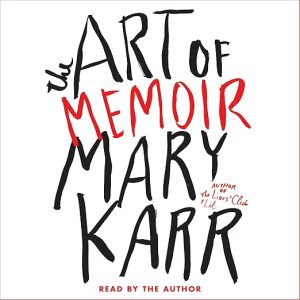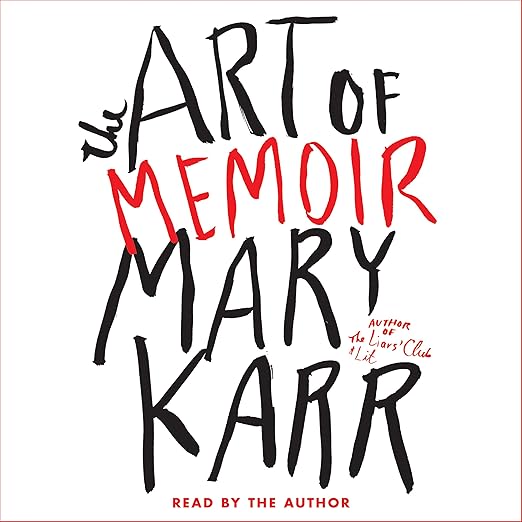
I came to The Art of Memoir the first time as a critic rather than a writer, which is not who Mary Karr wrote it for, and I found that it worked for me anyway. Karr has spent thirty years teaching memoir at Syracuse, where she has mentored writers including Cheryl Strayed and Koren Zailckas, and the book distills that teaching into something that operates simultaneously as a craft manual, a literary companion, and a deeply personal reflection on what it costs to tell the truth about your own life. I listened to the whole thing over two days this spring and immediately wanted to go back to the beginning. Karr's self-narration makes that urge stronger, not weaker.
The comparison to Stephen King's On Writing and Anne Lamott's Bird by Bird that the publisher offers is apt but sells Karr short on one dimension: she is a more rigorous critic of the form than either of those books. Where King and Lamott are primarily encouraging, their books are permission slips for people afraid to write, Karr is demanding. She wants her reader to understand that memoir requires a specific kind of honesty that is harder than simply telling what happened, because what happened is never simply what happened. Memory is partial, self-serving, shaped by narrative logic. Writing truthfully about your own life means interrogating those distortions, and Karr is insistent that the interrogation has to be real.
A Closer Look at The Art of Memoir
The book's most valuable extended argument is about the relationship between memoir and fiction, specifically, the discipline required to resist the memoirist's temptation to make their own story more coherent than it was. Karr draws on her three memoirs, The Liar's Club, Cherry, and Lit, as case studies in how she navigated that problem, which gives the craft advice a lived-in authenticity that purely theoretical craft books cannot achieve. The excerpts from other memoirs she admires, and her analysis of what they do well, constitute an informal canon of the form that is itself worth the listening time. She discusses writers from Nabokov to Frank McCourt to Mary McCarthy, and her critical voice is consistently sharp without being cruel.
The self-narration is essential to this book in a way that is rare even in the memoir-craft genre. Karr's argument is, at its core, that voice is the central element of literary memoir, that the most technically accomplished memoir fails if the writer's particular sensibility does not come through on the sentence level. Listening to her make that argument in her own voice, with her Texas inflections and her consistent irreverence, is an experience that the print edition cannot fully replicate. One reviewer described it as making them want to revise everything they had written; another immediately wanted to read or re-read every memoir she discusses. Both responses are exactly what the book intends to produce.
Things to Know Before Starting The Art of Memoir
This is a craft book that assumes a degree of familiarity with literary memoir, and some of the writers Karr references most extensively, including Augustine, Nabokov, and certain contemporary literary memoirists, will be more resonant for readers with that background. The book is not structured as a step-by-step guide in the way that some writing books are, which can frustrate readers who want a clear curriculum. It is more like an extended conversation with an extremely well-read professor who has opinions about everything, and those conversations circle back to the same core principles from multiple angles. Karr's chapter on family and the ethical difficulty of writing about living people is the section most likely to feel personally urgent for anyone working on their own memoir.
Who Mary Karr Is Writing For
Writers working in the memoir form who want both permission and rigorous challenge will find this indispensable. Readers of literary memoir who want to understand what separates the books that feel true from the books that merely describe events will find the critical framework genuinely useful. This is less suited to writers looking for practical structural guidance or step-by-step revision processes, Karr works at the level of intention and truth rather than technique in the craft-manual sense.
In Brief
- Narrator: Mary Karr self-narrates with exactly the irreverence and candor the book demands, her voice is the book, inseparable from the argument it makes.
- Subjects: Memory and truth-telling, the ethics of writing about real people, the cathartic function of putting a life on the page
- Tone: Intellectually alive and funny, a craft book that reads like the best kind of literary conversation
- Bottom line: The definitive audiobook for writers working in the memoir form, and unexpectedly essential for serious readers of memoir who want to understand what the best writers are actually doing.