- Narration: Brian Troxell delivers the entrepreneurial interview framing with clean, forward momentum that suits the podcast-format structure, keeping energy consistent across a collection of wide-ranging founder conversations.
- Themes: Founder mindset and resilience, pivot and failure as learning, peak creative flow states
- Mood: Energized, aspirational, and candid
- Verdict: A well-curated set of entrepreneurial conversations that works best for listeners who want access to how exceptional founders experience building, not just the tactical how-to.
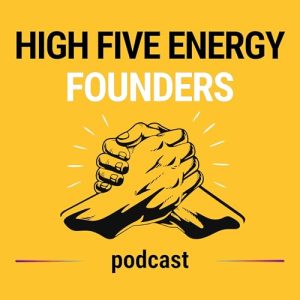
Jeffrey Chernick's High Five Energy lands in a crowded genre, the entrepreneurial interview collection, but distinguishes itself through its organizing concept. Chernick, a serial entrepreneur and investor, built this audiobook around the High Five Energy framework: that magnetic flow state where, as the synopsis describes it, doors open, the right people show up, and opportunities align. Narrated by Brian Troxell, this audiobook collects conversations with founders whose companies represent more than two hundred billion dollars in exits and IPOs, from Google AdSense to Kiva to Prodege and Telesign, and it asks each of them not just what they built but what state of mind made the building possible.
That internal angle gives the audiobook more traction than most collections of this type, which tend to accumulate tactical advice that sounds similar from conversation to conversation. Asking founders about pivots, failures, and the mindset shifts behind iconic companies produces more textured responses than asking them to describe their morning routines or their favorite productivity systems.
Troxell's Tone Avoids Hollow Motivational Enthusiasm
The podcast-origin format is one of the reasons this audiobook feels distinctive. Chernick's conversations have the quality of edited live dialogue rather than polished content produced specifically for the page. There is a candor in the exchanges that more scripted formats sand away. The founders in this collection are discussing real failure and genuine uncertainty, not delivering keynote speeches about their success. That distinction is audible, and it is one of the audiobook's genuine strengths.
Troxell's narration in framing material carries the episodes with consistent energy. His tone matches the title's concept without tipping into the hollow enthusiasm that plagues much motivational content in this category. The High Five Energy framing, which Chernick introduces as a flow-state concept describing peak entrepreneurial momentum, works better as a filter for curating conversations than as a fully elaborated psychological theory. Listeners who engage with it as a useful organizing metaphor will get more from the audiobook than those looking for a rigorous model of peak performance mechanics.
Founders From AdSense to Kiva Share Real Failure
The caliber of founders in this collection is the primary draw. Conversations with people who built companies from Google AdSense's early advertising model through Kiva's microfinance innovation and Prodege's rewards platform give the audiobook access to experiences that genuinely span different eras and categories of company building. Each episode surfaces the pivots and failures behind those iconic brands rather than glossing over the difficulty with retrospective confidence that makes many founder stories feel cleaned up for public consumption.
At just over an hour of runtime, the audiobook functions as a concentrated collection of entrepreneurial insight rather than an exhaustive program. That brevity has real advantages: you can listen in a single sitting and extract specific observations that apply to your current situation. The weekly release model mentioned in the synopsis suggests this title continues to expand, which adds ongoing value for listeners who return to it over time. Troxell's narration of connecting material maintains continuity across what could otherwise feel like loosely adjacent conversations.
Evocative Framework, Uneven Depth Across Episodes
The High Five Energy framework is introduced as an organizing concept, but listeners who come expecting a step-by-step method for achieving peak entrepreneurial flow may find the concept more evocative than operational. The audiobook earns its value through the quality of its conversations rather than through a systematic methodology. If what you need is a structured program for optimizing your entrepreneurial practice, this collection will feel more inspirational than prescriptive. If what you want is candid access to how exceptional founders actually experienced their journeys, the conversations deliver that much more directly.
The founder conversations also vary in depth depending on how much the specific guest has processed and is willing to articulate about their experience. Some interviewees are natural storytellers who make the internal logic of their pivots transparent. Others deliver more polished, curated narratives. That variability is inherent to any interview collection and does not reflect on Chernick's hosting quality, but it means the audiobook's richest moments are uneven across episodes rather than consistently distributed.
The audiobook's short runtime also means that individual founders receive limited airtime within each episode. The conversations are edited for impact rather than comprehensiveness, which is the right editorial choice for the format but means you will hear highlights rather than the full arc of any single founder's thinking. For any particular guest who resonates, the audiobook is more of an introduction that sends you looking for more than a definitive portrait of that person's philosophy or experience.
Founder Psychology Over a Systematic Scaling Playbook
This audiobook is well-suited for early-stage founders who want to understand what it feels like to build a category-defining company, rather than just what it looks like from the outside. Investors and operators who are interested in founder psychology and the internal experience of navigating uncertainty will also find it valuable. The short runtime makes it accessible even for listeners with limited time to commit to longer business books. Those looking for a systematic framework for scaling their own business, rather than immersive founder conversations, should supplement with more structured resources. The audiobook is best experienced as a source of perspective and energy calibration rather than as a tactical playbook.
It is also worth noting what the High Five Energy concept asks of the listener beyond passive reception. Chernick's framework is implicitly invitational: the flow state he describes is not something you observe in others but something you are meant to cultivate through the quality of your attention, your relationships, and your decision-making. The audiobook works best when approached as that kind of active prompt rather than as entertainment. The founders it features built things that mattered partly because they were paying close attention to the signals around them, and the audiobook is most useful when it prompts that same quality of attention in the listener.
Questions Listeners Ask
Is High Five Energy an audiobook of individual conversations or a continuous narrative?
It is structured as a collection of entrepreneurial interview episodes, in the tradition of podcast-format audiobooks. Brian Troxell provides connecting narration, but the primary content is Chernick's conversations with founders rather than a single continuous argument.
What does the High Five Energy concept actually mean in this audiobook?
Chernick defines it as a peak flow state where creative momentum builds, the right people and opportunities appear, and building feels aligned rather than forced. The conversations explore what produces and sustains that state across different founder experiences, though the concept serves more as an organizing lens than a fully systematic methodology.