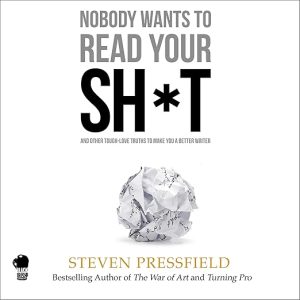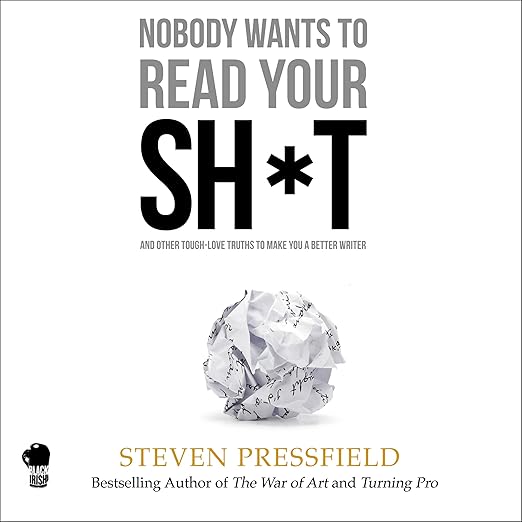
I first encountered Steven Pressfield through The War of Art, which I read in a single sitting on a flight from Paris to New York and thought about for the rest of the year. Nobody Wants to Read Your Sh*t sat on my list for a long time afterward - the title seemed to promise more of the same, and I was not sure I needed to be told again that resistance is the enemy and creative work is a war against yourself. What I got was substantially different and, in some ways, more immediately practical.
I listened to the audiobook on a Monday morning when I was trying to solve a structural problem in a piece I was working on. By noon I had figured out the problem, which was not primarily structural at all.
Where This One Lands
The title is the thesis: nobody is sitting around waiting to read what you have written. Your reader has a life, distractions, twelve other things demanding their attention, and no prior obligation to give you any of it. Recognizing this is, as Pressfield argues, the beginning of empathy - the actual skill that separates professional writers from the endless population of people who write for themselves and then wonder why the work does not land.
What distinguishes this book from the standard craft-book-as-discipline-lecture is that Pressfield locates his argument in autobiography. He spent years in advertising before becoming a novelist, and the advertising section of this book is the most practically valuable sequence in it. Advertising, he argues, forced him to develop reader empathy not as an abstract value but as a survival requirement - if the ad does not work, you lose the account, immediately and with consequences. That discipline, transferred to fiction and screenwriting, is what the book is actually teaching.
Why Listen to Nobody Wants to Read Your Sh*t
Pressfield reading his own work is a different experience from reading it on the page. He is not a trained narrator - there is nothing polished about the delivery - but that absence of polish is precisely what makes it compelling. When he tells you that nobody wants to read your shit, in his own voice, with the particular flatness of a man who has lived through enough failure to have no patience for self-congratulation, the message lands differently than it would through a professional performance. It is a corrective delivered by someone with skin in the game.
At three hours and fifteen minutes, this is the rare craft book that does not overstay its welcome. One of the critiques of both The War of Art and this book is that they are densely autobiographical in a way that can feel self-referential. The audio format mitigates this somewhat - Pressfield's autobiographical passages have a confessional quality in his own voice that reads differently than it does in print.
What Gives Us Pause
The book moves through advertising, then fiction, then screenwriting, using each discipline to illuminate a different facet of the reader-empathy argument. Listeners who work only in one of those forms may find the other sections less immediately applicable, but the underlying principle - that the reader is never obligated to continue - applies across all three. The screenwriting section is particularly useful for its breakdown of genre conventions as a contract with the audience: when you work in a genre, you are making a promise about what kind of experience you will deliver, and breaking that contract is a specific kind of failure.
The book also functions as a companion to The War of Art rather than a repeat of it. The War of Art is about the internal battle with resistance. Nobody Wants to Read Your Sh*t is about the external battle for a reader's attention. They address different problems and neither makes the other unnecessary.
Should You Listen to Nobody Wants to Read Your Sh*t?
Writers at any stage - the beginner who needs the fundamental reframe, the experienced writer who has lost sight of why audience empathy matters, the professional who wants three hours of rigorous compression rather than another bloated craft book. The self-narration is an asset, not a liability. The running time is respectful. And the core argument - that writing well is an act of empathy, not expression - is one that improves every sentence you write after you understand it.
Before You Listen
Is Nobody Wants to Read Your Sh*t a follow-up to The War of Art, and do I need to read that first?
It is a companion rather than a sequel, and addresses a different problem - where The War of Art deals with internal resistance, this book deals with reader empathy and audience communication. Neither requires the other, but they work well together.
At just over three hours, is this audiobook substantial enough to justify the listen?
Yes. Pressfield practices what he preaches - the book is compressed and direct, with no padding. Three hours of concentrated craft argument is more useful than twelve hours of padded how-to writing instruction.
Is Pressfield's self-narration a strength or a weakness for a listener who prefers professional audiobook narration?
A strength, in this specific case. The book's authority comes partly from Pressfield's lived experience, and his unpolished delivery carries that experience in a way a professional narrator could not replicate. It sounds like someone talking to you, not performing for you.