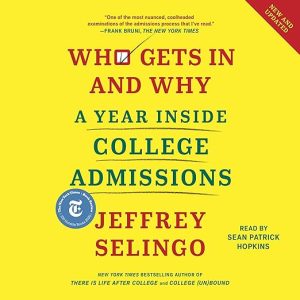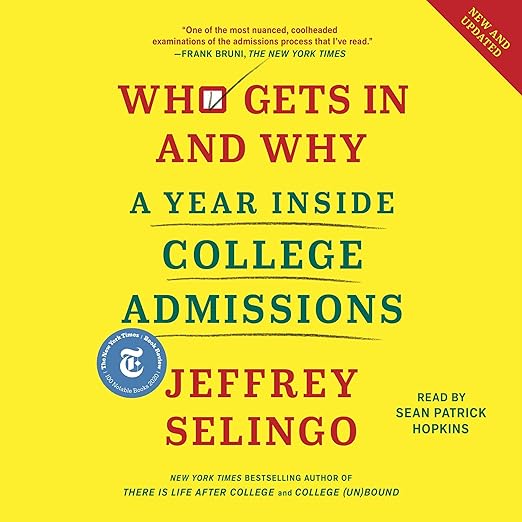
Who Gets In and Why occupies a specific and important niche: the audiobook for families who sense that the college admissions process is more opaque and more institutional than it appears, but who want documented evidence rather than anecdote. Jeffrey Selingo is a higher education journalist with New York Times bestseller credentials, and his method here is unusually rigorous for the genre. He spent extended time embedded in three different admissions offices, a selective private university, a leading liberal arts college, and a flagship public campus, observing gatekeepers as they made decisions in real time.
That embedded access distinguishes this from most college guidance books. Selingo is not reconstructing the admissions process from public statements or applicant accounts. He watched it happen. He followed specific students through the cycle. He traveled to meet high school counselors, consultants, marketers, and the ranking system operators whose products shape institutional behavior in ways families rarely perceive. The result is journalism rather than advice, which makes it considerably more unsettling and considerably more useful.
Selingo's central argument, supported by his embedded observations, is that college admissions is frequently less about the student's merit than about the college's agenda at a particular institutional moment. Diversity needs, revenue requirements, yield rates, the likelihood that an admitted student will enroll if accepted: these factors shape split-second decisions in ways that are invisible to applicants. The student filing the application is one variable in a calculation that includes dozens of institutional considerations.
Sean Patrick Hopkins narrates with a pace that suits investigative journalism well. The ten hours and eleven minutes feel appropriately weighty for the subject matter without dragging. Hopkins does not editorialize; his delivery trusts Selingo's reporting to carry the argument, which is the right call for material this substantive. The passages describing actual admissions office deliberations, where readers are in the room as decisions are made, carry particular tension in audio form.
One reviewer called it more riveting than any spy novel, which is hyperbolic but not entirely inaccurate. The process described is genuinely surprising in its opacity, and Selingo's access to it produces specific revelations rather than general impressions. Another reviewer purchased four college admissions books and finished only this one, a useful data point about the book's capacity to hold attention across a long runtime.
Why Who Gets In and Why Works as an Audiobook
The most direct argument for the audiobook format specifically is pace. Selingo's reporting moves quickly between scenes: an admissions officer reviewing files in real time, a high school counselor managing a student pipeline, a college marketer strategizing enrollment yields. Hopkins keeps that momentum intact across ten hours in a way that denser academic treatment of the same subject would not. This is fundamentally a narrative work, and narrative works reward the listening format.
For families in the middle of application cycles, or those a few years out who want to begin the process with accurate expectations, this audiobook provides the kind of systemic understanding that cannot be found in college guides focused on essay tips and extracurricular optimization. Understanding that the game has institutional rules that no amount of personal optimization fully controls is, paradoxically, more useful than the specific tactical advice most guidance books provide.
Selingo also argues that families with a narrow conception of what constitutes a good college, anchored to prestige and rankings rather than fit and outcome, are operating on assumptions that serve the institutions more than the students. That argument is both uncomfortable and well-supported, and it is delivered with the specificity of someone who has spent years covering the industry rather than repeating conventional wisdom.
Weak Spots in Who Gets In and Why
The book was published in 2020, which means some of the specific institutional examples and policy contexts it references have evolved. The pandemic cycle disrupted college admissions in ways that were still unfolding at publication, and several of the test-optional developments referenced were mid-process when Selingo completed his research. Listeners should approach some specifics as subject to institutional change while treating the broader structural analysis as durable.
The embedded access Selingo secured required cooperation from institutions, which means the admissions offices he observed agreed to his presence. That selection may not be representative of the most opaque or least accessible admissions processes. The practices he documents are real, but institutions willing to allow a journalist to observe may differ in some respects from those that declined.
Listeners primarily seeking tactical guidance, the specific essay structures, the optimal extracurricular profiles, the recommendation letter strategies, will find this audiobook less immediately practical than more targeted guides. Selingo's contribution is systemic understanding, not tactical coaching. Both are valuable, but they serve different moments in the application process.
The Right Listener for Who Gets In and Why
Parents and students in the college search process, particularly those targeting selective institutions, will get the most immediate utility. The systemic understanding Selingo provides recalibrates expectations in ways that reduce anxiety as much as they increase it: knowing the full picture of how decisions are made is more useful than operating on incomplete assumptions, even when that picture is complicated.
School counselors, educators, and anyone involved in advising students through the admissions process will also find this a foundational text. Selingo interviewed counselors extensively, and the book gives weight to their perspective in a way that most family-facing admissions guides do not. Readers who have already absorbed this book and want to continue with its themes will find Cal Newport's work on college fit and Kevin Carey's The End of College useful companions.
Before You Press Play
- Narration: Sean Patrick Hopkins delivers Selingo's journalism smoothly, keeping the pace appropriately brisk for what is essentially an investigative report.
- Themes: College admissions opacity, institutional self-interest, the myth of meritocracy
- Mood: Illuminating and slightly unsettling, with the energy of a well-researched exposé
- Verdict: An essential listen for any family navigating college applications, particularly those still operating under assumptions the admissions industry no longer supports.
How does the audiobook hold up over 10-plus hours on a single subject?
Reviewers consistently note strong retention across the full runtime. The embedded reporting format, moving between admissions offices, high school counselors, student experiences, and marketers, keeps the material varied. Sean Patrick Hopkins's narration maintains appropriate momentum. One reviewer bought four college admissions books and finished only this one.
Is this audiobook still accurate given changes to college admissions since 2020?
The structural analysis of institutional incentives, yield rates, diversity needs, and the gap between stated and actual decision criteria remains accurate. Some specific policies, particularly around standardized testing, have evolved since publication. The book is best treated as a durable framework with some details subject to institutional change.
Does Selingo discuss admissions at public universities as well as elite private schools?
Yes. His embedded access included a flagship public university alongside a selective private university and a liberal arts college. The comparison between how these different institution types approach admissions is one of the more illuminating elements of the book, showing that the dynamics vary significantly by institutional type and mission.