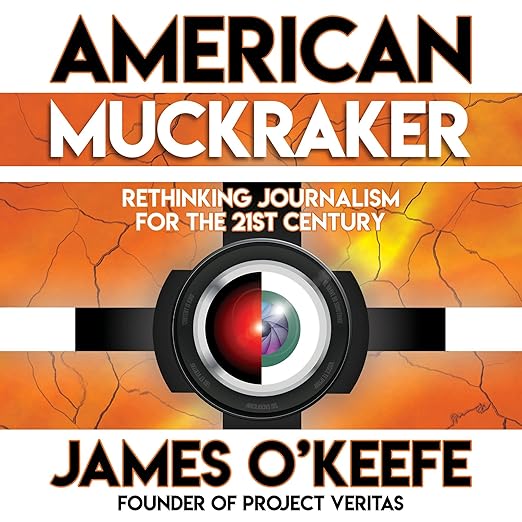
James O'Keefe has built his career on the claim that the press cannot be trusted to hold itself accountable, and American Muckraker is his most systematic articulation of that position. The audiobook draws on more than a decade of undercover investigative work, extensive philosophical and historical research, and a clearly polemical ambition: to define citizen journalism as a movement with roots in the tradition of Upton Sinclair, Ida Tarbell, and the muckrakers of the progressive era. O'Keefe self-narrates, and the voice carries the combative confidence of someone who has spent years being sued, attacked, and excluded by the institutions he targets. Listeners should know what kind of book this is before pressing play. O'Keefe is not attempting balance. He is making a case, and making it forcefully.
What James O'Keefe Delivers
The most interesting sections of the book are the ones that grapple with the tension O'Keefe himself identifies: the means and ends problem in investigative journalism. The passage he quotes from Thomas B. Morgan, that morally defensible journalism is rarely what you feel good about afterward, is the kind of uncomfortable honesty that gives the audiobook more intellectual texture than its detractors tend to acknowledge. O'Keefe is aware that the tactics he employs are ethically contested. His response to that awareness is to argue that institutions committing malfeasance do not have a right to privacy, citing the Don Hewitt framing from 60 Minutes: people committing malfeasance do not have any right to privacy, no more than Upton Sinclair's subjects had a right to keep their pencil out of the meatpacking plant.
The USPS whistleblower account, involving a Marine veteran who described the federal interrogation as more frightening than combat in Afghanistan, is presented as the kind of material that only citizen journalism will surface. The quote from the federal agent, admitting he is intentionally trying to create fear and psychological pressure while also saying he is not scaring the witness, is striking in context. O'Keefe's argument is that legacy media would not have pursued this story. Whether you accept that framing depends substantially on what you already believe about institutional journalism.
The audiobook is valuable as a primary source document for anyone trying to understand the epistemology behind Project Veritas and the broader ecosystem of citizen journalism that has emerged as a counterweight to legacy media. O'Keefe is articulate about his methodology, his influences, and his theory of what journalism is supposed to do. Whatever one thinks of his conclusions, the argument is made with more philosophical care than his critics typically credit.
Self-narration is the right choice here. The passion and conviction that O'Keefe brings to the material would be domesticated by a professional narrator's neutrality. Hearing him read the New York Supreme Court ruling from Project Veritas v. New York Times Company, or his own account of the power dynamics between large institutions and citizen reporters armed with smartphones, has an immediacy that serves the advocacy function of the book. This is a work designed to persuade, and the delivery is calibrated for persuasion. Listeners who find the approach compelling will find the audiobook format more effective than print for exactly this reason: the voice does not allow editorial distance.
Where James O'Keefe Loses Some Ground
The philosophical sections, drawing on Hemingway, Don Hewitt, and the legal record, are where the book makes its most durable arguments and where it is most worth engaging critically rather than accepting or dismissing wholesale. The historical grounding in the early twentieth-century muckraking tradition is substantive and adds credibility to the framework, though the analogies between Sinclair's era and the current media environment are imperfect in ways O'Keefe does not fully acknowledge. The press landscape of 1905 and 2021 are different enough that the parallel requires more friction than the audiobook provides.
The section on privacy and the right to record is particularly worth close listening. O'Keefe's argument here, that the right to document is an extension of the right to speak, has genuine legal and philosophical grounding even for listeners skeptical of his specific application of it. The New York Supreme Court's finding that Project Veritas had a substantial basis in law to proceed against the Times gave his framework external validation that separates it from pure advocacy. Engage with the argument on its own terms before applying your own conclusions to it.
The historical section on the original muckrakers of the early twentieth century deserves more attention than the audiobook's relatively brief runtime allows. O'Keefe's invocation of Upton Sinclair, Ida Tarbell, and Lincoln Steffens is more than rhetorical positioning. These journalists operated outside institutional frameworks by necessity, not preference, and their relationship to the press establishment of their day was adversarial in ways that map imperfectly but genuinely onto the citizen journalism model O'Keefe champions. Listeners who find those historical parallels interesting will want to follow the audiobook with reading on the original muckraking era to assess for themselves how cleanly the comparison holds and where it breaks down.
Who Should Pick Up American Muckraker
Listeners who are sympathetic to the Project Veritas methodology and want a thorough account of the philosophy behind it will find this the most complete version available. Journalists and media critics from any perspective who want to understand the first-person argument for citizen journalism as institutional accountability will find it useful as primary material. Readers of the broader tradition of press freedom literature, from the progressive era muckrakers to contemporary debates around shield laws and source protection, will recognize the terrain even if they dispute O'Keefe's map of it.
Listeners who are likely to find the advocacy too one-directional to engage with productively should skip it. This is not a book that will convert skeptics through balanced presentation of competing views. It is a book that articulates a position with conviction and historical reach. It does what it sets out to do, and what it sets out to do is make a case. Come prepared to push back, and the audiobook becomes a more productive encounter than it would be if approached passively.
- Voice: James O'Keefe self-narrates with the combative energy he brings to his journalism; the advocacy is transparent and fully embedded in the delivery.
- Big ideas: Citizen journalism and institutional power, the ethics of undercover reporting, press freedom and its limits
- Atmosphere: Polemical and energized, with a clear partisan current running throughout
- Worth it?: A useful primary source for understanding the Project Veritas philosophy from its founder; listeners should engage with full awareness that this is argument, not neutral reporting.
Questions Listeners Ask
Does the American Muckraker audiobook cover the legal history of Project Veritas, including the lawsuit against the New York Times?
Yes. O'Keefe includes the New York Supreme Court ruling in Project Veritas v. New York Times Company as a central exhibit in his argument about press freedom and the right of citizen journalists to conduct and publish undercover investigations.
Is this audiobook only for people who already support James O'Keefe's work, or does it have value for skeptical listeners?
It has value as a primary source for understanding the philosophy behind Project Veritas, regardless of the listener's starting position. Skeptical listeners who engage with it as advocacy rather than journalism will find the argument more historically grounded than they might expect, even if they ultimately disagree.
How does O'Keefe's self-narration of the audiobook affect its persuasive force?
It amplifies the advocacy considerably. His delivery carries the combative energy of someone in sustained public conflict with the institutions he targets. Professional narration would neutralize a tone that is essential to the book's argument and the experience it is trying to create.
Does American Muckraker provide a balanced view of undercover journalism ethics, or does it present one side?
It presents one side clearly and without apology. O'Keefe acknowledges the ethical tension in undercover reporting, particularly the means-and-ends problem, but his resolution consistently favors the journalism. Listeners seeking balanced treatment of press ethics should supplement with other sources.