Quick Take
- Narration: Virtual Voice handles the technical terminology of sleep medicine competently but cannot replace the teaching rhythm a credentialed sleep technologist narrator would bring to visually complex scoring concepts that simply do not translate cleanly into audio.
- Themes: RPSGT board exam preparation, AASM 3.0 scoring rule application, clinical decision-making in sleep technology
- Mood: Precise and technically dense, designed for practitioners who already work with polysomnography equipment and need exam-focused refinement
- Verdict: The most current AASM 3.0-aligned RPSGT prep resource available in audio form, with genuine clinical depth, though the visual nature of polysomnography scoring creates inherent audio-format limitations that no narration can fully overcome.
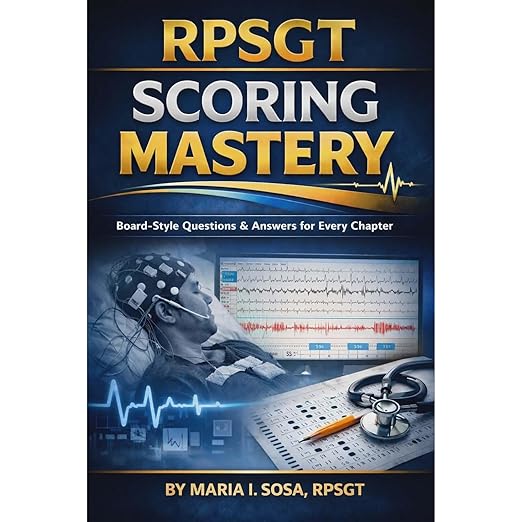
There is a category of professional knowledge that resists audio format more than most, and polysomnography scoring sits close to the top of that category. Sleep staging is fundamentally a visual discipline. You identify N1 versus N2 sleep by looking at EEG waveform characteristics. You score respiratory events by reading airflow channel patterns against oxygen saturation tracings. The RPSGT board exam tests whether you can look at a hypnogram and apply AASM rules correctly. None of that translates easily to audio, and yet here we are, with Mastering Polysomnography Scoring in audiobook form, 9 hours of content aimed at board-eligible sleep technologists preparing for one of the more visually intensive certification exams in allied health.
I want to be fair about what this book actually does, because within its obvious format constraints, it does something valuable. Maria I. Sosa Torres has produced the first comprehensive RPSGT exam prep guide fully aligned with AASM Scoring Manual Version 3.0, the updated standard that superseded the previous scoring rules and that many existing references have not yet incorporated. For candidates preparing for the current board exam, alignment with 3.0 is not a nice-to-have. It is a basic requirement, and Mastering Polysomnography Scoring delivers it.
AASM 3.0 Alignment as the Core Differentiator
The AASM Scoring Manual Version 3.0 introduced meaningful changes to how specific respiratory events are classified and scored, how hypopneas are defined, and how certain EEG features are interpreted during staging. Study resources built for the 2.6 or 2.3 standards will prepare candidates for an exam that no longer exists. Sosa Torres’s explicit orientation around Version 3.0, with an emphasis on rule-based decision-making as the exam actually tests it, addresses a real gap in the available prep landscape.
The content structure reflects solid exam-prep design: complete sleep staging review for all stages (Wake, N1, N2, N3, and REM) grounded in AASM 3.0 criteria, detailed respiratory event scoring including apneas, hypopneas, and RERAs, and what the synopsis correctly identifies as a critical distinction, the difference between exam mindset and clinical mindset. Experienced sleep technologists often struggle on board exams precisely because their clinical practice has developed local workarounds or facility-specific conventions that deviate from strict AASM rule application. The exam tests the rules as written, not as commonly practiced.
What Audio Can and Cannot Do for This Material
The decision-based flashcards mentioned in the synopsis make more sense in audio than the scoring criteria themselves. A flashcard prompt asking which respiratory event meets criteria when given a set of parameters is a reasonable audio-format question. The EEG waveform characteristics that distinguish N1 from N2 sleep staging are not, those require visual reference that this format cannot provide.
Reviewer Jonathan Araya, a practicing sleep technologist, calls this an outstanding resource for RPSGT preparation. That endorsement from a working professional with hands-on scoring experience carries more weight than a general reader’s five stars. The second reviewer’s mention of sleep apnea management suggests some listeners are coming to this from a patient perspective rather than a credentialing one, which misidentifies the book’s audience, this is a technical credentialing guide for professionals, not a patient education resource.
The Two-Review Caveat
With only two reviews, the 5.0 rating reflects early listener enthusiasm rather than broad clinical consensus. For a professional certification prep resource, this is a meaningful data gap. Candidates investing significant exam preparation time and money should seek out additional professional community feedback, sleep technology forums, RPSGT candidate discussion groups, before committing to this as their primary resource. The AASM 3.0 alignment is a genuine credential, but independent verification from a larger pool of board-eligible practitioners would strengthen confidence in its coverage accuracy.
Who Should Listen / Who Should Skip
Listen if you are a CPSGT or registered sleep technologist preparing for the RPSGT board exam and specifically need a resource calibrated to AASM Scoring Manual Version 3.0. The clinical depth and exam-mindset framework are genuine assets. Pair it with physical scoring references and hypnograms because the audio format cannot replace visual practice. Skip it if you are a patient looking for information about your own sleep apnea, this is a technical certification guide, not a patient education resource, and the clinical terminology density makes it inaccessible for that purpose.
Frequently Asked Questions
Is this the only RPSGT prep audiobook aligned specifically with AASM Scoring Manual Version 3.0?
The book claims to be the only comprehensive polysomnography scoring guide fully aligned with AASM 3.0, which is a meaningful claim given how recently Version 3.0 superseded the previous scoring standards. Most existing prep materials were built for earlier versions. Whether this is literally the only 3.0-aligned audio resource should be verified through the current AASM bookstore and specialty publishers, but the 3.0 alignment is a real differentiator.
How do you practice actual scoring decision-making from an audiobook format?
The audio is most effective for learning the verbal logic and rule structure behind scoring decisions, the conceptual frameworks that govern how you apply AASM criteria. Actual scoring practice requires visual materials: sample hypnograms, EEG tracings, and respiratory channel data. This audiobook should be paired with visual practice resources rather than used as a substitute for them.
Does the book cover pediatric scoring differences, which are commonly tested on the RPSGT exam?
Yes, pediatric and special scoring considerations are explicitly listed as content areas, which is important because pediatric scoring uses modified age-specific criteria under AASM rules. The exam tests both adult and pediatric standards, and resources that omit the pediatric distinctions leave candidates underprepared for that portion.
Is Virtual Voice narration a problem for the medical terminology density in this book?
Virtual Voice handles technical terminology in sleep medicine reasonably well, the terms are pronounced consistently and the content is intelligible. The limitation is not pronunciation but instructional rhythm: a human narrator with sleep technology background would naturally pace the delivery around the complexity of specific scoring decisions in ways that help listeners distinguish critical from supporting information. For a highly visual subject like polysomnography scoring, that instructional pacing loss is a genuine constraint.