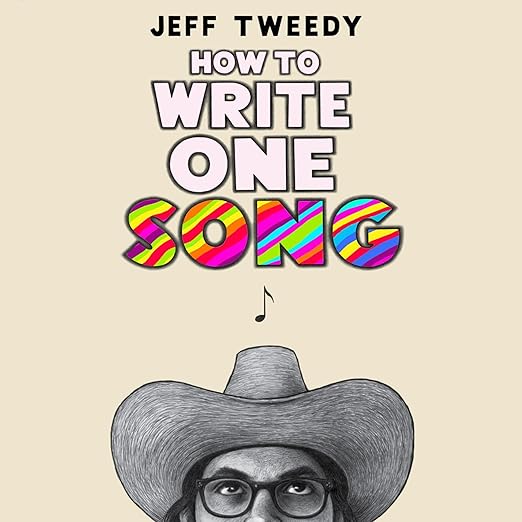
Quick Take
- Narration: Jeff Tweedy narrates his own book and that fact is not incidental. His voice, familiar from decades of recordings, gives the material an intimacy and specificity that a professional narrator simply could not replicate.
- Themes: Creativity as daily practice, the demystification of artistic process, songwriting as self-knowledge
- Mood: Warm and gently philosophical, like a long conversation with someone who takes joy seriously
- Verdict: A short, unusually honest book about creativity that earns its focus on one song rather than songwriting in general, best experienced in Tweedy’s own voice.
I put this on a Saturday morning when I had a few hours and nothing in particular to do. I finished it before noon. At three hours and eight minutes, How to Write One Song is not long, and I do not say that as a complaint. Tweedy has written a book that is exactly as long as it needs to be, and in a genre where creative guidance often expands to fill all available space, that restraint is itself a kind of argument. The book is about singularity, about the focused act, about why doing one thing well is a more useful ambition than imagining yourself into a career. It would be strange if the book itself sprawled.
Jeff Tweedy is the Grammy-winning cofounder of Wilco and, before that, Uncle Tupelo. He has been writing and recording music for more than thirty years, and he has a public reputation as one of the more intellectually engaged songwriters of his generation. You expect a certain kind of craft-forward reflection from him. What How to Write One Song delivers instead is something more personal and less systematic: an account of how creativity feels from the inside, why it matters as an activity regardless of whether it produces anything valuable to anyone else, and how the ambition to become a capital-S songwriter can actually prevent you from writing anything at all.
Why One Song Is the Right Frame
The book’s central argument is deceptively simple. Writing one song and becoming a songwriter are not the same goal, and conflating them creates the kind of pressure that stops most people before they start. Tweedy makes a careful distinction: one song is achievable, bounded, completable. It does not require an identity shift. It does not require gear, a studio, a producer, a deal, or an audience. It requires attention, time, and the willingness to put something together from available parts. The low stakes of this framing are not a trick. Tweedy means it, and his argument that creativity should be part of ordinary life rather than reserved for credentialed artists is made without condescension or false modesty.
He walks the listener through the three components of a song, lyrics, music, and the integration of the two, with specificity that does not overwhelm. He is not teaching a course. He is describing his own process and inviting the listener to find analogues within their own experience. One reviewer described his words as feeling like he is talking directly to you in the room, and that quality is even more present in the audio version than it would be in print. Tweedy’s narration is not slick. It has the rhythm of someone thinking aloud, pausing, circling back, reaching for the right phrase. That texture is not a flaw. It is the point.
The Self-Narration That Cannot Be Separated from the Content
There is a version of this book narrated by a professional actor that would be perfectly competent and almost entirely beside the point. Tweedy talking about the experience of making something, in his own voice, with its particular hesitations and warmth, is the experience the book is designed to create. This is not a technical argument. It is an emotional one. When he describes the moment a song becomes something separate from the person who made it, you believe him in a way that a hired narrator, however skilled, could not achieve. The two reviews for this title are from listeners who are not musicians, and both describe coming away from it with a clearer appreciation for Tweedy’s own music as well as for creativity in general. That cross-domain effect, learning about songs and also learning about how you think about making things, is what distinguishes this from a standard how-to.
What It Offers Non-Musicians
Tweedy explicitly frames this book for non-musicians as much as aspiring songwriters, and that frame holds. The question he is actually asking throughout is: what happens when you make something, fully, with intention, just once? The answer he arrives at has implications beyond music. One reviewer, a self-described non-musician, came away feeling that the book had changed how he understood the relationship between practice and meaning. Another described it as a clarification of why any creative pursuit matters at all. These are not responses to a technical manual. They are responses to something closer to a short philosophical essay that uses songwriting as its primary material.
How to Write One Song is not for listeners looking for chord progressions, industry advice, or a structured curriculum. It is for people who want to understand what creative attention feels like when it is directed with care, and who are willing to spend three hours in conversation with someone who has been doing it for most of his life. At that, it is quietly remarkable.
Frequently Asked Questions
Do I need to be a musician or know music theory to get value from How to Write One Song?
No prior musical knowledge is needed. Tweedy writes explicitly for non-musicians as well as aspiring songwriters. Multiple reviewers with no musical background describe finding the book valuable as a reflection on creativity and practice in general, not just songwriting.
Is Tweedy’s self-narration a significant part of the experience, or would a professional narrator work equally well?
The self-narration is integral. Tweedy’s voice, with its distinctive rhythm and personal warmth, gives the material an intimacy that a professional narrator could not replicate. The book is partly about the experience of making something yourself, and hearing it in his own voice reinforces that argument throughout.
Is the book’s focus on writing just one song a genuine organizing principle, or is it a marketing angle?
It is a genuine and carefully developed argument. Tweedy distinguishes between the achievable act of writing one song and the identity of becoming a songwriter, and makes the case that conflating them creates paralyzing pressure. The focus on singularity runs through the entire book.
At just over three hours, does the book feel too brief to be substantive?
The brevity is intentional and consistent with the book’s argument about focused, contained creative acts. Reviewers consistently describe the book feeling complete rather than truncated. The three-hour runtime is dense with reflection rather than padded for length.