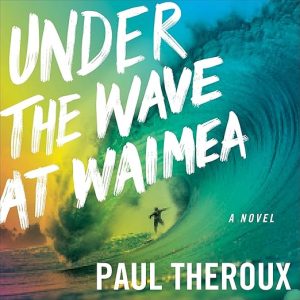
Joe Sharkey has spent decades daring Waimea's biggest swells, so what gives out first as he ages past his prime, his body or his nerve? Paul Theroux's novel answers that question by putting Sharkey behind the wheel on a bad night, driving home from a bar after one too many, and having him accidentally kill a stranger on the road near Waimea. Everything that follows in this audiobook traces the wreckage of that single moment.
"Theroux's work is like no one else's," Francine Prose wrote in the New York Times Book Review, a claim reviewer HG backs up by pointing to the author's three decades living in Hawaii and his long-standing eye for capturing places outsiders rarely see honestly. That lived-in familiarity with Oahu's north shore surf culture, not just its postcard version, gives the setting real texture. That backdrop knowledge is worth carrying into the listen from the very first chapter.
The book runs on two tracks at once: Sharkey's own reckoning with fading relevance among younger surfers who still idolize him even as his sponsors look elsewhere, and his devoted girlfriend Olive's parallel investigation into the dead man's identity. Her digging becomes the engine that eventually helps Sharkey find his way back toward the water, and toward himself.
Not every reader arrives already sold. Reviewer Thomas A. Clark admits he expected 'a flawed effort,' noting he generally finds Theroux's fiction 'mediocre' next to his nonfiction, which he calls 'superb.' He doesn't fully recant that view here, but the fact that this book earned even a qualified nod from a skeptical reader says something about its reach.
Waimea Bay itself carries real weight in surf culture beyond this novel: it's home to the Eddie Aikau Big Wave Invitational, one of the sport's most legendary and rarely-held competitions, named for a lifeguard who died attempting a rescue at sea; the event famously runs only when swells clear a strict minimum size, which has meant entire years passing without it happening at all. Theroux setting a story about fading relevance and mortality at this specific break is not incidental.
Theroux's own bibliography stretches back decades, through travel writing like The Great Railway Bazaar and fiction like The Mosquito Coast, and that range shows here in how comfortably the book moves between physical, sensory surf description and interior, almost confessional reckoning.
The novel's structure runs backward from convention in a useful way: instead of building slowly toward a single catastrophic event, it opens with the accident already committed and spends its length on the aftermath, forcing both Joe and the listener to sit with consequence rather than anticipation.
What Works
Jim Meskimen has built a long career on vocal range and character work, and that versatility is a reasonable asset for a novel that needs to carry both a weathered surfer's interior voice and Theroux's own literary, observational prose without either overwhelming the other. No confirmed prior title data exists yet to point to a specific past performance, so this assessment leans on genre fit rather than a track record.
Reviewer Michael calls the book 'a beautiful juxtaposition of poetry on a special setting,' which is the right frame for what this narration actually needs to deliver: not sports-commentary energy, but a patient, literary register that trusts quiet sentences to carry real weight. That's a harder needle to thread than a straightforward adventure novel would require.
Reviewer HG's point about Theroux having lived in Hawaii for roughly three decades is worth taking seriously as more than biographical trivia; it's the difference between a writer visiting a setting for research and one who has actually watched a specific surf community age, change, and lose people over real time.
Even Joe's own nickname carries irony worth noticing: 'the Shark' was earned as a young, dominant predator of the break, and the entire novel is essentially about what happens when that same man becomes prey to his own aging body, guilt, and diminishing relevance instead.
Before You Commit to Under The Wave At Waimea
The listing tags this as sports-outdoors with a 'Water Sports' label and an 'energetic and motivating' tone, and that framing undersells what the book actually is. This is literary fiction about guilt, aging, and privilege that happens to use big-wave surfing as its backdrop, not an adventure or athletic-achievement narrative, and listeners drawn in purely by the surf-culture tags may be surprised by how morally heavy it gets.
With only a single rating attached, the data here is thin, and Thomas A. Clark's mixed history with Theroux's fiction is worth keeping in mind as a genuinely divided critical reception rather than universal acclaim. That doesn't undercut the book's quality, but it's an honest caveat before committing to an 18-hour, emotionally demanding listen.
Olive's half of the book reads almost like a quiet procedural dropped into literary fiction, methodical, patient, entirely unglamorous, and that tonal restraint keeps her chapters from ever competing with Joe's for the reader's sympathy.
Who Paul Theroux Is Writing For
Literary fiction listeners, existing Theroux readers, and anyone wanting a serious, unhurried meditation on mortality and privilege dressed in a Hawaiian surf setting should find real value here. It rewards patience rather than urgency.
Listeners expecting a straightforward sports or adventure story, in line with how the title gets categorized, should adjust expectations before starting. The emotional register runs closer to a slow reckoning than to a beach-read thriller, and that mismatch is the single biggest thing to know going in.
At 18 hours and 20 minutes, this runs long for literary fiction, closer to a big historical novel than a slim character study, and that length gives Theroux real room to let Joe's reckoning unfold slowly rather than rushing toward resolution, best suited to a patient, multi-sitting listen rather than a single weekend binge.
The title itself carries a literal meaning worth knowing before starting: getting caught 'under the wave' at a break like Waimea describes a genuine big-wave hold-down, being driven underwater and held there with no control over when the next breath comes, and Theroux uses that real physical danger as a direct metaphor for what's happening to Joe emotionally throughout the book.
Good to Know
Is Under the Wave at Waimea a sports audiobook or a literary novel?
It's literary fiction despite its sports-outdoors tags. The surfing backdrop serves a story about aging, guilt, and privilege rather than athletic achievement.
Does this audiobook require any surfing knowledge to follow?
No. The surf culture details add texture, but the emotional plot around Joe's accident and reckoning doesn't require prior familiarity with the sport.
Who is Olive in the Under the Wave at Waimea audiobook?
Olive is Joe Sharkey's devoted girlfriend, and her own investigation into the identity of the man Joe accidentally killed becomes a central thread of the story.
Is this a good entry point for new Paul Theroux listeners?
It works as a standalone novel, though one reviewer notes Theroux's fiction has drawn more mixed reactions historically than his acclaimed nonfiction, worth knowing before diving in.