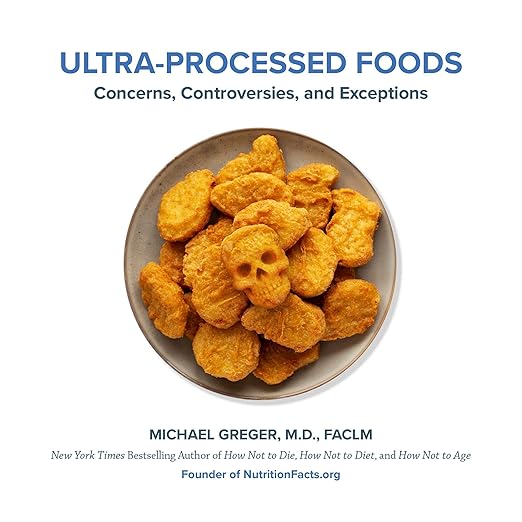
Quick Take
- Narration: Greger narrates his own work with the same focused, slightly urgent pace that fans of his How Not to Die series will recognize. The density of citations is easier to absorb in audio form than on the page.
- Themes: Ultra-processed food risks, plant-based food science, evidence hierarchies in nutrition research
- Mood: Dense and purposeful, the audio equivalent of a long research briefing from someone who has clearly done all the reading
- Verdict: At just over three hours, this is a tight, rigorous examination of a genuinely complex nutrition debate that earns its conclusions through evidence rather than advocacy posture.
I was halfway through a Saturday morning run when Michael Greger started talking about peanut allergies, and I nearly tripped. Not because the information was shocking but because the framing was so blunt. He doesn’t warm you into the material. He opens with epidemiological data on ultra-processed food and disease correlation and starts immediately distinguishing between what is established, what is proposed, and what is contested. For anyone who has spent time in nutrition media, where most claims are presented with far more certainty than the evidence supports, the precision here is genuinely refreshing.
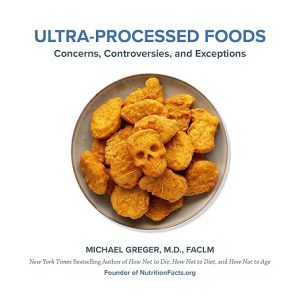
Ultra-Processed Foods is relatively short at just over three hours, which is itself a kind of editorial statement. Greger is not trying to build a comprehensive dietary philosophy in this volume. He is addressing a specific debate: whether ultra-processed foods as a category are inherently harmful, and if so, whether plant-based ultra-processed products constitute an exception or a solution. The focus is tight enough that the argument never gets lost in side roads.
The 16-Factor Investigation
The intellectual core of the book is Greger’s examination of sixteen proposed mechanisms that might explain why ultra-processed food intake correlates with cancer, dementia, inflammatory bowel disease, chronic kidney disease, and other conditions beyond what you would expect from their sugar, salt, and calorie content alone. This is where the book earns its place in the nutrition literature rather than on the self-help shelf. The proposed factors include food additives, industrial contaminants, packaging chemicals, and alterations to the food matrix itself, and Greger works through each with citations from peer-reviewed research.
What makes this section work in audio form is that Greger’s self-narration carries the investigative momentum. He doesn’t read the book so much as present it, and the distinction matters. There is a difference between a narrator voicing prose and an author defending their reasoning aloud, and Greger’s delivery has the quality of someone who has thought deeply about this material and knows exactly which findings he finds compelling versus provisional. Reviewer DaveZZ describes the research as backed by reliable sources, and that credibility reads through in how Greger handles uncertainty, noting when evidence is strong and when it is more tentative.
The Plant-Based Meat Question
The second half of the book addresses what will be the most contentious section for some listeners: Greger’s assessment of plant-based meats and milks as a category distinct from other ultra-processed foods. His argument is that while the processing is real, the comparison class matters. A plant-based burger being ultra-processed is only relevant if the alternative is a whole plant food, not if the practical alternative is an animal-based burger. Greger reviews studies on gut microbiome response, inflammation markers, cardiovascular outcomes, and cancer risk comparing plant-based meats to whole plant foods and to animal-based products.
This section will likely generate the most disagreement, and Greger seems aware of that. His framing is careful: the evidence suggests plant-based meats are not equivalent to whole plant foods but may be substantially better than the animal-based products they replace. Reviewer Rita describes him as committed to reducing major chronic disease through nutritional evidence, and that sense of institutional purpose is present throughout without tipping into advocacy that would compromise the analytical rigor. He acknowledges where comparative food safety data is limited and where longer-term studies are still needed.
Self-Narration as Epistemic Signal
Greger narrates his own books, and by this point in his publishing career, that decision is a feature rather than an aesthetic preference. He founded NutritionFacts.org and has spent decades reviewing nutrition research, and his narration carries the authority of that investment. The slight urgency in his delivery is not performance. It is what happens when someone genuinely believes that the information they are presenting matters to how long and how well people live.
Reviewer J.C. Cory, who describes reading all of Greger’s books, notes that this one presents the science in a concise, easy to understand manner while remaining applicable at an individual level. That is an accurate description. Greger manages to write for both the general reader who wants to understand what to eat and the practitioner or researcher who wants to understand why the evidence points in a particular direction.
The Scope It Covers and the Scope It Doesn’t
Three hours is short for a topic this multifactorial, and Greger knows it. The book doesn’t attempt a comprehensive dietary guide or a full critique of food manufacturing. It is a focused investigation into a specific evidence question, and its conclusions are proportional to what the evidence actually supports. Listeners expecting a complete protocol for avoiding ultra-processed foods will find less actionable guidance than in Greger’s longer works. Listeners who want to understand the scientific debate around ultra-processed food categorization and its implications for plant-based nutrition will find exactly what they need.
Frequently Asked Questions
Is this a continuation of Greger’s How Not to Die, or can it be read as a standalone?
It works as a standalone. Greger introduces the relevant background on ultra-processed food categories and disease correlation without assuming you’ve read his previous books. That said, listeners familiar with his earlier work will find it builds naturally on established themes.
Does the book take a definitive stance against all ultra-processed foods, or is the argument more nuanced?
More nuanced. Greger distinguishes between categories of ultra-processed foods, arguing that sweetened beverages and animal-based processed products drive most of the risk, while plant-based ultra-processed products may be healthier than the animal-based foods they replace. The argument is evidence-qualified throughout.
At only three hours, does the audiobook cover the topic thoroughly or does it feel like a summary?
It covers a specific, well-defined question thoroughly rather than the broader topic of nutrition. Greger examines sixteen proposed mechanisms for ultra-processed food harm and evaluates the plant-based meat evidence with genuine rigor. It is complete within its scope, not a survey.
How does Greger handle the research on food additives and packaging chemicals, which are often discussed with more alarm than evidence supports?
Carefully. He reviews the proposed mechanisms without overstating certainty, noting where evidence is stronger and where it is more preliminary. The tone is investigative rather than alarmist, which is consistent with how he handles contested science across his other books.