- Narration: Rose Akroyd delivers Tyldesley's ten-perspective structure with measured authority, distinguishing between ancient voices and modern scholarly analysis without overplaying the drama.
- Themes: Archaeological discovery and ownership, myth vs. historical record, the politics of ancient Egypt
- Mood: Scholarly and revelatory, with flashes of genuine wonder
- Verdict: Tyldesley's multi-lens approach is the most honest and structurally inventive account of Tutankhamun's life and legacy available in audiobook form.
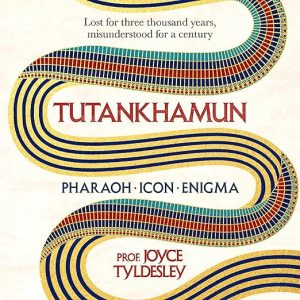
Joyce Tyldesley's Tutankhamun lands as an audiobook that does something genuinely unusual: it refuses to let its subject be a symbol. For a figure so thoroughly absorbed into pop mythology that his name conjures gold masks and cursed archaeologists before it conjures a person, that refusal requires real discipline. Tyldesley brings it. What she has assembled here is not a single biography but ten interlocking perspectives on Tutankhamun, and the structural audacity of that choice pays off in ways that a conventional cradle-to-tomb account simply couldn't.
Listening to Rose Akroyd navigate those ten distinct vantage points over nearly nine hours, I kept thinking about how rarely ancient history books ask us to sit with the gaps in our knowledge rather than paper over them. Tyldesley asks exactly that. Her ten lenses range from Tutankhamun himself and the royal family to ancient embalmers, tomb robbers, Western explorers, and Egyptian archaeologists whose contributions were largely erased from the popular record. That last category alone makes this audiobook essential for anyone who grew up with Howard Carter's name attached to the 1922 discovery and never heard another.
Who Got Erased From the 1922 Discovery
The real achievement in Tyldesley's book is what she does with the 1922 discovery. That moment has been told so many times it has calcified into legend: the flickering candle, the gleam of gold, the breathless telegram. Tyldesley does not skip it, but she reframes it entirely. She is interested in what happened after the cameras left, in the fight over ownership of the artifacts that continues to this day, and in the Egyptian scholars and workers present at the dig whose names never made it into the international press. One reviewer described the research as "very balanced and thorough," and that balance is precisely what distinguishes this from the dozens of Tutankhamun titles that have preceded it. Tyldesley is a leading Egyptologist and she writes with the confidence to unsettle comfortable assumptions rather than reinforce them.
She is equally rigorous about the boy king himself. The pharaoh who died young, under circumstances still debated, is here reconstructed from three thousand years of fragmentary evidence: administrative records, tomb inscriptions, forensic analysis of the mummy, and the political context of a court still reeling from Akhenaten's religious revolution. The picture that emerges is of a teenager on a mission to restore order to a kingdom destabilized by his predecessor, who met a violent and unexpected end before that mission was complete. Tyldesley is scrupulous about what can and cannot be known, which makes the moments of genuine insight land harder.
Akroyd Holds the Thread Across Two Timelines
The audiobook format serves this material in specific ways. Akroyd's pacing gives the listener time to absorb the chronological leap at the book's structural heart: the account moves between ancient Thebes in 1336 BCE and modern Luxor in 1922 CE, threading both timelines through the same physical spaces and the same object, the tomb. That kind of layered history reads well on the page but works even better when a single voice holds the thread. Akroyd's performance is controlled rather than theatrical, which suits Tyldesley's scholarly register. She does not manufacture emotion where Tyldesley has not placed it, and the result is a narration that trusts the material.
One reviewer flagged that the print edition includes photographs they wished there had been more of. That is worth noting for audio listeners: you lose the visual component entirely. Tyldesley's prose compensates with specific, evocative description of artifacts and tomb paintings, but those accustomed to illustrated editions may feel the absence. The book's argument does not depend on imagery, however, and Tyldesley is careful to describe what she references with enough detail that the audio experience holds up independently.
Journalists Under Deadline Invented the Curse
The most striking section covers the curse mythology that exploded in Western media after Lord Carnarvon's death in 1923. Tyldesley's treatment of this episode is a small masterpiece of historical debunking done without condescension. She tracks the origin of the curse narrative back to journalists under deadline pressure and a public hungry for mystery, and demonstrates how that narrative obscured the genuine complexity of the discovery's political fallout. The Egyptian government's claims over the artifacts, the colonial dynamics baked into the excavation's funding and publicity, the erasure of local expertise: these are the stories the curse replaced, and Tyldesley retrieves them with precision.
The section dealing with tomb robbers is equally surprising. Tyldesley traces evidence of ancient robbery attempts at Tutankhamun's tomb and uses them to reconstruct something of the ancient economy around royal burials: who knew where the tombs were, who had access, what the risk calculations looked like for a professional thief working in the Valley of the Kings two or three centuries after a pharaoh's burial. It is the kind of granular historical reconstruction that distinguishes a serious Egyptologist from a popular writer, and it elevates the book's final third considerably.
The Multi-Perspective Structure Takes a Moment
Listeners who grew up fascinated by ancient Egypt and feel they already know the Tutankhamun story will find that Tyldesley has reset the conversation. The multi-perspective structure ensures that even readers familiar with the 1922 discovery will encounter voices and arguments they have not met before. Scholars looking for an accessible synthesis of current Egyptological thinking will also find it useful, though the book pitches itself above popular history rather than at academic level.
Those who prefer straightforward chronological biography may find the ten-perspective architecture momentarily disorienting at the opening, though Akroyd's narration quickly establishes the rhythm. Anyone who has ever wanted to understand the ownership dispute over Tutankhamun's artifacts in its full historical context, from the ancient tomb robbers onward to the present, will find this is the audiobook that has been missing from the literature. Tyldesley has done the work, Akroyd delivers it cleanly, and the result is a genuine contribution to a subject that has been written about too many times without enough care.
Frequently Asked Questions
Does the audiobook cover the current repatriation debate around Tutankhamun's artifacts?
Yes. Tyldesley explicitly addresses the ongoing fight over ownership that began in 1922 and continues to the present day, situating it within the colonial context of the original excavation and the Egyptian government's claims over its own heritage.
Is this audiobook accessible to listeners with no Egyptology background?
Yes. Tyldesley writes for an educated general audience rather than for specialists, and the audiobook format with Akroyd's measured pacing makes the material approachable even for listeners new to ancient Egyptian history.
Does the audiobook address the 'Tutankhamun's curse' story, and is it taken seriously?
Tyldesley debunks the curse narrative in detail and traces it directly to 1923 media sensationalism following Lord Carnarvon's death. Her treatment is thorough and unsentimental, and she uses the episode to illustrate how mythology formed around the discovery to the detriment of the genuine historical story.