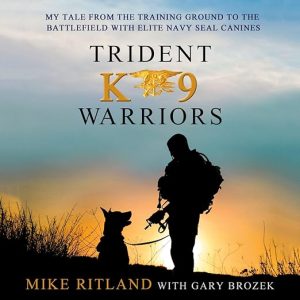
Key Details
- Narration: Jeff Gurner brings appropriate gravitas and pace to Ritland's account of elite military working dogs, handling both operational detail and emotional material well.
- Themes: human-animal partnership in combat, elite selection and training culture, devotion to duty across species
- Mood: Focused and respectful, with the quiet intensity of mission briefing
- Verdict: The most thorough and personal account available of Navy SEAL working dogs, from someone who actually trained them.
I grew up around dogs, and I came to Trident K9 Warriors with the kind of background that makes training methodology genuinely interesting rather than merely instrumental. Mike Ritland's book does something unusual in the military nonfiction space: it centers the dog rather than the handler. The dog is not a tool or an accessory to the human story. The dog is the subject, and Ritland's account of how he finds, selects, and trains the animals that serve alongside Navy SEALs is shaped by that prioritization throughout.
Ritland's path to this work is worth understanding. He was a SEAL who watched a military working dog in action in Iraq and recognized something in how that animal operated. He left the teams and started a company training and supplying dogs to SEAL units, US government agencies, and the Department of Defense. His selection process is global, he searches across multiple countries for animals with the specific traits that make the small fraction of a percent of working dogs capable of this level of performance, and his training methodology is built around positive reinforcement rather than the dominance-based approaches that characterized military dog training for decades.
The Verdict, Briefly
The book's opening section, which establishes what these dogs can do in combat conditions, sets a high standard for the narrative that follows. Ritland is describing animals that can detect explosives, conduct apprehension work, clear buildings, and operate effectively under fire in darkness, heat, and high altitude, all while maintaining the handler bond that makes them operationally useful rather than merely capable. Reviewer J. G. Scott described the prologue as giving "you chills," and the specific details Ritland provides in those opening pages are genuinely striking.
What follows is both a training manual and a love story. Ritland is transparent about his emotional relationship with these animals, and the book does not shy away from the reality that working dogs are often injured or killed in the operations they serve. That vulnerability is handled without sentimentality but with genuine grief, and it is what distinguishes this from a purely operational account. Reviewer KnoxCoResident, a dog trainer with more than twenty-five years of experience, called it "amazing in the skill levels they teach" and found the positive training methodology validating rather than foreign.
The Best Parts of Trident K9 Warriors
Jeff Gurner's narration captures the combination of operational precision and personal warmth that the material requires. This is not a book that benefits from dramatic performance, and Gurner does not provide one. He reads with the kind of steady, informed quality that suits nonfiction with high stakes but restrained tone. The chapter on what happens to retired military working dogs is handled particularly well in audio, where Gurner's pacing gives the more emotional material room without overplaying it.
At seven and a half hours, the book is efficiently paced. Reviewer Edwin noted it was informative and enjoyable for commute listening, which is accurate. The chapters are structured around specific aspects of the selection and training process, and each stands relatively well on its own, making it suitable for interrupted listening without losing narrative thread.
Points to Consider
The book was published in 2013, following significant public attention on Navy SEAL dogs in the wake of the Bin Laden raid. Ritland acknowledges in the text that the secrecy requirements around specific operations prevent him from being fully explicit about certain details. The result is a book that is comprehensive about methodology and culture but appropriately vague about specific missions. Listeners looking for classified operational detail will not find it here, and Ritland is honest about that limitation rather than trying to imply access he does not have.
Reviewer Joshua R. Price, a board member at a canine rescue organization, noted the book "provides a great beginning insight" into the career field, and that framing is useful. This is a thorough introduction rather than an exhaustive technical treatise. Dog training professionals will find the methodology interesting but not unprecedented; for general readers, the material will be revelatory.
Who Should Pick Up Trident K9 Warriors
Military history enthusiasts, dog lovers, and anyone curious about the intersection of elite human performance and animal training will find this essential. The 60 Minutes connection brings in listeners who want the longer version of what the television segment could only gesture toward, and the book delivers on that promise. Skip it if you want primarily mission narrative and combat memoir; the operational storytelling serves the dog training account, not the other way around.
Good to Know
Does Trident K9 Warriors cover specific combat missions, or is it more focused on training?
The emphasis is on selection and training methodology, with operational deployment as context rather than primary subject. Ritland is explicit that security requirements prevent detailed mission accounts, so readers seeking combat narrative will find that the training and selection process is the real story here.
How does Jeff Gurner's narration handle the emotional sections involving dogs that were killed or injured in service?
With appropriate restraint. Gurner does not dramatize the losses, which is the right call. The emotional weight is in the writing and the specific details Ritland provides, and Gurner trusts those details to carry the moment without additional performance.
Is this book relevant for someone interested in civilian dog training, or is it exclusively about military applications?
Multiple reviewers with civilian dog training backgrounds found the methodology directly relevant. Ritland uses positive reinforcement approaches that apply broadly, and his philosophy about working with a dog's natural drives rather than overriding them has clear civilian applications. KnoxCoResident, with twenty-five-plus years of obedience training experience, specifically praised the training methodology.
What breed of dogs does the book focus on, and does Ritland discuss the selection process across breeds?
Ritland discusses Belgian Malinois and German Shepherds primarily, with some discussion of Dutch Shepherds. He is explicit about why certain breeds rather than others have the combination of drive, environmental stability, and trainability that SEAL work requires, and the breed selection discussion is one of the more technically detailed sections of the book.