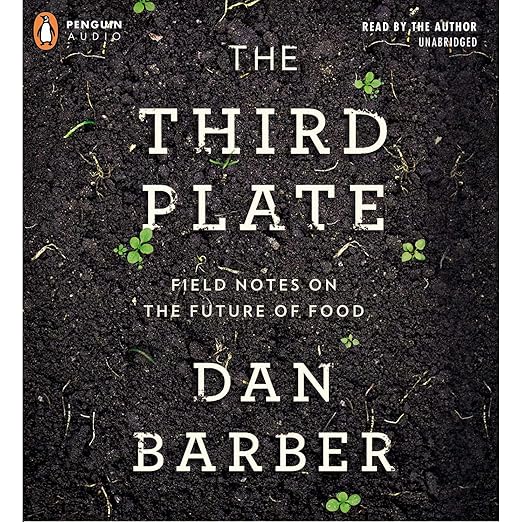
I listened to The Third Plate over the course of a week, mostly during long walks, and it changed the way I thought about dinner in ways I am still processing. That sounds like hyperbole but it isn't, Dan Barber is making an argument about the relationship between cooking and agriculture that is both intellectually rigorous and practically urgent, and he makes it in the voice of a chef rather than a policy writer. That distinction matters enormously to how the book lands.
Barber is the chef at Blue Hill Farm in New York, one of the most celebrated farm-to-table restaurants in the country, and this book is partly his confession that farm-to-table as typically practiced is a con. Not a deliberate one, a structural one. The local food movement, he argues, has made consumers feel virtuous about their choices without actually changing the underlying economics of industrial agriculture. The third plate of the title is his answer: a different relationship between chef, farmer, and eater, one built around what the farm can actually sustain rather than what the restaurant wants to serve.
A Closer Look at The Third Plate
Barber reads his own book and this is absolutely the right decision. His voice carries the authority of someone who has spent decades in professional kitchens and walking the fields that supply them, and the storytelling rhythm of a chef, observant, specific, attuned to texture and process, transfers naturally to spoken-word memoir. The Washington Post compared him to Michael Pollan, and the comparison is apt in terms of cultural reach and the ability to make agricultural argument feel personally relevant. But Barber is more interested in culinary mechanics than Pollan is, which gives The Third Plate its distinctive flavor.
The book's four sections move through soil, land, sea, and seed, and each section uses a specific farm, fishing community, or agricultural practice as its anchor. The soil section opens with Barber's obsessive investigation of a Spanish farm that raises the world's most extraordinary pigs, which is not where you expect a book about sustainable agriculture to begin, and that unexpectedness is the point. Barber is making you understand that what feeds the pig is the argument, not the pig itself.
What Makes The Third Plate Worth Hearing
At fourteen hours, this is a substantial listening commitment, and the material rewards that commitment. Barber doesn't repeat himself, each section builds on the previous one, and by the time he reaches the seed chapter, you have accumulated enough context that his arguments about grain revival and heritage varieties land with the weight they deserve. One reviewer who underlined the book heavily called the soil section particularly compelling; in audio, those same passages have the density of a lecture from someone who knows the subject cold.
The sensory specificity of Barber's writing is a pleasure in audio. He describes flavor with precision and purpose, not for pleasure's sake but to make an argument about what good farming tastes like. This is a book that will make you taste the difference between a commodity tomato and one grown in alive soil, conceptually at least, and hold that comparison in your mouth as an argument about what food should be.
Things to Know Before Starting The Third Plate
Some listeners may find Barber's pacing in the middle sections slightly ruminative, he follows threads patiently and sometimes at greater length than the argument strictly requires. The sea section, which covers aquaculture and the tragedy-of-the-commons problem in fishing, is the longest and the most digressive. It is also the most scientifically dense, and some listeners found it harder to follow in audio than the farming sections, where Barber's direct experience gives him cleaner authority.
The book is also explicitly a manifesto, which means it persuades rather than surveys. Barber is not presenting competing views of how agriculture should work, he is making a case. Readers who want even-handed journalism rather than passionate argument should know what they're getting into.
Who Dan Barber Is Writing For
For cooks, farmers, food writers, anyone who has ever wondered whether farm-to-table is actually doing what it claims, and anyone who wants a rigorous, beautifully rendered argument for a different relationship between kitchens and fields. Not for listeners who want a gentle, easy listen about food, this is a serious, demanding book that happens to be about something you eat every day.
- Voice: Dan Barber reads his own book and the choice pays off, his chef's authority and storytelling rhythm give the material an intimacy that a third-party narrator couldn't replicate.
- Big ideas: Sustainable agriculture, chef responsibility, the ecology of eating
- Atmosphere: Intellectually urgent and richly sensory
- Worth it?: A serious, beautifully argued food manifesto that earns its fourteen hours, required listening for anyone who thinks about where their food comes from and what cooking can ask of farming.
Before You Listen
Is Dan Barber's narration of his own book distracting, or does it work?
It works exceptionally well. Barber is a practiced public speaker and storyteller, and his chef's sensibility, specific, observant, rhythmically varied, transfers naturally to audiobook narration. This is one of the stronger self-narrated food books available.
Is The Third Plate anti-farm-to-table, or is it arguing for a better version of the same idea?
The latter, precisely. Barber's critique is that farm-to-table as currently practiced doesn't go far enough, it places the restaurant's menu at the center rather than the farm's ecology. His third plate is a more demanding version of the same commitment, not a rejection of it.
How does this compare to Michael Pollan's books as an audiobook listen?
Barber is more technically specific about cooking and farming than Pollan, and more interested in the chef's particular relationship with ingredients. Pollan writes about the food system from a journalist's distance; Barber writes from inside a professional kitchen. Both are excellent; they complement rather than duplicate each other.
Is the sea and aquaculture section as accessible as the farming sections?
It is the most scientifically dense section of the book and the most digressive. Some listeners find it harder to follow in audio format because the fishing ecology arguments require more active tracking. The farming sections are more immediately visceral and easier to absorb while doing other things.