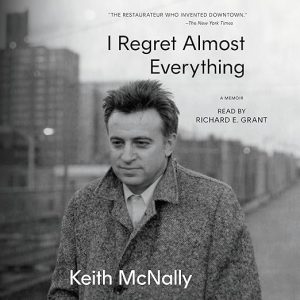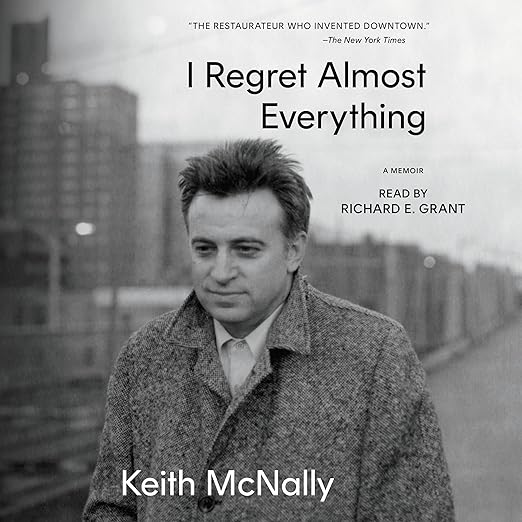
- Read by: Richard E. Grant, an actor rather than the memoirist himself, narrates alone across the full eleven-hour runtime, voicing McNally's opinions as reported speech.
- At its heart: Restaurant history, candid self-reckoning, reinvention across decades
- Vibe: Dry, candid, and a little chaotic
- Short version: A strong pick for anyone with real affection for downtown New York dining history, less so for readers wanting a straightforward business memoir.
Handing narration duties to an actor rather than the memoirist himself is a specific choice this audiobook makes, and it is worth naming upfront: Richard E. Grant reads Keith McNally's own account of his life, rather than McNally reading it in his own voice. That arrangement is common enough across the format generally, but for a memoir this candid about its author's own opinions and voice, judging from what the five reviews describe, it changes what "hearing him tell it" actually means for a listener. McNally's own name carries the story, but the specific cadence a listener hears belongs entirely to Grant.
Restaurant History Alone Does Not Prepare You
Keith McNally built a specific slice of New York, and this memoir traces how: from a "gritty London childhood in the fifties" through a serendipitous arrival in New York, on to founding the Odeon, Cafe Luxembourg, and Nell's, and later the restaurants most readers will actually recognize by name, Balthazar, Pastis, Minetta Tavern, and Morandi. The synopsis calls him "eloquent and opinionated," and every review on file backs that description up without exception, which is a rare kind of agreement across five otherwise independent readers. Fiona's review adds a detail the restaurant list alone would not suggest: Fiona's review frames McNally building much of that career "far from his childhood home" as central to the story rather than incidental to it. BooksAreWings addresses the point from the other direction, telling any reader who happens to be "a Manhattanite" that they have almost certainly already bellied up to one of his bars without necessarily knowing the man behind it.
Restaurant history alone does not prepare a listener for how much of the book sits outside the kitchen entirely. The synopsis lists the angst of being a child actor, an underprepared overland trip to Kathmandu at nineteen, the instability of two marriages, a devastating stroke, and, more recently, real notoriety on Instagram. Gary's review makes the point directly: this "is not a book regarding his very successful career as a restaurateur," even though that career understandably meanders through it, since McNally's life after leaving London in the 1970s is the actual subject. Two marriages, a stroke described in the synopsis as "devastating," and a more recent second act as an outspoken presence on Instagram all get folded into that same account, which is a lot of ground for one memoir to cover without the restaurants ever fully disappearing from the frame.
Grant Voices McNally's Dry Wit as Reported Speech
Richard E. Grant carries the entire eleven-hour-and-three-minute runtime alone, voicing a memoir written in a register reviewers repeatedly describe as dry, candid, and unsparing about its own author. That is a different task than narrating fiction: the performance has to sell McNally's specific sense of humor and self-regard as reported speech rather than invent a character from scratch, since the words and the attitude behind them both belong to someone else entirely.
That voice comes through even secondhand in how reviewers describe it. BooksAreWings calls McNally "one of the legendary restaurateurs, and raconteurs, of all time," and describes the specific ritual of bellying up to the bar at Pastis or Minetta or Balthazar for "a spectacular burger and a dry martini, Vesper for me please," language that captures a very particular New York social world. Nicole Struensee describes the book itself as "riddled with adventure, wit, self doubt, candor," which lines up with what BooksAreWings calls his "dry wit, drier even than that martini."
Carolyn Hahn's review adds a more chaotic layer to the same personality, describing catching up with "more recent Keith on Instagram" and finding him "kind of insane," posting on every topic, arguing with people, and sharing reports from his own staff about how a given night went. That is the same eloquent, opinionated figure the synopsis promises, just filtered through a different, more unfiltered platform, and it suggests the audiobook's tone has real continuity with how McNally already presents himself in public.
One Vote, a 4.5 Average, Five Written Reviews
One data point on this listing does not add up cleanly. The rating counter shows a single vote behind the 4.5 average, a figure that no lone whole-star rating could actually produce under any rounding method, and five different people left complete written reviews without any of them registering in that count. Treat the star badge as approximate rather than exact, and lean on the written reviews themselves for a real sense of reception. All five of those written reviews land at four stars or higher, for what that pattern is worth, even without a clean vote count to back it up.
Not every review is unreserved praise, either. Fiona's four-star account calls the book "fun" and "inspiring for dreamers," particularly readers interested in building something of their own, but adds a specific regret, writing "only wish he had shared more of how" before the sentence cuts off entirely. Listeners hoping for a deep business memoir specifically should take that regret seriously, since Gary's review already confirms the restaurant career is treated as backdrop rather than the main event.
Real Affection for a Downtown Dining Era
Anyone with real affection for a specific era of downtown New York dining, or curiosity about the person behind restaurants they have actually eaten in, is the clear audience, and Nicole Struensee's review frames McNally's contribution to that scene as lasting rather than incidental. Listeners drawn to candid, self-critical memoirs generally, regardless of the restaurant angle, should also find plenty here, since the synopsis and every review agree that McNally does not spare himself. Carolyn Hahn's review describes a long personal history with the Odeon, a favorite since the early 1980s, which is a useful reminder that this book is likely to hit hardest for listeners who already have their own memories tied to one of these rooms.
Those expecting a structured business memoir about building a restaurant empire should adjust expectations before starting, since Gary's account is explicit that this book is not really about that career in any conventional sense. Fiona's wish for more detail on the business side is worth keeping in mind too, for anyone hoping the entrepreneurial thread gets more room than the personal one. Listeners who want an aspirational how-I-built-this narrative above all else may come away wanting a second, more practical book to go alongside this one.
Common Questions
Why does this audiobook use an actor instead of Keith McNally himself as narrator?
The record does not explain the choice, only the credit itself: Richard E. Grant is listed as narrator while Keith McNally is credited as author, meaning the two roles belong to two different people rather than one, unlike memoirs where the author reads their own material aloud. No review on file comments on that choice directly.
Is this audiobook mostly about Keith McNally's restaurants, or about his personal life?
More the personal life than the restaurants, according to Gary's review, which states plainly that the book is not really about McNally's career as a restaurateur even though that career runs through it. Two marriages, a stroke, a child-actor past, and recent Instagram notoriety all get significant space alongside Balthazar, Pastis, and the rest.
Does this audiobook work for listeners who have never eaten at any of McNally's restaurants?
It should, based on the reviews. Several describe the appeal in terms of McNally's personality, wit, and candor rather than requiring firsthand restaurant knowledge, though Carolyn Hahn's account suggests the emotional pull is strongest for listeners who already have their own history with one of these dining rooms.