
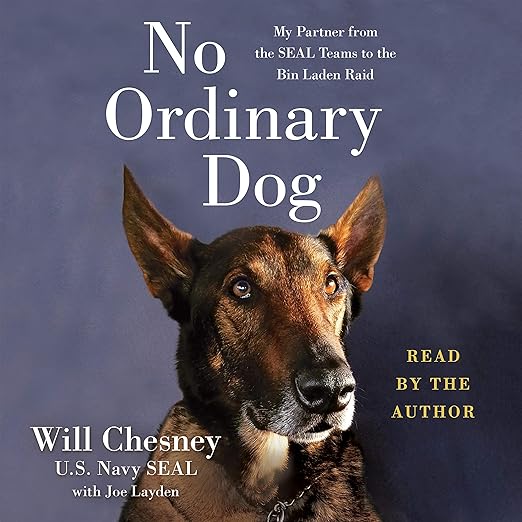
One line of the description does more work than everything else on this audiobook page combined: "This program is read by the author." Will Chesney is a former SEAL Team Operator and military dog handler who came home from a 2013 grenade blast with a brain injury, PTSD, chronic pain and memory problems. He is also the person credited with reading it aloud. Nine hours and forty-four minutes of it, in the voice of the person the events actually happened to, which is not a small production decision to bury in a second line.
The One Name Made Public Belonged to the Dog
Will Chesney's account starts in 2008, when he was introduced to the DEVGRU canine program and paired with Cairo, a Belgian Malinois. They worked hundreds of critical operations together, the copy says, depending on each other for survival. In May 2011 the call came: "Pick up your dog and get back to Virginia. Now." Several weeks of training followed for a secret mission, which turned out to be Operation Neptune Spear, and Cairo went in among the first members of the US military on the ground in Pakistan.
Cairo is the reason the book exists and the reason it has a hook worth the telling. Of the two dozen Navy SEALs who descended on the compound that May, the description points out, exactly one name was made public afterward, and it belonged to the dog. That is a genuinely odd fact about how the operation reached the public, and it hands the memoir its structure. The dog collects the fame, the handler collects the injuries, and the back half turns on which of the two ends up rescuing the other. Very few military memoirs have that shape available to them.
Christine's five-star response never mentions listening at all. It is about a used hardback: a stated preference for "a REAL book," hardback if possible, ordered through Amazon vendors on a fixed income, arriving in great shape with clean print and a cover that "looks almost new." The review signs off from a retired Animal Cruelty Investigator of eighteen years, which is the most relevant credential in the column attached to the least relevant format on the page.
Only One Voice Can Vouch for Either
Nine hours and forty-four minutes makes a compact memoir, and the self-narration is the whole argument for choosing this edition over the hardback Christine liked so much. The description does not hedge the point or hide it in a credits block. It states in its own second line that the program is read by the author. A book about a brain injury that damaged memory, and about a partnership no third party witnessed, arrives in the only voice that can vouch for either of those things.
Osama bin Laden's compound takes up a few sentences and then the book moves past it, which is the correct proportion for what this actually is. Dave Guinn came to the memoir specifically for Cairo, after hearing interviews with Navy SEALs who had worked alongside him, wanting to know how he was utilized and what he did and how many lives he saved. Lisa arrived from the opposite direction entirely, opening with a declared lack of interest in military detail, and stayed for prose the review calls spectacular. Two people arriving from opposite ends of the shelf, both landing on five stars.
A grenade blast in 2013 closes the operational half of the story and opens the harder one. The copy lists what followed without softening any of it: crippling migraines, chronic pain, memory issues, depression, and modern medicine offering only modest relief. What helped, in the telling, was the dog. Then the obligation reverses one last time and Chesney has to be present for Cairo. Nobody in the column gives away how that resolves, though Victoria M. closes a review by thanking Cheese and Cairo by name, a nickname the listing itself never uses.
A Vote Tally Smaller Than Its Own Review Count
Hardbacks aside, the numbers along the top of the page deserve a squint. A 4.8 average is on display over a tally of four votes. Underneath both sit five written responses, and every one of them carries a five-star grade. So every verdict you can actually read is higher than the average being displayed, and the tally of votes is smaller than the tally of reviews. Nothing about that is scandalous. It does mean the figure on display and the paragraphs below it are answering different questions.
Whether this belongs on a gardening shelf is a question the listing raises entirely by itself. The genre fields file No Ordinary Dog under biographies and memoirs, which is right, and then under home and garden, which nothing in the description or in five reviews supports in any way. The tag underneath reads Military & War. If you browse by category rather than by search, that middle label is the one likely to put this book in front of precisely the wrong person.
Macmillan Audio occupies the publisher field, and the description signs off by calling this "A Macmillan Audio production from St. Martin's Press," so the audio house and the print house are both accounted for. What the page never supplies is any note about the recording itself: no abridgment statement, no indication of added material, no word on how a first-time narrator was supported through ten hours of his own worst years. The one production fact you do get arrives in seven words.
Lisa Had No Appetite Yet Finished It Anyway
Military memoir listeners are the core audience, and this one is unusually well placed for them. A first-hand account of the DEVGRU canine program, a role inside Neptune Spear, and a post-service chapter about brain injury that a lot of comparable books hurry past. Dog people are the second audience, and Dave Guinn's review is written from exactly that seat. Lisa's is the useful test case: someone with no appetite for military detail at all, who finished it anyway and could not stop recommending it.
Pass if you want the operational thriller that the first half implies, because the back half is about migraines, memory and a dog growing old. Do not lean on the column as a guide to the recording either, given that its most detailed entry is a report on a used hardback's cover. Know going in, too, that the book asks you to sit with a grief it starts assembling in its opening chapter. Dog people will finish it in two sittings and then sit quietly for a while.







