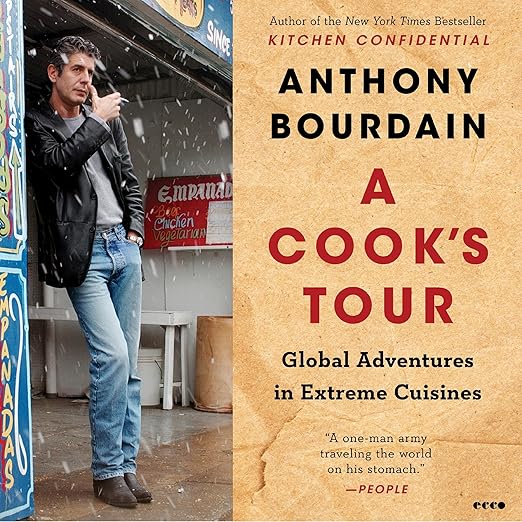
Read the description of this audiobook and the first thing it tells you is who is speaking. Read the five written responses underneath and not one of them mentions a voice. The copy opens with the words read by the author and available digitally for the first time, about the most audio-specific claim a listing can make. Everything the column beneath it grades is prose: a highly crafted sentence, a writer's opinions, a book somebody could not put down. That gap is the real story of this page.
Bourdain Narrates His Own Gonzo Gastronome Quest
A quest structure holds the book together, and the copy states it plainly. Bourdain sets out inspired by one question, what would be the perfect meal, and the answer keeps refusing to arrive in the shape he expects. From California to Cambodia, the description says, and somewhere in between the pursuit of perfection turns the whole notion of perfection inside out. That is the honest engine of the thing. Eating is the surface, and the argument underneath is that the best meal is almost never the most technically accomplished one. The copy calls him a gonzo gastronome, in quotation marks, and the phrase does more work than most jacket adjectives: the method is deliberately undisciplined and the results are supposed to be.
Two details in the description deserve flagging before you press play. The title field reads A Cook's Tour, apostrophe before the s, while the description writes A Cooks' Tour, apostrophe after it. Same page, two grammatically different books. The copy also spells the same travel verb two different ways within a few lines of itself, once with a doubled consonant and once without, and the first sentence runs straight into the second with no punctuation between them. None of that affects the listening. All of it tells you how carefully this particular record was assembled.
Bourdain reads it himself, and the listing leads with that for a reason. His voice is the product. The pull quote from the New York Times Book Review, credited to Sam Sifton, says his opinions are as strong as his language and his tastes as infectious as his joy, and every one of those is a delivery quality as much as a prose quality. An author performing his own travel memoir removes the interpretive layer completely. What you hear is what he meant, including the passages where he is being unfair on purpose.
A Wood Grub, Haggis, and a Dish Cut Off
For a listener who came to Bourdain through television, this is the closest thing to the show in book form, and one response says exactly that: the language and the vibe are exactly like watching No Reservations. The copy leans on the same connection, opening with a reference to the star of that program. Five hours and fifty minutes is a manageable runtime for a book of episodes, and the episodic build means you can stop almost anywhere without losing a thread or forgetting who anyone is.
Five hours also means the book moves at speed. The written responses list what he eats with something close to awe: a big wood grub, haggis, and a Mexican dish that one entry breaks off in the middle of describing. Another writes that he eats it so you don't have to, the cleanest summary of the appeal anyone on this page manages. The delight is in the specificity, and specificity survives a format that gives you nothing whatsoever to look at.
Nothing about the argument has aged into safety, either. One four-star response takes real issue with the way Bourdain writes about vegans, calls the position deluded, and points out that he flinches when he has to kill an animal himself. Whether you side with the reviewer or the writer, the fact that somebody in 2026 is still arguing with the book tells you the opinions in it were never decorative. Travel writing that still picks fights with its readers is doing something most travel writing does not attempt.
Three Votes, Five Responses, Numbers That Won't Reconcile
The rating badge and the review column disagree with each other. The counter says three votes. Five written responses sit directly beneath it. That mismatch turns up often on records re-listed under a new edition, and it means the 4.6 on display is not a summary of the five opinions you can read. Do no arithmetic with it, because the numbers on this page cannot be reconciled without knowing which convention produced them in the first place.
The column is also, in every practical sense, a column about a printed book. Its oldest entry carries a July 2009 date, more than sixteen years before the January 13, 2026 release stamped on this recording. One calls it the first book I read by him. One says the book could not be put down. One praises the highly crafted sentence. The description promises the author's voice and the responses answer with the author's paragraphs, so nobody on this page has told you whether the recording itself works.
When you reach the category fields the shelving gets stranger still. Three genre buckets hold this title at once: biographies and memoirs, travel and tourism, and home and garden, with a Professionals and Academics tag laid over the top. Home and garden is an unusual home for a book containing grubs, haggis and a sautéed insect dish. Anyone browsing by genre will meet this record somewhere it does not belong, and anyone searching where it does belong may never meet it at all.
An Author Reading His Own Work, No Negotiation
Food-television audiences who never got to the books are the obvious buyers, and they are also the readers this copy was written for. Listeners who like travel writing with an argument inside it will do better here than those hoping for a guidebook or an itinerary. Cooks and former cooks will recognize the register inside five minutes. And an author reading his own work, with every emphasis landing exactly where he set it down, is on offer here from the first minute, without negotiation.
Squeamish listeners should know the book earns its reputation, in detail, repeatedly. So should vegans and vegetarians, since one reviewer reports that it generalizes about them in terms worth arguing with. Anyone hoping for warm, gentle food writing about markets and grandmothers is on the wrong page entirely, and anyone who needs a recording vouched for by other listeners will find five responses that never once mention the reading. A tidy travelogue this is not, and the mess is most of the point.
In Brief
- Performance: Anthony Bourdain reads his own memoir, and the listing puts that fact in its opening words.
- What it covers: A quest for the perfect meal, culinary risk, travel as argument, appetite as character.
- Feel: Restless, funny, unsentimental.
- Our call: The voice is the product here, and the voice belongs to the man who wrote the sentences.
Does hearing Anthony Bourdain read his own book change it?
The listing bets that it does, opening with the words read by the author. Self-narration strips out the interpretive layer, so emphasis, timing and the sneer all land where the writer put them. No reviewer on this page confirms how that plays, since all five responses discuss the writing and never the recording.
Should a Bourdain newcomer start with this audiobook?
Two entries out of five call this their first Bourdain book, and both came away enthusiastic. The book is episodic, self-contained, and needs no prior reading whatsoever. At five hours and fifty minutes it makes a short introduction as well. The one caveat is tone, because it argues and never apologizes.
Which spelling of the title is correct on this audiobook listing?
The page carries both spellings at the same time. Its title field puts the apostrophe before the s; the description shifts it after, turning one cook into several. That same copy renders one travel verb two different ways within a few lines, and runs its opening sentence into the next without punctuation.