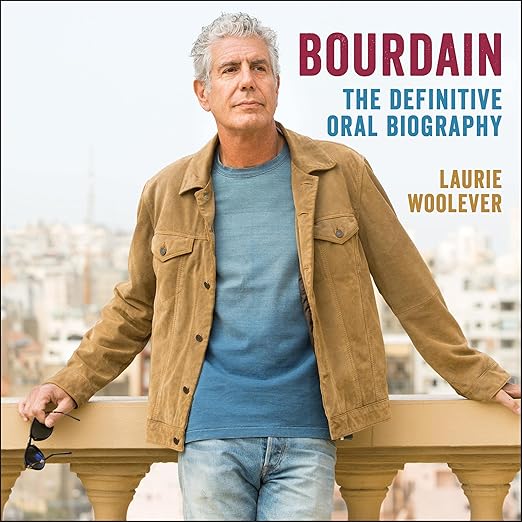
Nearly a hundred people were interviewed for this audiobook, and not one of them is Anthony Bourdain. Laurie Woolever, described in the copy as his longtime assistant and confidante, put the questions to kitchen crews, writing and television partners, publishers, his brother, his late mother and his daughter, then arranged what came back in chronological order. Eleven hours and twenty-eight minutes of other people's memories is the result, with Woolever taking the reading. The description promises a full, vivid and nuanced vision of Tony's life and work, which is a large claim for a book that never once speaks in its own voice.
First, the Big Picture
Oral biography has rules, and the four-star entry on this page states them more plainly than the marketing does: this is not a biography in the traditional sense but a set of interview transcripts, stitched together to form a timeline, with none of the connecting narrative that bridges events in a conventional life. That reader compares the effect to the closed captions of a documentary. The comparison is exact, and whether it reads to you as praise or as complaint is the thing that decides whether to buy at all, because nothing in eleven hours will soften it.
What the form buys is a kind of honesty no single biographer could manage. Dozens of people who knew the same man disagree about him on the page, and nobody is arbitrating. A kitchen colleague and a television partner remember different men, and the book does not tidy the difference away. What the form costs is momentum. Speakers are introduced and dropped, subjects arrive out of nowhere, and a listener who loses the thread has no narrator to hand it back. In print you can flick to the speaker's name. In audio you wait for the next attribution.
Bourdain emerges more contradictory than the television version and less resolved than either his admirers or his critics would like. The copy lists what it means to show, and the list is unusually candid for jacket writing: motivations, ambivalence, vulnerability, blind spots, brilliance. All five are present, and the blind spots are not softened by the people best placed to describe them. Whether that portrait is fuller than his own writing gave us is arguable. It is certainly less flattering, and it was assembled by someone who worked beside him for years.
Access is the argument. An April 2025 five-star calls the collection well designed and well written, and notes that the impressions gathered here run both fleeting and deep, which is the right way to describe a book where a passing acquaintance and a decades-long friend get similar space. The same reader admires Bourdain's writing and television work while refusing to admire everything about how he lived, then says this book helps explain the early death that saddened so many people. That is a fair account of what eleven hours of testimony does and does not deliver.
Woolever's position complicates the reading in a useful way. The same person asked the questions, appears quoted inside the book alongside everyone else, and now speaks all of it aloud, so a listener is hearing the interviewer voice the subjects. Every attribution has to land cleanly or the speakers blur, and the transitions between voices are where a book like this succeeds or falls apart, since nothing else holds the chronology together. Sample a passage where three people describe the same period, rather than the opening, and listen for how the handoffs are marked.
What to Watch For in Bourdain
Casting is the first thing this record gets wrong. The description ends with a heading announcing the voices featured, followed by a block of names run together with no punctuation between them, and the narrator field on the same record carries exactly one name. Nothing on the page says which of those people were interviewed for the book and which are speaking on the file. Solo reading or large ensemble, the listing never says which one you are buying. The title fields are careless in a smaller way too: the copy names the book in full as an oral biography with a subtitle, and the record shows a single word.
Reception here is counting two groups at once, and neither explains the other. Five signed responses spanning nearly four years sit beneath a counter that records a single rating, and the badge above them reads 4.6. One vote and five written verdicts cannot both be the basis of that average, and the page itself never identifies which of the two produced it. It matters here more than usual, because a buyer weighing an eleven-hour interview transcript wants to know how many people finished it, and the one figure that looks like an answer is not one.
Two of the book's pleasures do not survive the format. The copy advertises a treasure trove of photographs from Bourdain's life, and the audio edition ships them as a supplemental PDF, which is a download rather than part of the listening. An April 2024 five-star also warns about scope, saying the book leans heavily on the adult years and wishing for more on his development and family life; that reader calls the interview form quick and easy to read, which is another sign that the column here is grading pages. Neither point argues against buying the recording, but both belong in the decision.
Who It's For
People who came looking for an explanation will find something more useful than one. An October 2021 five-star came to the book wanting to understand why Bourdain killed himself, found that the people closest to him offer no easy answers, and reports clues instead, listing a difficult mother, an impulsive temperament and unresolved addiction among them. That is the honest shape of the material. This suits listeners who already know his writing, who can tolerate a chorus rather than a story, and who want the version of a public figure that only colleagues and family can supply.
Pass on it if you want a narrative biography with an argument, because this book is deliberately not that. The subject matter is worth weighing separately, since suicide, addiction and grief run through the testimony without much cushioning. Anyone hoping for kitchen memoir in the vein of his own books should also look elsewhere; the food is background here and the man is the subject. Easy answers are not on offer, and the book is better for refusing to manufacture any.
At a Glance
- Voice: Laurie Woolever reads a book made entirely of other people's speech, and the record credits a single reader while the copy trails a page of names.
- Big ideas: celebrity and its cost, addiction and grief, the gap between a public persona and a private life, food television
- Atmosphere: Candid, fragmented, and often sad
- Worth it?: The fullest portrait of Bourdain anyone has assembled, delivered in a form that will frustrate listeners who want a story.
Does this audiobook explain why Bourdain died?
It does not, and it says so. A July 2025 five-star response puts it well, concluding that the book offers no answers beyond the sense that everyone wanted a piece of him all the time. What you get is the testimony of people who were there, arranged in order, with the conclusions left to you.
How is the audiobook organized without a narrator connecting the interviews?
Chronologically. Woolever cut the interview answers into segments and laid them along a timeline, from childhood through New York, the memoir that made his name, and the television years. Speakers alternate within each period, so the structure is the calendar rather than an argument, and attributions do all the signposting.
Why is an oral biography of a chef filed under home and garden?
The record puts it there with a food and wine tag, presumably because Bourdain is filed as a food figure. It is a bad fit. This is a biography with almost no cooking in it, and listeners browsing home and garden are not the ones who will want eleven hours of interview transcripts about a man's life.