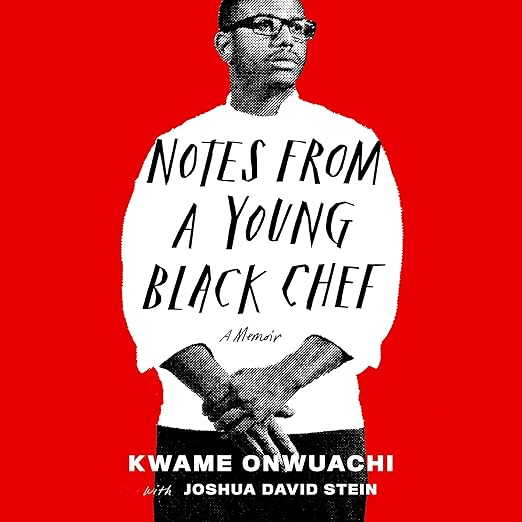
- Performance: Kwame Onwuachi narrates his own memoir with the storytelling ease of someone who has spent years cooking for rooms full of people, unhurried, direct, and fully present.
- What it covers: Race and fine dining, self-reinvention, the cost of ambition
- Feel: Candid and propulsive, with moments of genuine warmth and hard-won honesty
- Our call: One of the more compelling chef memoirs in recent years, the audiobook gains significant power from Onwuachi's own voice telling his own story.
I finished Notes from a Young Black Chef on a Saturday morning, at the kind of hour when the kitchen is quiet and you have time to think. There is something fitting about that. This book is fundamentally about what happens in kitchens, not the Instagram version, but the real one, with its hierarchies and its brutality and its occasional transcendence.
Kwame Onwuachi grew up in the Bronx, was sent to rural Nigeria by his mother when she decided he needed grounding, and returned to a life that could have gone in multiple directions, most of them bad. Food became his way out and eventually his identity. By his late twenties he had trained in acclaimed restaurant kitchens, competed on Top Chef, launched a catering company with money made selling candy on the subway, and opened, then closed, a restaurant that was supposed to be the culmination of everything. The story is as much about failure as triumph, and it is better for it.
A Closer Look at Notes from a Young Black Chef
The memoir is told with what the publisher calls shockingly honest self-assessment, and that is not marketing copy. Onwuachi does not spare himself. He accounts for his own bad decisions, the detours, the overreach, the misreading of situations, with the same clarity he brings to criticizing the systemic barriers that made his path harder than it should have been. That combination of personal accountability and structural critique is what gives the book its real weight.
The culinary world he describes is one where excellence is necessary but not sufficient for a person of color. His experiences of racism in high-end restaurant culture are specific and devastating in their matter-of-factness. He is not writing a polemic, he is writing a life, and the racism is simply part of the life, which is precisely what makes it so effective as a document.
What Makes Notes from a Young Black Chef Worth Hearing
The audio version has a significant advantage over the print edition: Onwuachi reads it himself. His narration carries the memoir in the way that only self-narration can. You hear the pauses that carry specific weight, the warmth when he talks about his grandmother's cooking, the flatness that enters his voice when he describes the restaurant's closure. One reviewer observed that the book captures how food is love, and listening to him say that, in his own voice, is a different experience than reading it on a page.
Questlove's praise, that Onwuachi illuminates food and culture not just in American restaurants but around the world, is borne out in the Nigerian section, which is genuinely affecting. The cross-cultural food education he receives, from his grandmother's kitchen to oil-rig cooking to fine dining stages, gives the book a geographic and culinary range that most chef memoirs lack.
Things to Know Before Starting Notes from a Young Black Chef
The book moves fast, Onwuachi covers a remarkable amount of territory in under eight hours, and occasionally that pace costs it depth. Some of the more formative relationships feel slightly compressed. One reviewer wanted more insight into his specific motivational strategies during the hardest stretches. Those who want to linger in the culinary detail will find the narrative moves past certain moments before they have fully settled.
The restaurant closure, which should be the emotional centerpiece, is handled with admirable restraint but perhaps too quickly dispatched. The book is stronger on the journey toward it than on the reckoning after. Still, the recipes included as a PDF supplement give the audiobook a tangible takeaway that other memoirs of this kind cannot offer.
Who Kwame Onwuachi Is Writing For
For food lovers, aspiring cooks, and anyone interested in the interior life of professional kitchens, this is essential listening. It is also genuinely valuable for readers interested in race and professional culture in America, the culinary world turns out to be a sharp, specific lens on much broader dynamics.
If you prefer memoirs with a slower pace and deeper emotional excavation, you may find this one moves past its most painful material too quickly. But for listeners who want an energetic, honest account of one man's complex relationship with ambition and identity, Onwuachi delivers something memorable.
Does Onwuachi discuss his time on Top Chef in detail?
He references it as part of his broader culinary journey, but Top Chef is not the focus of the memoir. The book is more concerned with his restaurant and catering experiences, his upbringing, and the systemic challenges he faced in fine dining culture.
Is the audiobook suitable for people who are not particularly interested in food culture?
Yes. While food is the memoir's vehicle, the core of the book is about race, identity, resilience, and the nature of ambition. Readers who do not follow culinary culture will still find the personal and social themes engaging.
How does self-narration affect the listening experience here compared to a professional audiobook narrator?
Onwuachi is a natural storyteller and his narration is clear and well-paced. The intimacy of hearing the author's own voice telling his own story more than compensates for the lack of professional voice-acting range.
Does the PDF of recipes from the book add meaningful value, and can it be accessed on Audible?
Yes, the recipe PDF is included as a supplement in the Audible edition. It covers dishes referenced throughout the memoir and functions as a companion to the listening experience rather than a standalone recipe guide.