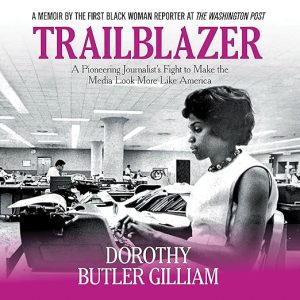
Dorothy Butler Gilliam was the first Black woman to work as a reporter at the Washington Post, arriving at the paper in 1961 in a Washington, D.C. that was still visibly segregated and in a newsroom that had no framework for her presence. Her audiobook memoir Trailblazer, narrated by January LaVoy, covers the fifty years of journalism that followed: a career spent fighting for access that should have already existed, mentoring generations of journalists of color who came up behind her, and watching the slow and incomplete transformation of American media toward something closer to representative coverage.
The book arrives in that space between personal memoir and institutional history, and Gilliam is accomplished enough in both registers to handle the weight of the combination. She spent five decades as a working journalist and then as a journalism educator and advocate. She knows how to build a scene. She knows how to identify the moment that changes everything. And she writes about her own life with the same kind of searing, unsentimental clarity that she brought to her Washington Post columns over the decades of her career.
The memoir's structure moves through Gilliam's early life in the segregated South, through her extraordinary trajectory into one of the country's most prominent newspapers, and outward into the broader history of Black press, civil rights media coverage, and the long fight for diversity in mainstream journalism. One reviewer described it as a comprehensive view of how media, especially newspapers, affected the movement for equal rights in this country. That description is accurate. Gilliam does not limit herself to her personal story. She situates it within the larger arc of American media history, from the era of transformative Negro newspapers like the Chicago Defender through the civil rights movement and into the incomplete diversity gains of the present day.
The death of her father and other formative experiences from her childhood in the segregated South are rendered with restraint and power. Gilliam does not dramatize the injury of those years. She allows the facts to carry their own weight, and the reader arrives at the civil rights era with an earned understanding of what was at stake personally as well as politically. The book's most striking passages are the ones where the historical and the personal are indistinguishable, where what happened to the country and what happened to one specific woman working at a specific newspaper become the same story.
LaVoy Locates the Emotion Already There
January LaVoy's narration is precisely calibrated for memoir of this kind. LaVoy has extensive experience with literary and historical audiobooks, and her reading of Gilliam's prose reflects that depth. She does not impose emotion on the material. She locates the emotion that is already present in Gilliam's writing and delivers it at the temperature the prose calls for. The passages about the segregated South are read with a quietness that amplifies rather than diminishes their impact. The sections describing Gilliam's professional triumphs and the systemic resistance she faced alongside them are delivered with the measured pride of a woman who earned every advancement.
At nearly 9 hours, the audiobook is substantial enough to develop real intimacy with Gilliam's voice and her world. The journalism milieu that she describes, the culture of the Washington Post, the competitive pressures of the civil rights era press landscape, the dynamics between the Black press and the mainstream newspapers, is rendered with the specificity of an insider account. Reviewers have described the book as something that should be mandatory reading in schools, a response to the density of historical material it contains and the accessibility with which Gilliam delivers it.
Two Timelines the Listener Must Track
The book's emphasis is on media history and professional experience rather than personal life in the conventional memoir sense. Readers expecting a more intimate domestic narrative alongside the professional history may find the balance skews toward journalism and institutional change. That is a choice Gilliam makes deliberately. Her career was her primary subject, and she frames personal events in terms of how they shaped her professional decisions and capacity. The death of family members, the negotiations of marriage and motherhood in a demanding profession, the friendships formed across the civil rights movement, all appear but always in service of the larger professional and historical narrative.
The book's structure is broadly chronological but weaves between personal history and media history in ways that occasionally require the listener to track two timelines simultaneously. LaVoy's narration handles these transitions smoothly, but it is worth noting that the book rewards sustained attention more than casual listening. The historical references are specific and numerous, and the depth of the experience requires the listener to stay engaged.
She Was in the Rooms, She Knew
Listeners with interest in civil rights history, journalism history, or the specific institutional history of the Washington Post will find this audiobook extremely substantive. Gilliam's access to the history she describes is unmatched. She was in the rooms. She knew the people. She worked the stories. For readers interested in how major American institutions change, or fail to change, in response to social pressure and moral argument, the Washington Post's evolution across the decades of Gilliam's tenure is a precise and revealing case study.
Memoir readers who prioritize intimate personal narrative over historical and institutional analysis may find the book's orientation more outward-facing than they prefer. And listeners without significant context about the civil rights era press landscape, the role of papers like the Chicago Defender, and the specific culture of the Washington Post will benefit from some background knowledge to fully appreciate the significance of what Gilliam describes. For those who come to it with that context, this is a primary source memoir of unusual weight and clarity.
Quick Take
- Narration: January LaVoy brings Gilliam's story the vocal authority and emotional clarity it deserves, navigating decades of civil rights history and personal memoir with consistent intelligence.
- Themes: Racial integration in media, the personal cost of being first, journalism as social justice
- Mood: Reflective and historically rich, with a current-events urgency that the decades of context earns fully
- Verdict: Gilliam's account of integrating the Washington Post and shaping modern media diversity is a document of institutional history told with the intimacy only a primary witness can provide.
Common Questions
Does the Trailblazer audiobook focus primarily on Dorothy Butler Gilliam's personal story or on the broader history of Black journalism?
It does both with genuine integration. Gilliam's personal career serves as the through line, but she situates every stage of it within the larger history of civil rights media coverage, the Black press, and the fight for diversity in mainstream journalism. Reviewers describe it as a comprehensive view of how media affected the civil rights movement, not a narrowly personal memoir.
Is the Trailblazer audiobook accessible to listeners without deep background knowledge of Washington Post history or civil rights-era journalism?
The audiobook benefits from some familiarity with the civil rights era and the press landscape of that period. Gilliam writes for an informed audience rather than explaining the context of every reference. Listeners who come to it with basic knowledge of the civil rights movement will follow comfortably; those with specific interest in journalism history or Washington Post culture will get additional layers of meaning from the institutional detail.
At nearly 9 hours, does Trailblazer sustain its narrative momentum, or does the historical material become dense in places?
The book is substantive and historically rich throughout, which means it rewards sustained engagement more than casual listening. LaVoy's narration handles the transitions between personal history and media history smoothly, but this is not a light audiobook. Listeners who give it their full attention, rather than treating it as background, will find the narrative momentum consistent. Several reviewers called it difficult to stop.