The Short Version
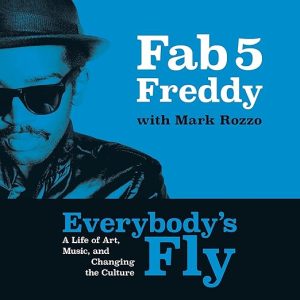
- Read by: Fab 5 Freddy self-narrates with the authority of someone who was present at every scene, plus exclusive audio conversations with Grandmaster Flash, Q-Tip, Debbie Harry, and others.
- At its heart: Hip-hop's crossover moment, artistic boundary-crossing, Black creative genius in New York
- Vibe: Electrifying and panoramic, with the rhythm of someone who has always known how to hold a room
- Short version: An essential primary source on New York's creative explosion from the late 1970s through the early 1990s, told by the person at the center of every scene.
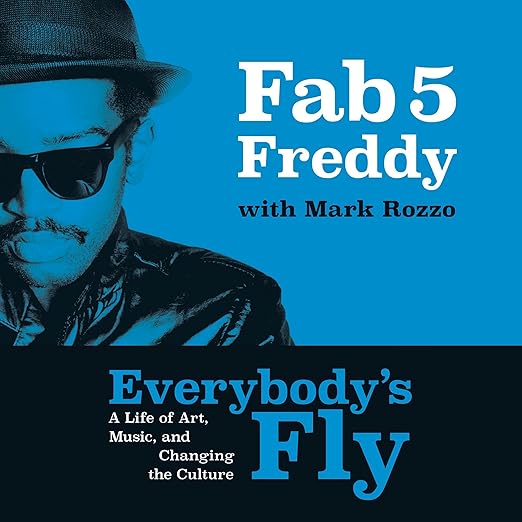
Blondie's 'Rapture' opens with eight words that changed the direction of American pop music: 'Fab 5 Freddy told me everybody's fly.' That opening rhyme, in the first number-one hit to feature hip-hop, was the moment the culture moved from the streets of New York to somewhere else entirely. The audiobook version of Everybody's Fly gives you seventeen hours of the man who was not just referenced in that moment but was actively constructing the world that made the moment possible, narrating it himself, in his own voice, with the pacing and cadence of someone who has spent fifty years knowing exactly how to make you lean in.
Self-narration is the only possible choice for this audiobook. Fab 5 Freddy, born Fred Brathwaite, is not describing a world he observed from the sidelines. He painted subway cars that became moving masterpieces. He was the bridge between Jean-Michel Basquiat and the downtown new wave scene. He brought hip-hop to the clubs of the East Village for the first time. He made the first hip-hop film. He was the original host of Yo! MTV Raps, the show that took rap global. A professional narrator would be translating. Freddy is transmitting.
Exclusive Conversations Turn Memoir Into Oral History
The exclusive audio conversations included in this production, with Grandmaster Flash, Michael Holman, Debbie Harry and Chris Stein of Blondie, Charlie Ahearn, Lee Quiñones, Q-Tip of A Tribe Called Quest, and Futura, transform the audiobook from memoir into something closer to oral history. These are not promotional additions. They are primary documents: the people who made the culture, talking about making the culture, with the person who connected them all. Rolling Stone compared the book to work by Richard Price, Lucy Sante, Tom Wolfe, and Ed McBain, writers who understood New York as a subject requiring both precision and flair, and the description is accurate. Freddy has both.
The seventeen-hour runtime gives the memoir room to be genuinely comprehensive. This is not a greatest-hits summary but a full account: childhood in a book-and-jazz-filled Brooklyn home, the formation of a specific aesthetic sensibility before any of the scenes he would help create existed, the early subway painting years, the downtown crossover moment, the MTV chapter, and the longer arc of what it means to have shaped culture across multiple decades and to be standing at the far end of that arc with your perspective intact.
Knowing Basquiat Before the Art World Did
The book-and-jazz household that produced Freddy is crucial context that the memoir provides and that the headline version of his story usually omits. He was not an outsider who stormed the art world from the streets. He was someone with deep cultural formation who understood the art world's internal logic well enough to move through it on his own terms, bringing the Bronx with him into the East Village and the East Village into spaces that had never encountered hip-hop. The synthesis he practiced, from highbrow to street, from the Bronx to the East Village, from punk to rap, from Warhol to Wild Style, required fluency in all of it, and the memoir traces how that fluency was built.
The Basquiat sections are among the most valuable in the audiobook. Freddy knew Basquiat before the art world did, and his account of that friendship, the specific quality of Basquiat's genius, the circuit boards and subway stations and cultural saturation that fed his painting, comes from proximity that no subsequent biographer can replicate. Similarly, the account of the making of Wild Style, the first hip-hop film, is a primary source document on a cultural artifact that most accounts describe from the outside.
Freddy's Voice Carries Hip-Hop's Rhythm for Seventeen Hours
The audio conversations with Grandmaster Flash and Q-Tip are worth particular attention. These are not interviews conducted for the audiobook in a studio. They have the quality of extended conversations between people who share decades of history, and the exchanges go places that a formal interview format would not reach. Flash's account of the Bronx in the early days of hip-hop, filtered through his relationship with Freddy, adds a perspective that the memoir's first-person account alone cannot provide.
Freddy's voice carries the rhythm of hip-hop even when he is not discussing music: the phrasing, the timing, the way he builds toward a point and lands it. At seventeen hours, this is a long audiobook, but the self-narration means the energy does not diminish across the runtime in the way that a celebrity memoir read by a hired actor sometimes does. The voice and the material are the same thing, which is the condition that makes self-narration worth its occasional unevenness. In this case, the unevenness is minimal and the authenticity is irreplaceable.
Freddy Built the Room Himself
This audiobook is required listening for anyone serious about understanding New York's creative explosions from the mid-1970s through the early 1990s. The convergence of hip-hop, graffiti, punk, new wave, and contemporary art in a single city during a specific historical moment produced a cultural formation that continues to shape everything that followed, and Freddy was at the center of all of it. Music historians, art historians, urban cultural historians: all of them need this primary source.
Beyond the specialist audiences, this is a memoir that works for any listener drawn to stories of creative genius operating without permission in spaces that had not yet been created. Freddy did not wait for the culture to invite him in. He built the room. For listeners who care about that particular kind of ambition and want seventeen hours of someone who lived it explaining exactly how it worked, Everybody's Fly delivers.
Before You Listen
Does Fab 5 Freddy self-narrating the Everybody's Fly audiobook add value beyond what a professional narrator would provide?
Significantly. Freddy was present at every event the memoir describes, and his voice carries the rhythm and cadence of the culture he is documenting. The audio-exclusive conversations with Grandmaster Flash, Q-Tip, Debbie Harry, and others are only possible because he recorded them himself. A professional narrator would be performing; Freddy is remembering.
At 17 hours, is the Everybody's Fly audiobook too long for its subject, or does it use the runtime well?
Rolling Stone noted the book chronicles New York from the mid-1970s to the early 1990s with vivid, journalistic descriptions, which is a lot of ground to cover with specificity. The self-narration keeps the energy consistent throughout, and the exclusive audio conversations add dimension rather than padding. Listeners report the runtime feeling appropriate to the scope of what Freddy actually lived.