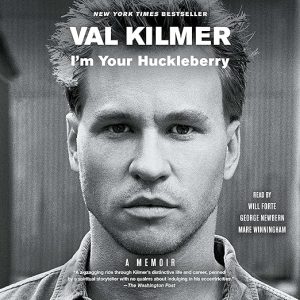
Before I listened to I'm Your Huckleberry, I would not have placed Val Kilmer among actors whose memoirs I expected to find genuinely moving. I knew the films, Tombstone, Heat, The Doors, Top Gun, and I knew the reputation, which was for volatility and difficulty and a certain legendary stubbornness. What I did not know, and what this book reveals over 7 hours and 10 minutes, is that Kilmer is a considerably more interior and literarily minded person than his public image suggested. The surprise of the book is part of its pleasure.
Will Forte narrates for Simon and Schuster Audio. It's a New York Times bestseller, and the reception has been, by celebrity memoir standards, unusually warm.
The Review
The memoir is non-linear, which Kilmer presents as a deliberate formal choice, his life doesn't proceed chronologically in his memory, and he's not going to pretend otherwise. Some readers find this disorienting; most reviewers describe adjusting to the structure and finding it rewarding. The result is something closer to an essay collection or a poet's notebook than a traditional career retrospective. Kilmer moves between the set of Tombstone and his one-man Mark Twain show, between childhood memories and the Indian Ocean island where he was cared for by a local tribe during a bout of delirium, between the Juilliard years and the throat cancer diagnosis he kept private for years.
The book's most commented-on quality, among readers who came to it without strong prior investment in Kilmer, is the writing itself. Kilmer is not a celebrity who dictated a memoir to a ghostwriter. The prose has a genuine literary awareness, references to poets he loves, a comfort with digression that reflects actual intellectual curiosity rather than anecdote-stringing. One reviewer describes arriving skeptical of celebrity autobiographies and finding this among the best they'd read in years.
The Best Parts of I'm Your Huckleberry
Will Forte is best known as a comedian, which might seem like a counterintuitive casting choice for a memoir that gets genuinely grave in its later sections. But it works. Forte has the range to handle Kilmer's wry humor, the stories about Marlon Brando on the set of The Island of Dr. Moreau require someone who can convey absurdity without slapstick, and the restraint to allow the throat cancer sections their proper weight. He narrates as an interpreter rather than a performer, which is what the material requires.
That said: listeners who've watched the documentary Val, in which Kilmer narrates his own life using recordings made over decades and his post-cancer voice, will understand what's missing here. Kilmer's actual voice, with all the cost of what happened to it, is an instrument no stand-in can replace. The audiobook is the next best thing, and Forte is a good-faith effort, but the documentary is worth seeing for context on what the autobiography is reaching toward.
The Caveats
The non-linear structure is the primary navigational challenge. If you prefer autobiography that moves from childhood to present in orderly sequence, this book will feel like a conversation that keeps changing subjects. That's by design, Kilmer is writing the way he thinks, but it requires a certain kind of attention that linear narrative doesn't. The payoff is that the book builds a composite picture of a person rather than a timeline of events, which is ultimately more revealing.
The Christian Science sections require patience from readers who are not drawn to faith-based frameworks. Kilmer's belief in Christian Science is not incidental to the memoir, it shaped his response to his cancer diagnosis in ways that were controversial, and he discusses this candidly without either defending his choices as obviously right or retreating from them. It's one of the book's more interesting passages, precisely because he doesn't resolve the tension for the reader.
The Right Listener for I'm Your Huckleberry
Film history enthusiasts with any fondness for Kilmer's work, Tombstone especially, but also The Doors, Heat, and Top Gun, will find the behind-the-scenes material genuinely fascinating. Readers who like celebrity memoirs that go beyond surface anecdote and engage seriously with questions of identity and mortality will find this one of the more thoughtful examples of the genre. Anyone who has followed Kilmer's later career or seen his documentary will want to hear the memoir's version of events. Listeners who prefer conventional linear biography may find the structure frustrating, stick with it past the first hour and the rhythm becomes clear.
The Short Version
- Read by: Will Forte is a capable stand-in, warm and well-paced, but many listeners who've also seen the documentary 'Val' will feel the absence of Kilmer's own voice, which carries a weight no proxy can fully replicate.
- At its heart: Hollywood mythology and the actor's life, Christian Science faith, mortality and illness, the performance of identity
- Vibe: Candid and emotionally generous, funny in unexpected places, grave in others
- Short version: One of the more genuinely surprising celebrity memoirs in recent years, Kilmer writes with literary awareness and disarming vulnerability about a life larger and stranger than his on-screen work suggested.
Before You Listen
Why doesn't Val Kilmer narrate his own memoir, and does Will Forte's performance compensate?
Kilmer's throat cancer treatment significantly affected his voice, making traditional audiobook narration impossible at the time of production. Will Forte is a thoughtful choice, warm, intelligent, capable of the range the material requires. But listeners who've seen the documentary 'Val,' which used Kilmer's own recordings, will feel the absence. Forte compensates as well as any stand-in could; the gap is simply inherent to the situation.
How does I'm Your Huckleberry handle Kilmer's throat cancer diagnosis and treatment?
With unusual candor and without sentimentality. Kilmer discusses the diagnosis, his decision to manage it initially through Christian Science rather than conventional medicine, and the long treatment and recovery process. He doesn't present his choices as obviously right or wrong, he describes them as his, shaped by a lifetime of belief that he examines without abandoning. The sections are among the book's most affecting.