
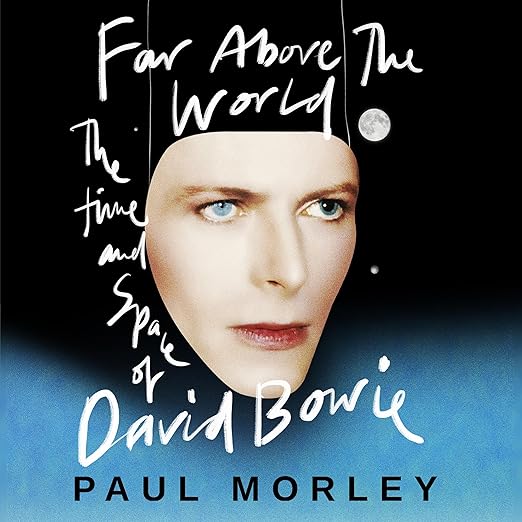
Bono is quoted on this listing calling the book a zoetrope of the life of David Robert Jones, which is a very Bono sentence and also, as it happens, accurate. A zoetrope makes still images move by spinning them past a slit. Paul Morley's collection of Bowie writing, gathered for the tenth anniversary of the death, works on the same principle: fragments in sequence until something animates. The audiobook runs thirteen hours and thirteen minutes, read by Morley, published by Headline in November 2025.
Keen-Bean Enthusiast and Cunning Strategist
Five endorsements occupy the top of this description before a line of publisher copy appears: Dave Roberts of God is in the TV zine, The Voice, Bono, Johnny Marr and Neil Tennant. A wall of musicians and music press vouching for a book about a musician, and Tennant's contribution is the one worth reading twice. It describes Morley's Bowie as the keen-bean enthusiast and cunning strategist, the original and the imitator, the star and the bloke, the pale intellectual and the sexy rock-and-roller, then credits the book with holding all of them in a single frame.
Below the blurbs, the page goes quiet. Three ratings, no written responses whatsoever, and a displayed average of 4.2 that three whole-star votes cannot produce: three votes reach 4.0 or 4.3, with nothing available in between. Whatever that figure is measuring, it is not the arithmetic of three people. For a book that arrived in November 2025 with endorsements from Bono and Johnny Marr attached, an empty response pool nine months later is itself worth noticing.
Criticism Read by the Critic Who Wrote It
Criticism read by its own critic is a different object from criticism read by an actor. Johnny Marr's endorsement calls Morley's Bowie writing magical and inspired, and Neil Tennant calls the study intriguingly philosophical, which between them describe a book that argues rather than narrates. An argument delivered by the person who assembled it takes the guesswork out of where the emphasis is meant to land. Thirteen hours in one writer's company is the real decision to weigh here.
Bowie lived in the future is the copy's central claim, and the method follows from it: the pop song treated as a document of overwhelming and dangerous times, a channel held open between the postwar twentieth century and wherever we happen to be now. Morley is not writing biography. The description says as much, positioning the book as a study of a cultural force rather than a life, which is why the phrase Dave Roberts uses, the man and not just the myth, does real work instead of sitting there as reviewer boilerplate.
Anniversary books usually recycle. This one is positioned squarely against that, arguing that the songs and the messages and the warnings inside them become more relevant as time passes, and placing Bowie in the now and next as much as in the past. Whether the argument holds is for a listener who cares about the question. What the framing makes clear is that a real argument exists, which separates this from the photograph-led anniversary titles that follow every major rock death.
The Title Even Capitalizes Its Own Words Differently
Ten years since the death of David Bowie in 2016 is how the copy opens, and the recording was published in November 2025, which places the anniversary framing ahead of the calendar it invokes. A small thing, and a real one if you are buying this as a commemorative object with a date attached to it. The book was plainly timed to the ten-year mark and shipped just before reaching it, which is publishing practice rather than an error anyone made.
Bono's line is the closest thing on the page to a report on the experience: enjoyment of the intimacy of the read. That was written about the printed book and it carries over, since intimacy is precisely what a self-recorded critic can offer and a hired reader cannot. Title drift is the other wrinkle. The listing reads Far Above The World with a capital T, while the copy underneath writes Far Above the World twice in lowercase, which matters only when you are searching for it.
Collections repeat themselves, and this is described as exactly that, a body of writing assembled across a decade. Dave Roberts calls it a wondrous collection; the publisher calls it a landmark exploration. Both phrases describe a book with no narrative spine, which over a run this long means themes will return, phrases will recur, and the reinventions will be approached from several angles rather than once each. Listeners who need forward motion should know that before starting.
For People Who've Already Decided Bowie Matters
Anyone whose relationship with Bowie survived the death and kept going is the target, and the copy says so outright: the grief that followed 2016 has become an enduring attachment to the music, the style, the wit and the outsider spirit. That listener already owns the albums and needs no discography. What they want is somebody thinking hard about why the songs still function, which is the service on offer.
Music criticism readers get the rarer thing, a book-length argument in a form that mostly survives as reviews and obituaries. The Voice's endorsement states the pitch plainly: the influence did not end in 2016 and continues to illuminate the present. That is a thesis rather than a tribute, and a listener who wants a thesis tested at length is the person this was made for. Casual curiosity will not carry you through it.
Set it aside if you want a life story, because this is not biography, the copy never claims it is, and anyone expecting dates and studios will spend the whole run waiting. Set it aside as well if the average above the description is your usual guide, since three ratings cannot produce the number displayed and no written verdicts exist to check it against. Morley built this for people who have already decided Bowie is worth arguing about, and the recording delivers the argument in the author's own voice.
In Brief
- Performance: Paul Morley reads the collection personally for Headline, so the critical voice and the recorded one belong to the same person rather than to a hired reader.
- What it covers: Bowie as a continuing cultural force, reinvention as working method, the pop song as a document of its times
- Feel: Associative and unhurried, closer to an argument than to a life story
- Our call: Built for listeners who already own the albums and want somebody to think hard about why they still work.







