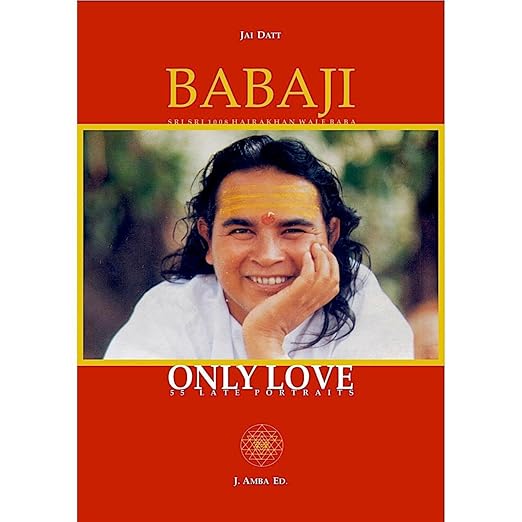
Can a book of photographs work as an audiobook? That is the honest question this listing raises before any other, because Babaji Only Love is built around fifty-five late portraits of Hairakhan Babaji Mahavatar, revisited by Jai Datt Gianbarberis and paired with poems. The images are the substance of the object. The audio edition runs one hour and twenty-one minutes and is credited to Virtual Voice rather than to a named narrator, which means what you are buying here is the verse and the framing prose.
The Word 'Rivisited' Signals a Translated Text
Poems sit beside each portrait in the printed collection, and the description frames them as the point of contact: the pictures open a door and the verse carries the devotion through it. Read that way, an audio edition is less absurd than it first sounds. Fifty-five poems is a genuine body of work, and the recording is short enough to speak them without hurry, which is the right pace for writing built on repetition.
Nobody has left a written response on this listing. Three ratings exist and no text accompanies any of them, so every judgment available about this edition is a bare number. That is unusual even for a small devotional press, and it leaves the star average as the only signal on the page. Given how much of the value lives in images the recording cannot deliver, a silent pool is a real gap rather than a formality.
It comes from J. Amba Edizioni, and the description carries traces of a non-English original. The copy describes the portraits as "rivisited" by Gianbarberis, an Italian inflection that survived intact into the English text. Small signs like that usually mark a translated listing rather than a careless one, and the register stays devotional the whole way through, closer to liturgy than to writing about photography.
Only Love Is the Entire Teaching, Literally
Devotional listening runs on its own logic, and this title understands that logic well. Babaji is presented as the Mahavatar who came to the village of Hairakhan in the Himalayas teaching Truth, Simplicity and Love, and the poems return to those three words the way a chant returns to a refrain. Repetition is the form rather than a flaw in it. Spoken aloud, the effect sits closer to a recorded prayer than to a book you finish.
Verse of this kind asks for a particular tolerance. The description promises a sacred pilgrimage into the Temple of His countenance, and language pitched at that height either moves you or does not, with very little available in between. What I found is sincerity rather than salesmanship, which is not a small thing: the same sentences from a large publisher would read as marketing, and from an imprint publishing inside this tradition they read as belief.
Babaji's message reduces to two words in the title, and the book means them literally. Only Love is offered as the entire teaching rather than as a summary of some longer system, and the collection is arranged to demonstrate instead of to argue. If you arrive expecting doctrine, that will feel thin. If you arrive looking for something to sit with in the early morning, the brevity is the feature and not the compromise.
No Combination of Three Votes Makes 3.5
Arithmetic on the rating field does not resolve. Three whole-star votes can average 3.33 or 3.67, which display as 3.3 and 3.7; the listing shows 3.5, and no combination of three whole votes between one and five lands there. Either the count is wrong or the average traveled in from another edition of the same title. On a page carrying no written responses at all, nothing verifiable stands behind that number.
Series fields tell a similar story. The collection is filed under Babaji Mahavatar with the volume number left blank, so a buyer cannot tell whether this is the first of several photographic books or a standalone. The byline compounds it: the listing credits Jai Datt, while the description credits Jai Datt Gianbarberis and then Gianbarberis alone. One person, recorded at three different lengths, and only the shortest is searchable.
Whether any of this matters depends entirely on why you came. A devotee looking for eighty-one minutes of poems about Babaji will not be troubled by a missing volume number. Somebody who bought because of the Photography tag will be, because the fifty-five portraits named in the book's own subtitle, which this listing title drops, are precisely the part audio cannot carry across.
A Virtual Voice Where Breath and Pause Matter
Devotees of Babaji and of the Hairakhan tradition are the clear audience, and for them the recording works as intended: a short, unhurried sequence of poems about a figure they already hold in view. It also suits listeners who use devotional audio as a morning or evening practice, where a brief recording fits into a routine far more easily than a full-length spiritual book manages to.
Leave it alone if you came for the photographs. The Photography tag on this listing is accurate about the source and misleading about the product, and no quantity of good verse compensates for pictures you cannot see. Leave it alone too if you need a human reader, because the narration credit here is Virtual Voice rather than a person, and devotional poetry is a form where breath and pause do most of the work.
Without a single written response to weigh, I can only describe the object honestly: fifty-five poems from a small devotional press, spoken aloud in a brief recording, attached to a book whose pictures live somewhere else entirely. If Babaji already means something to you, that is likely enough. If you are curious from the outside, the printed collection is where the fifty-five faces actually live.
A Few Questions About Babaji Only Love
Does the Babaji Only Love audiobook include the 55 portraits?
No companion PDF is offered on the listing, so the fifty-five portraits the book is built around remain with the printed collection. What the recording carries is the poems and the framing prose around them. If the photographs are your reason for buying, this is the wrong format to choose.
How long is the Babaji Only Love audiobook, and does it suit daily listening?
One hour and twenty-one minutes, short enough for a single sitting or for a week of mornings taken a few poems at a time. Each piece stands alone, so stopping anywhere costs nothing, and the repetitive devotional register rewards return visits more than it rewards finishing.