In Brief
- Read by: Lisa Wright reads the talking half of a two-part product, since the photographs and recipes the copy advertises sit in a separate companion download.
- At its heart: Seasonal decorating with less stuff, hospitality without performance, the five senses, household rhythm.
- Vibe: Warm, practical, permission-giving.
- Short version: Four hours of genuinely useful hosting argument, on a listing whose rating counter contradicts its own review pool.
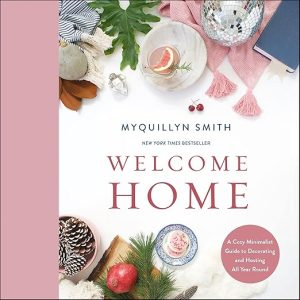
Photographs sell this book, and on the audiobook they live somewhere else entirely. The description promises engaging how-tos and inspiring photos, then adds a line at the very bottom: images, recipes and hosting tips are available in the companion PDF download. What you press play on is four hours of a two-part product, and the half that answers what does this actually look like is a file you have to go and open on something with a screen.
Subtraction, Not Addition, Is the Whole Method
Seasonal decorating is the subject and the pitch is a refusal. Myquillyn Smith, who writes as The Nester, argues that marking the turn of a season at home needs neither bins of factory-made decor nor much time or money, and that most of what makes a house feel seasonal is subtraction rather than addition. The promise attached is a home that stays ready for guests without ever having been staged for them, which is a more interesting claim than it first sounds.
Five Responses Somehow Sit Under Two Ratings
Five written responses appear under a counter reading two ratings. Those numbers cannot both be describing the same pool, and the average makes it stranger still: 4.8 is unreachable from two whole-star votes, which can only produce 4.5 or 5.0. Every one of the five visible grades is a five. Whatever the display is computing, it matches neither the grades you can read nor any possible pair of whole-star votes.
Whatever the counter is doing, the responses themselves are consistent and specific, which is more useful than the number. All five are enthusiastic and they agree on the source of the enthusiasm: less stuff, the rhythm of the year, and permission to have people over without mounting a production. The most recent, filed in February 2026, runs to three words. The rest are long enough to argue with, and on a listing carrying almost no rating data, that is what you have.
Four Hours Because Restraint Is the Point
Restraint is the thesis and the reason the book is short. Four hours and seven minutes is about right for an argument that reduces to a handful of moves repeated through the year: notice what is happening outside, bring a little of it in, take more out than you put in, and stop. Padding that to ten hours would have contradicted the case being made. Design books rarely show this much discipline about their own length.
Hosting Compared to Taking a Dreaded Shower
Hospitality is where Smith is sharpest, and it survives audio best because it is all argument and no picture. Hosting is like taking a shower, dreaded because it is so much work and never regretted once it is over: that comparison is what the December 2020 entry, at five stars, found funniest in the whole book. The same buyer wants the year reflected inside the house without being buried under clutter, which is precisely the tension the book exists to resolve.
Guests are the actual point, and the structure keeps returning to them. Feeling confident enough to volunteer your house for a gathering, knowing what matters and what does not, hosting as a relaxed person rather than a performing one: none of those chapters needs to be seen. Somebody listening while cleaning a kitchen gets full value from them. The five-senses framework the copy names, which puts sound and smell beside sight, also suits a recording better than a photograph ever could.
Recipes Live in a PDF, Not Here
Images, recipes and hosting tips all sit in the companion PDF, and that sentence carries more weight than the copy gives it. Recipes are not decoration. A book that hands you seasonal food and then files it in a separate download has moved a functional chapter out of the thing you are listening to. Anyone planning to cook from this is running two files at once, and the audio half cannot tell you when you have missed something in the other.
A Book Meant to Come Off the Shelf
Pulling a book off the shelf when the season turns is how one November 2020 five-star buyer puts its own use of it, and that sentence is a problem for this format. The buyer in question ordered it on sale for the preorder bonuses, expected not to need it, then found the value in the physical retrieval: the object comes down four times a year and gets consulted. A recording is a poor substitute for something you reach for on a seasonal schedule.
Architecture is the tag this page carries, which is not what the book is. Nothing here concerns structure, plans or buildings; it concerns arrangement, restraint and having people over. Filed under arts and entertainment beside home and garden, with Architecture underneath, the record points a buyer looking for one thing at a book doing something quite different. That is a small misfiling with a real cost on a title whose audience already knows what it wants.
Written for Hosts Who Dread Hosting
Hosts who dread hosting are who this was written for, and the pool keeps confirming it. September 2020 brought five stars from somebody describing years of overdoing the decorating until it became a burden, plus genuine stress about inviting anyone in at all, and crediting the book with shifting both. If that description fits you, four hours is a small outlay against a problem that recurs on a schedule. Using what the season already supplies, rather than buying more of it, is the move doing the work.
Minimalists who have found decorating advice unbearable are the second audience. Anyone whose objection is that such books want you to reproduce a stranger's living room will find this one arguing the reverse, since the stated goal is your own style and your own household rhythm rather than a look. Listeners who cook and entertain seasonally should plan on opening the PDF rather than treating it as a bonus, because the recipes are in there and nowhere else.
Pass on This One for the Photographs
Pass on it if you want a visual reference, because that is exactly the half you are not buying, and the photographs the description advertises are why many people choose this sort of book at all. Renters and anyone working in a very small space will find the advice adaptable but not addressed to them. Anyone after specific product recommendations has picked the wrong title, since the argument is against buying things. Open the PDF first, then decide whether the four hours are worth it.