- Narration: Dan Woren delivers Brady's prose with a documentary reporter's clarity, unhurried but never sluggish, letting the characters breathe.
- Themes: Counterculture economy, legalization debates, identity and place
- Mood: Intimate, journalistic, and quietly elegiac
- Verdict: One of the most honest portraits of a community built on a forbidden crop, told with real affection and no easy answers.
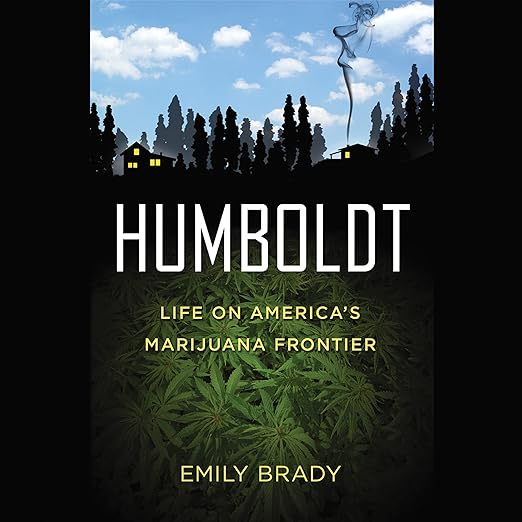
Emily Brady's Humboldt is the rare audiobook that arrives with a clear thesis and then proceeds to complicate it at every turn. Brady spent a year living inside Humboldt County, Northern California, a region whose name draws a knowing grin from strangers, and the proximity shows on every page. This is not journalism conducted from a safe distance. Dan Woren's narration captures the texture of Brady's reporting with a quality that suits the material: the voice of someone who has done the reading, visited the place, and is not interested in making things simpler than they are.
Humboldt County built itself on marijuana across nearly four decades. Not metaphorically, but literally. Fire departments, schools, the informal economy of entire towns: the plant funded it, and the people who grew it shaped a culture around its illegality in ways that made the legal status almost incidental. Brady structures her account around four individuals who know the industry from distinct vantage points, which allows her to triangulate a community that might otherwise be too diffuse to portray with specificity.
A Totally Different Universe From Nearby Regions
What Brady does brilliantly is hold the legalization question open rather than resolve it. The people of Humboldt County are genuinely divided, and the division is not simply between growers who want legitimacy and those who want profit. It runs through individual people, through families, through a culture that has organized its identity around operating outside the mainstream economy. When legalization looms over the later sections of the book, it functions not as a solution but as a new kind of threat: to prices, to community, to the particular freedom that comes with being invisible to conventional markets.
One listener who lives in the Bay Area describes Humboldt as a totally different universe from nearby regions. That phrase is not hyperbole. Brady is careful to render the physical landscape as more than backdrop: the remoteness of Northern California, the fog and timber and distances between towns, shapes the community and its capacity for insularity in ways that an abstract account of the drug economy would miss entirely. Woren's narration handles the landscape passages with the same care as the character scenes, giving the setting the weight it deserves.
Woren Keeps the Pace Organic, Never Compressed
The comparison to Susan Orlean's The Orchid Thief and Deborah Feldman's Unorthodox on the cover is earned in spirit if not perfectly in genre. Like Orlean, Brady is drawn to subcultures that most people will never enter, and she has Orlean's ability to make eccentric characters feel recognizable rather than merely exotic. The savings buried in backyards, the cash economy, the thick wads of money that appear where credit cards would elsewhere: these details accumulate into a portrait of a community that has developed its own logic in response to legal constraint.
At seven hours and twenty-nine minutes, Dan Woren keeps the material moving at a pace that feels organic rather than artificially compressed. Brady's prose is not showy, and Woren respects that plainness without flattening it. The character scenes, when Brady is sitting with one of her four subjects and listening to them explain their relationship to the crop, have an intimacy that the narration preserves well. The book rewards the listener who lets its rhythms set in rather than pressing forward.
A Book That Has Aged Into a Historical Document
Brady is an outsider in Humboldt County, and she is honest about that. The community's secretiveness is not incidental to the story: it is the condition that makes embedding oneself for a year the only viable method of reporting. Readers who attend to the texture of the relationships Brady builds with her subjects will notice how carefully she handles the trust extended to her. The result is a book that is sympathetic without being advocacy, honest about the costs of the black market economy without moralizing about the illegality.
The moment when legalization stops being abstract and becomes a practical question the community must answer is the book's most interesting passage. The people who want their heritage legitimized and those who want to preserve the inflated profits of the black market are not simply greedy versus principled. Brady shows that both positions are coherent responses to the same history, and she resists the urge to adjudicate between them. That refusal to provide an easy moral is what separates this from journalism that uses marginalized communities as material for preordained conclusions.
Listeners who want to understand what Brady calls a 'totally different universe' will also find that the book has aged interestingly since its publication. The legal marijuana market that was looming over Humboldt County when Brady was embedded has since arrived and reshaped the economics she describes. The book functions now as both reportage and historical document, capturing a specific moment of transition before it resolved into the new normal. That added temporal dimension makes the audiobook more resonant on a second listen, when you know what happened next.
A Companion to McPhee's and Orlean's Reportage
Listeners drawn to the tradition of immersive American reportage, such as John McPhee's long cultural profiles, Orlean's subculture portraits, or Jon Ronson's investigations into unusual communities, will find this audiobook a natural companion. The cannabis policy angle makes it useful for anyone following legalization debates who wants ground-level context rather than abstract argument. Brady's four characters give the book the human texture that policy discussion usually lacks.
Listeners who want advocacy or a clear moral position on marijuana legalization will need to look elsewhere. Brady is a reporter, not a campaigner. And those who need their narrative journalism to have clean resolution may find the book's open ending frustrating. Humboldt County's crossroads is not resolved. Brady documents the moment of uncertainty rather than its outcome, which is the honest choice, even if it is not always the satisfying one for listeners who prefer closure.
Good to Know
How does Dan Woren's narration handle Brady's reporting style in the audiobook?
Woren's delivery matches Brady's plain, precise prose. He does not dramatize the material beyond what it calls for, which suits the journalistic register well. The character passages feel grounded rather than theatrical, and his pacing over the seven-and-a-half-hour runtime keeps the book moving without rushing the more contemplative sections.
Is prior knowledge of Humboldt County or California marijuana culture necessary to get the most from this audiobook?
Not at all. Brady writes for readers who know nothing beyond the name's reputation, and she builds the community's history and geography from the ground up. In fact, the book may be more useful for those coming in without assumptions, as Brady spends considerable effort dismantling stereotypes about what the growers and their community actually look like.