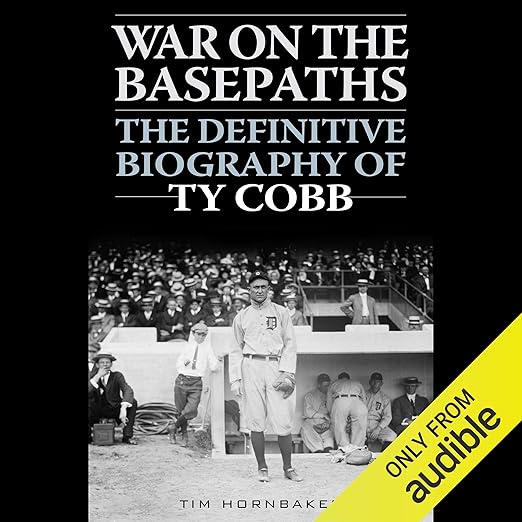
Ty Cobb has been dead since 1961 and the argument about him is still running, which is the reason this audiobook exists. Fifteen hours is a long stretch to spend relitigating a reputation, but the reputation has proved unusually durable: sharpened cleats, spiked second basemen, a man remembered as rude, nasty, racist and disliked by peers and press alike. Tim Hornbaker's project is to work out which parts of that survive contact with the record, and which parts were assembled afterward.
A 2013 Sentence Still Claims 85 Years
Hornbaker had done this once before, with Charles Comiskey in Turning the Black Sox White, and the method carries over. The claim in the description is an unbiased biography built from detailed research and analysis, which is a large promise about a subject whose story, in the copy's own words, has been altered for almost a century. In practice it means a book that spends its length on evidence and provenance rather than on delivering a verdict early and defending it.
Copy written a decade ago is still sitting on this page, and it dates itself. The description says Cobb retired from the game over 85 years ago, then notes three sentences later that he retired in 1928. Those two statements agree in 2013, which is roughly when the sentence was drafted. They do not agree in 2026, when the honest figure is ninety-eight. Small as it is, that gap is the only clue the page offers about how old this material has become.
Reputation is the actual subject here, rather than the batting averages. Cobb went into the Hall of Fame on the inaugural ballot beside Honus Wagner, Babe Ruth, Christy Mathewson and Walter Johnson, still leads career batting average, and sits second in runs, hits and triples. None of that is what people remember about him. The book's real question is how a player with that record ended up known principally for his footwear, and who profited from the version that stuck.
Figures Land Differently When You Hear Them
Statistics carry the first half of the case, and they are more startling than the anecdotes. A twenty-four-year career. A most valuable player award. A Triple Crown. Twelve batting titles. A career average nobody has passed in the ninety-eight years since he stopped playing. Delivered aloud, figures like that land differently than they do in a table, because a listener has to hold each one as it arrives instead of scanning past a column to the total.
Research is what is being sold, and the argument depends on it holding up. The description promises detailed research and positions the book against almost a century of altered accounts, a claim that either produces receipts or collapses under its own weight. Nuance is the word one reader reached for seven weeks after publication, awarding five stars and calling this the rare Cobb treatment that declines to lead with the demons, then singling out the relationship with Cobb's father as the piece other writers underplay.
Fifteen hours is a great deal of baseball, and the shape of the material makes it work better than the runtime implies. A twenty-four-year career supplies a natural spine, season by season, so the controversies arrive at intervals rather than piled into one indictment chapter. The description promises to place listeners in the box seats, which is marketing language, but the structure does back it up: you get the games as well as the arguments about the games.
A Specialist Book Argued Against Al Stump
Nobody in this pool arrives new to Ty Cobb, and that shapes every grade on the page. Three of the four written responses position this book explicitly against other Cobb books they had already read, and the fourth is a sustained argument about how Cobb has usually been handled. What you have is a small group of specialists grading a specialist book. That is useful information, and it is not the same thing as a general readership finding the case persuasive.
Al Stump hangs over the whole enterprise, and one four-star response makes that plain. Filed in December 2017, it recounts reading Cobb's own autobiography several times, then Stump's devastatingly critical biography, then writing off the film adaptation in which Tommy Lee Jones played Cobb, before arriving here alongside Charles Leerhsen's Ty Cobb, A Terrible Beauty. Its verdict is that both recent books resurrect the reputation. That is context the description never supplies: this is one entry in a live revisionist argument rather than a standalone life.
No Passive Listening Through Fifteen Hours of Numbers
Numbers are load-bearing in this book rather than decorative, which raises the stakes on the format. Career leaders, season totals, twelve batting titles, second place in three categories at once: figures like those either land cleanly in speech or wash together, and a listener cannot glance back up a column to check one. Anyone who wants to hold the statistical case in their head should expect to rewind, and should not plan on fifteen hours of passive listening.
Copying How Cobb Held His Hands on the Bat
Baseball listeners who already know the Cobb story are the primary audience, and the pool proves it. Sixty years of Cobb reading sit behind the January 2023 five-star entry, which describes receiving Cobb's own autobiography, written with Al Stump, as a Christmas present, rereading it three or four times, and even copying the way Cobb held his hands apart on the bat. That is the reader Hornbaker is arguing with, and the book is built to satisfy the argument.
Sports historians and anyone curious about how reputations get manufactured will find the second layer more absorbing than the first. How the nasty version of Cobb was assembled, and why it held for the better part of a century, is a case study in the way sports writing builds a character and then spends decades defending or prosecuting him. Hornbaker's earlier Comiskey book suggests that process, rather than baseball, is the writer's real subject.
Casual sports listeners should start somewhere shorter, because fifteen hours of contested biography assumes you care which version is correct. Anyone wanting a takedown will be disappointed, and so will anyone wanting a defense, since the stated aim is neither. Listeners who want the games rather than the argument about the games are better served by a straight season narrative. What Hornbaker offers is the record at length, plus the patience to let it complicate a story everybody assumes they already know.