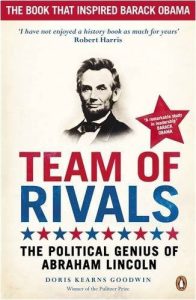
Lincoln's answer to the rival who had wanted his job was to hand that rival a cabinet post, and Doris Kearns Goodwin spends the length of a very long audiobook working out why the move was strategy rather than weakness. The Penguin edition runs forty-one hours and thirty-two minutes, read by Suzanne Toren, which puts it among the longest single-narrator biographies anyone can reasonably commit to. I went in braced for endurance. What arrived was closer to a serial, and the length turned out to be structural.
The Presidency as a Management Problem First
What Goodwin builds is not a life of Lincoln so much as a group portrait with Lincoln at the hinge. The book keeps several political careers running in parallel, and the effect is that you come to understand the presidency as a management problem before you understand it as a moral one. That is a strange and effective inversion for a subject this heavily written about, and that inversion is why the book found readers who do not otherwise buy nineteenth-century political history.
Doubted a Female Voice, Then Converted
Of the five responses visible on this listing, two discuss nothing but the book. One of those, filed in October 2023, admits to doubts about a female voice reading a Lincoln biography and then concedes the point outright, saying the narrator did a wonderful job with it. The same response credits the book with sending it off to research how the two American parties swapped positions over time, which is close to the highest compliment a work of history can collect.
That single admission is the most concrete thing on the page about the recording, and it is worth more than the star average. Suzanne Toren has to hold a book of this scale together across political correspondence, committee maneuvering and legal argument, with no second voice credited and no episodic structure to hide behind. One converted skeptic is a small sample, but it points at the reading itself rather than at the text, and that is the rarer kind of evidence.
Letters Become Dialogue, Rooms Acquire Weather
Goodwin's argument is that Lincoln's political genius was social. The description quotes The New York Times calling him a virtuosic politician and managerial genius, and that pairing is the whole thesis in miniature: the skill was not oratory alone but the ability to keep dangerous, talented, resentful people pulling in one direction. Read that way, the book turns into a leadership text almost by accident, which is more or less how it has been used ever since.
One February 2024 response says the book opened its eyes to presidential elections and cabinet selection, and calls the writing incredible and immersive. That reaction is common and, I think, correct about the craft: Goodwin writes archival material as scene rather than as citation. Letters become dialogue. Committee rooms acquire weather. It is why a documentary history of this scale never feels like homework, and why the audio edition survives a format that punishes dry prose.
Cabinet-making is the actual subject, and it is far more interesting than it sounds. Goodwin's Pulitzer came for No Ordinary Time, a book about the Roosevelts, and the same instinct runs through this one: history told through the daily friction of people forced to share a table. Barack Obama named this the book he could not live without in the White House, which reads less like a blurb than like an admission of method.
One Average, At Least Two Products
Three responses out of five on this page are about delivery, wholly or in part. Two report only that a shipped copy arrived on time and in the condition described, and a third, from December 2020, praises the research and the writing and then thanks the delivery in the same sentence. Those are reviews of a parcel. They still feed the 4.7 figure sitting at the top of an audio product.
Nine hundred seventy-six pages sit in this record's page-count field, and the listed price reads like a boxed print edition rather than a download. Both are paper artifacts that traveled onto an audio listing alongside those delivery notes, and the publisher and language fields carry stray invisible characters picked up from wherever the record was assembled. None of that changes the recording. All of it means the star average is measuring at least two different products.
Even so, the contamination is a warning about the metadata rather than about the edition. What you actually get is a Penguin audio production of a Pulitzer winner's best-known book, read start to finish by a single narrator and first issued in this form in February 2009. The record wrapped around it is messy. The product inside it is not, and the distinction is worth holding onto before the average scares you off.
Rushing It Is the One Reliable Mistake
Long-form history listeners are the core audience here, above all the ones who like biography that behaves like a novel. Anyone who reads political memoir for the maneuvering rather than the ideology will find this generous. It suits leadership readers honestly rather than cynically, too: the management lessons are real, they are simply embedded in period detail instead of extracted into bullet points at the end of each chapter.
Forty-one hours and thirty-two minutes is the number to sit with before starting. That is a month of listening for most people, and the narrative does not offer a natural exit point until quite late. Skip it if you want a brisk Lincoln primer, if dense quotation from letters tires you, or if one voice across that distance wears on you. This is not a title anybody samples successfully.
Set aside the shipping notes and the stray page count, and what remains is one of the most useful political biographies in general circulation, delivered in a form that rewards patience above everything else. I would give it a month at an hour a night and let the cabinet assemble slowly. Rushing it is the one reliable way to get this book wrong.