
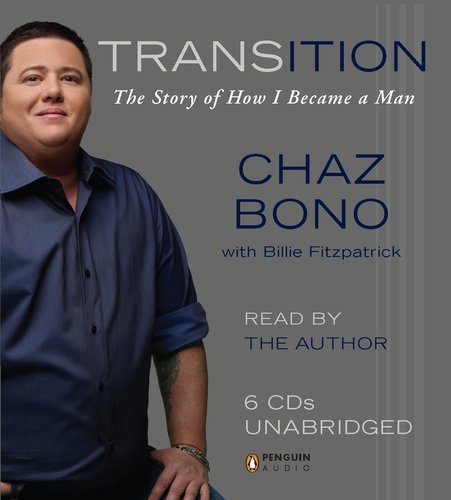
- Voice: Chaz Bono narrates his own memoir with unguarded honesty, and the lack of professional distance is exactly the point - his voice carries the weight of decades lived inside the wrong body.
- Big ideas: gender identity and transition, family legacy, addiction and recovery
- Atmosphere: Candid and emotionally raw, with moments of hard-won tenderness
- Worth it?: Chaz Bono's first-person account strips away celebrity mythology and delivers something genuinely hard and genuinely human.
Chaz Bono begins his story long before the headlines. This audiobook, narrated by Bono himself, covers a forty-year arc that most listeners will know only in fragments from tabloid coverage, and what makes the full account so different from the public version is the granularity of the interior life Bono exposes. He doesn't start with the transition. He starts with a little girl who wore boys' clothing whenever possible and played on boys' teams, and who had no language for what she already knew.
The title signals the structural promise: this is a story of crossing from one state to another, not just medically but existentially. Bono divides the book into two clear movements. The first retraces the decades of suppression, public scrutiny as the child of Sonny and Cher, the early coming out as a lesbian activist, and the long road through addiction and then five years of sobriety that finally cleared the ground for something he'd been circling his entire life. The second section, written as a real-time diary, documents the transition itself, day by day, as his body changes and his world reorganizes around a new identity he had been building toward since childhood.
The Roughness of the Real Voice
What separates Transition from a celebrity memoir in the familiar mold is its refusal to flatten the pain into inspiration. Bono is honest about drug addiction in a way that doesn't aestheticize it, honest about the grief of losing his father before he could live openly as himself, and honest about the toll that decades of hiding extract from the soul. The phrase he uses, that harboring secrets shatters the soul, isn't rhetorical. He earns it through specificity. The book catalogs not just what happened but the texture of shame and its slow dissolution.
The self-narration matters enormously here. Bono is not a trained voice actor, and he doesn't perform his story. What you hear instead is something closer to testimony, a man accounting for his own life in his own register. There are places where a professional narrator would have managed the emotional peaks more cleanly. But clean management is not the point. The roughness of the real voice, the slight hitch when certain names come up, the steadiness when he describes the transition with almost clinical precision, all of it carries meaning that a hired performance could not replicate. Memoir has always been most powerful when the teller and the tale are one, and in audio form this collapse of distance is as complete as it gets.
Photographs Are Absent, Verbal Precision Fills the Gap
The audio format transforms the documentary passages in Part Two. Bono's diary entries describing day-to-day physical changes read differently when you hear them in his own voice, at the pace he chose, with the weight he assigns to each detail. You notice which moments he lingers over and which he moves through quickly. The photographs referenced throughout the print edition are absent, but the verbal precision he applies to describe his own body fills that gap in its own way.
The arc from Chastity, the cherubic television child of the 1970s, to Chaz Bono, advocate and public figure, is a story about the gap between how we are seen and who we are. But it is also a story about courage operating on a very private frequency, the small daily decisions to keep going toward a self that the world has not yet recognized. Bono's willingness to include the failure points alongside the triumphs gives Transition a credibility that more polished memoirs often trade away in pursuit of narrative tidiness. The LGBTQ rights advocacy work he describes, including his years working with major organizations, is framed not as resume-building but as a holding pattern, a way of being useful while the larger personal work remained undone.
Granularity Increases as Identity Crystallizes
Pay attention to how Bono handles time in the early chapters. The childhood passages move quickly, almost impressionistically, because the emotional knowledge came before the language. As he approaches his thirties and then the pivotal year of 2008, the prose slows. The granularity increases. Details accrete. This is not accidental: it mirrors the way identity crystallizes from something ambient and wordless into something nameable and actionable. The structural choice is itself an argument about how self-knowledge actually develops.
Listeners who come expecting a straightforward victory narrative will find something more complicated and more interesting. The addiction chapters are uncomfortable. The passages about his mother, Cher, are measured but not without friction. Bono is careful not to assign blame and equally careful not to paper over difficulty. The result is a portrait of a famous family that feels neither like an expose nor a rehabilitation, but like an honest reckoning with complicated love under extreme public pressure.
More Honest and Durable Than Resolution
Readers drawn to first-person memoir that prioritizes emotional truth over narrative shape will find this deeply rewarding. Anyone whose life has involved a significant identity transition, whether related to gender, sexuality, sobriety, or the loss of a defining relationship, will recognize the particular texture Bono captures: the strange period when you know what you're leaving and can only dimly see what you're moving toward. Those looking for a thorough, compassionate, insider account of what gender transition actually involves, beyond the medical summary, will find Transition unusually specific and unusually honest.
Listeners interested in the broader history of LGBTQ visibility in America will find Bono's account useful as a primary document. His career at the intersection of public advocacy and private struggle spans decades of rapid social change, and the memoir captures something of what that acceleration felt like from inside a life being lived through it. Those who preferred Bono's earlier, more advocacy-focused work may find this closer and rawer than expected. Listeners who prefer memoir that resolves cleanly or avoids difficult material should be aware that this book does neither: the six hours and forty minutes do not end with a tidy settlement, but with something more honest and more durable than resolution.
Before You Listen
Does Chaz Bono narrate the audiobook himself, and does that affect the listening experience?
Yes, Bono narrates his own memoir throughout the full 6 hours and 40 minutes. The self-narration is a significant asset rather than a limitation: his voice carries an authenticity that a professional narrator couldn't replicate, particularly in the real-time diary sections of Part Two where he documents the transition day by day.
Is this audiobook appropriate for listeners who are not familiar with Bono's public story?
Entirely. Bono provides full context throughout, covering his childhood appearances on his parents' television show, his coming out as a lesbian activist, and the advocacy work he did before transitioning. No prior knowledge of his biography is needed to follow or appreciate the account.
How does the audiobook handle the more difficult subjects, including addiction?
Directly and without dramatization. Bono describes his drug addiction and the five years of sobriety that preceded his decision to transition with the same plainspoken honesty he applies to everything else. The book doesn't minimize the difficulty or frame the recovery as a simple turning point.
Does the audiobook include the photographs that appear in the print edition?
No, the photographs referenced in the book are not included in the audio version. However, Bono's verbal descriptions of the physical changes documented in Part Two are detailed enough that the absence of images does not significantly diminish the account.







