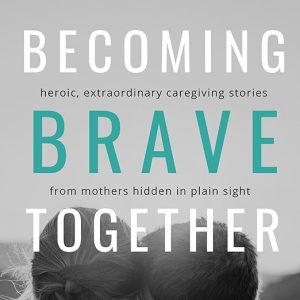
Picture a support group gathering where each woman in the room speaks in turn, carrying a weight that most people outside will never fully understand. That is the closest analog for the experience of this audiobook, which gathers the voices of caregiving mothers in a format that is deliberately communal rather than authored by a single central perspective. Becoming Brave Together, compiled by Jessica Patay, is an anthology of first-person accounts from mothers who care for children with rare degenerative diseases, autism, severe ADHD, debilitating mental illness, and other conditions that fundamentally reshape the structure of family life. The narration is shared across the contributors themselves, and that structural decision is the book's defining achievement.
Anthologies of personal narrative are genuinely difficult to execute well. The persistent risk is that individual voices flatten into a single undifferentiated testimony, that the specific becomes generic through accumulation, that the reader finishes feeling they have read one story told in many variations rather than many genuinely distinct lives. Patay has largely avoided this, and the avoidance is deliberate. Each contributor brings a different angle, a different condition, a different emotional starting point, and a different relationship to the question of how much one person can realistically be expected to give before something breaks. Some stories are about grief that has not resolved and may never fully resolve. Others locate joy in unexpected places. Several address the particular and largely invisible loneliness of being the primary caregiver for someone whose needs the public world does not easily see or acknowledge.
The multi-narrator production is the audiobook's greatest and most irreplaceable asset. Each mother narrates her own story, which gives every chapter a specificity of voice that no single professional narrator, however skilled, could replicate. The accents, the pauses, the moments where a voice catches on something real: these are not performance choices but genuine emotional facts, and they communicate something that even excellent professional narration cannot manufacture. This is testimony rather than entertainment, and the format honors that distinction throughout.
At four hours and twenty-four minutes, the audiobook is compact enough to hold together as a listening experience without exhausting its audience. Patay's editorial shaping is present but not intrusive. She knows her role here is curatorial rather than authorial, and she exercises restraint in letting the contributors speak for themselves rather than through her mediation. The result is a book that feels genuinely collective.
Print Blurs Voices, Audio Keeps Them Distinct
The case for audio over print is particularly strong for this anthology. Reading multiple first-person accounts on a page can create a visual sameness that blurs the distinctions between contributors. Hearing distinct voices, each carrying the specific texture of a different life and a different burden, sustains the differentiation that the anthology's argument depends on. The listener experiences something closer to the community that the book proposes rather than simply being told that such a community exists.
For caregiving parents who feel isolated by the specificity of their circumstances, this audiobook functions as evidence that their experience is shared at its core even where it differs in its details. Not identical: the conditions, family structures, financial situations, and coping strategies vary enormously across the accounts. But the emotional heart of the caregiving experience, the exhaustion that has no bottom, the refusal to quit, the need to be genuinely seen rather than merely admired, recurs across every account in ways that validate without collapsing into comfortable sameness.
The compact runtime is also practically important. Four hours and twenty-four minutes fits the interrupted listening schedules that caregivers necessarily live. That brevity feels considered and respectful of the audience's actual circumstances.
The Imperfection Is the Point
Pay close attention to what each narrator says, and does not say, about asking for help. The reluctance to seek support, the guilt that attaches to needing rest or time away, and the social pressure to perform competence regardless of internal reality are threads that run through almost every account. They are rarely stated directly as complaints or arguments but are present in the texture of the stories in ways that build into a cumulative picture of a particular kind of cultural invisibility.
Notice also the range of conditions represented across the anthology. Patay has assembled accounts covering a deliberately wide spectrum of care needs, from children with rare degenerative diseases that are rapidly fatal to children with conditions requiring lifelong management that allows for meaningful shared lives. That range prevents the audiobook from implying a single, unified caregiving experience, which would be both inaccurate to the reality and diminishing to the specificity of each mother's particular journey.
The production is honest about its multi-narrator structure rather than trying to smooth it into professional polish. Some contributors are more practiced speakers than others, and the rougher edges in some accounts are part of what makes the testimony feel genuine rather than curated. The imperfection is the point.
Understood Without Dramatics or Simplification
Caregiving parents, and particularly caregiving mothers, are the primary and most obvious audience, but this audiobook reaches well beyond them. Healthcare professionals who work with families of children with disabilities will find it a valuable corrective to clinical frameworks that do not and cannot fully capture lived experience. Anyone who loves someone who is a primary caregiver, and genuinely wants to understand what that life actually costs on a daily basis, should hear these accounts. Social workers, therapists working with caregiver populations, and anyone in disability advocacy will also find it illuminating and practically honest in ways that research literature rarely achieves. This audiobook asks to be understood, and it earns that ask without dramatics or simplification.
In Brief
- Narration: Fourteen contributors narrate their own stories, producing a multi-voice anthology where authentic emotional texture fully replaces professional polish.
- Themes: Caregiving, maternal resilience, disability, the cost of unconditional love, and the hunger to be seen.
- Mood: Raw, honest, and ultimately fortifying for those who stay with it.
- Verdict: An anthology that succeeds precisely because it refuses to simplify the lives it records.
Good to Know
Is this audiobook appropriate for someone currently in a caregiving role who may find the content emotionally intense?
The content is honest about struggle, grief, and exhaustion, and may be difficult for listeners in similar situations. Many caregivers report finding it validating rather than destabilizing, however. Listening in shorter segments is advisable during vulnerable periods.
Does this audiobook only represent mothers of children with physical disabilities?
No. The conditions covered include rare degenerative diseases, autism, severe ADHD, anxiety and depression, and debilitating illness in adult children. The range is deliberately broad to reflect the full spectrum of what caregiving mothers actually navigate.
How does the multi-narrator audiobook production affect the listening experience compared to a single narrator?
It strengthens the anthology significantly. Each contributor narrating her own account produces distinct voices and emotional textures that a single narrator cannot replicate. The variety sustains attention and honors the individuality of each experience.
Is this audiobook useful for healthcare professionals and social workers who work with caregiving families?
Yes, directly. Providers and social workers will find accounts that clarify what clinical frameworks often miss: the cumulative emotional weight of sustained caregiving, the specific reluctance to seek help, and the loneliness of managing conditions that are invisible to the outside world.