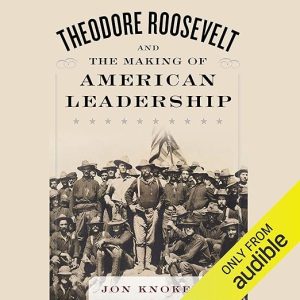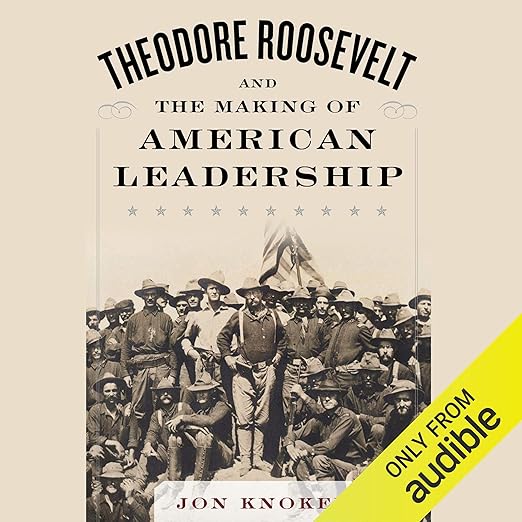
Unpublished letters and interview notes are what this biography runs on, and the audiobook gives them fifteen and a half hours of room to work in. Jon Knokey turned the material up as a graduate student: hundreds of documents left by people who knew Theodore Roosevelt and then went unquoted for a century. The book built on them argues that Roosevelt was not born to lead but assembled himself into a leader, and everything rewarding and everything frustrating here follows from that one decision.
Holsopple's One Job Is Momentum
Roosevelt reaches the White House at the very end, and that placement is the entire design. The journey to 1600 Pennsylvania Avenue is the subject; the presidency is the destination rather than the material. A buyer writing on November 15, 2015, five stars, describes the span exactly, running from Abraham Lincoln's death through the inauguration, and calls the result a fast-paced, well-spun novel. That is accurate as praise, and it doubles as a warning about what this book declines to be.
Brian Holsopple has one job above all the others on a book this long, and it is momentum. The description promises a biographical narrative written as story rather than as analysis, which tells you what the prose is reaching for. In print a reader sets that pace personally. In audio it is set for you, and across a run of this size the distance between propulsion and recitation is the distance between finishing the book and abandoning it halfway through.
Sources are what separate this from the shelf of Roosevelt biographies already in print. What Knokey found was correspondence and interview notes from Roosevelt's contemporaries rather than from Roosevelt himself, which moves the point of view outward: you get the man as the people around him described him at the time, before the legend had hardened. That is a genuinely different book from one built on a subject's own papers, and it is why the failures stay so visible.
Four Incompatible Sets of Witnesses
Failure gets more room than triumph, and the description says as much without embarrassment: terrific failures, intimate introspection, self-made luck. A biography of Theodore Roosevelt could easily run as a parade of achievements, and this one keeps stopping to examine the collapses instead. For anybody reading it as a leadership book, which is transparently the intended use, that is the correct emphasis, because the recoveries transfer to a reader's own life and the achievements cannot.
Cowboys from the Badlands, Rough Riders, New York reformers and Harvard classmates supply the testimony, and the spread of it is the book's best structural feature. Roosevelt behaved differently inside each of those worlds, and the people in them saw different men. Assembling a portrait from four incompatible sets of witnesses works better than a single omniscient account would have, and it goes some way toward explaining how a figure this theatrical could also be widely trusted.
Self-doubt is what the November 20 response carried away, describing a book about the personal challenge of living a life of purpose and about a man who needed genuine reflection and real uncertainty before finding his calling. That account credits the depth of the research into personal journals for making the doubt legible at all. It is a useful recommendation, because it names the thing this biography does that the standard ones tend not to.
A Title That Oversells Its Own Scope
Partial is the objection, and it arrives from the only sub-five response on the record. Filed in October 2020, it reports confusion and disappointment that large stretches of Roosevelt's work as Governor of New York and as President are excluded rather than merely compressed. The same account misspells the byline as Knolet and quotes the title back without its definite article, which would be trivial except that it shows how readily the scope of this book gets misread from its packaging.
Scope is the thing the title never states. Theodore Roosevelt and the Making of American Leadership reads as a full-life biography of a president, while the book itself is narrower and more interesting: an account of how a person became capable of the office, which stops as he enters it. No subtitle, no note and no chapter list on this page corrects that impression, and anybody committing to a long biography deserves to know where it ends.
A decade separates the earliest written response from the newest, which is unusual enough to read as a signal. Two arrived within weeks of the 2015 release and the rest are scattered across the decade since, with the grades holding up the whole way. Books published into a crowded subject normally stop attracting written verdicts inside a year or two. This one is still collecting them, which says something the star average does not.
A Business-Shelf Argument in a Historian's Coat
Leadership readers are the intended audience, and the description makes no secret of the frame: a business-shelf argument wearing a historian's coat. A buyer writing in November 2016, also five stars, supplies the version that sells it, tracing the arc from a sickly child in a wealthy New York family through voracious reading, a deliberate rebuilding of his own body, and Harvard, all the way to the White House. Anybody who likes that shape of story is well served.
Completists should look elsewhere, because the presidency is not the subject and no quantity of goodwill will make it appear. Readers who want historiography rather than narrative will find the argument light on counter-evidence. And anybody allergic to leadership lessons drawn from the past should know the framing is applied firmly from the opening chapter onward. Ambition before the office is what this book is really about, and that is a better subject than the one its title implies.
- Narrator: A long single-voice narrative assembled from quoted letters and interview notes rather than from scenes; Brian Holsopple is credited
- Subjects: leadership assembled rather than inherited, failure and recovery, archival discovery, ambition before power
- Tone: Energetic, admiring and argument-driven
- Bottom line: A sharp, well-sourced account of how Roosevelt became presidential, which stops at precisely the point most listeners expect it to start.
Does the audiobook assume knowledge of American political history?
Some, though less than you might fear. Party machinery and the New York reform politics of the period arrive with enough explanation to follow, and the narrative carries you past whatever you do not recognize. A listener who knows only the Rough Riders and the name will manage the whole run.
Is this audiobook's length justified for a partial biography?
It depends entirely on what you want from it. The length goes into archival testimony rather than into events, so the payoff is texture rather than coverage. A listener after the facts of the life will find shorter books that supply more of them; a listener who wants to watch a character being formed will not.