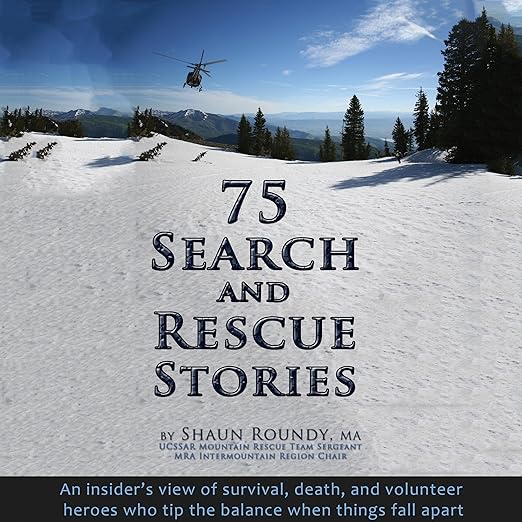
Seventy-five stories about search and rescue is a bold structural bet, and Shaun Roundy's audiobook wins it. Covering real rescues conducted by one of Utah's busiest volunteer SAR teams over a 12-year period, this is the kind of listening experience that recalibrates your sense of what other people quietly do without recognition or compensation. Roundy is a university writing instructor as well as a search and rescue veteran, and that combination produces something that the genre rarely achieves: accounts that are tightly told without being cold, and emotionally resonant without being sentimental.
The opening quote in the synopsis, a rescuer wading into a river with a limp child, already tells you what register this audiobook occupies. These are not adventure stories designed to glorify risk. They are accounts of what happens when something goes wrong in the backcountry, and who shows up to address it at personal expense and without expectation of return. That framing anchors every story that follows.
Roundy covers an unusually wide range of rescue scenarios: climbing accidents, boating incidents, motorcycling mishaps, cave rescues, avalanches. The Thanksgiving Nutty Putty Cave incident is here. The Aspen Grove Christmas avalanche is here. The Elizabeth Smart case is referenced among the stories that captured national attention. But the majority of these accounts are not famous. They are local emergencies that happened to real people on ordinary days outdoors, and that anonymity makes them more affecting rather than less. Each story illustrates how quickly a situation escalates, how quickly a group of trained volunteers can mobilize, and how the gap between life and death often comes down to the quality of communication between team members.
What Roundy does particularly well is shift perspective. Listeners hear from rescuers and from victims, sometimes within the same story, sometimes in separate accounts. That dual vantage point is what separates this collection from a standard SAR procedural. The emotional texture of being carried out of a canyon by strangers is not the same as the texture of making the decisions that lead to someone else's survival, and Roundy renders both with specificity. One reviewer noted that the book provides a clear sense of what SAR teams actually do and what mistakes to avoid in the field, and that practical dimension is consistent throughout the collection.
Eight and a Half Hours of Recalled Experience
Roundy self-narrates, and over 8.5 hours of audio that choice pays off consistently. His voice carries the weight of having actually been in these situations. When he describes pulling someone from a river or coordinating on a ridge in a storm, the narration is not reconstructed drama. It is recalled experience, and listeners can hear the difference. A trained performer might have delivered a more technically polished read, but there would be a layer of distance that this material does not need. The intimacy of hearing Roundy recount these events himself is a significant part of what makes the audiobook work.
The pacing is deliberate and efficient. At 8.5 hours for 75 stories, each account gets enough space to breathe without overstaying its welcome. Roundy's background as a writing instructor is evident in how cleanly he builds each scene, introduces the central problem, and resolves it without padding. Several reviewers noted that the collection was difficult to stop listening to, which speaks to the structural momentum he maintains across a large number of individual accounts.
Handled With Care but Without Evasion
Listeners should expect genuine emotional weight. Some of these rescues do not end well, and Roundy does not soften those outcomes. The entries involving child victims are handled with care but without evasion. If you are looking for a collection of triumphant survival tales, this partially delivers that, but it does not exclude the rescues that arrived too late or the situations where even the best team work was not enough. That honesty is what gives the book its credibility, but it is worth knowing going in.
The Utah-specific geography and the local team that forms the center of these stories means some regional knowledge helps, though it is not required for engagement. One reviewer who described themselves as a Utah County native found the location recognition added an extra dimension to the reading experience. Listeners without that regional familiarity will still find the accounts accessible and absorbing. The practical safety observations embedded throughout, about the types of errors that lead to backcountry emergencies, function as genuine field knowledge rather than lecture.
The book also functions as an indirect tribute to a specific institutional culture: Utah County Search and Rescue, one of the nation's most active volunteer teams. Roundy describes their operations with enough specificity that the team itself comes alive as an ensemble character across the 75 accounts. The internal dynamics, the communication protocols, the shared language of people who work together under pressure toward a common goal, are present throughout the collection as context rather than subject. This is not a book about how SAR teams are organized. It is a book about what they do, told from inside the experience of doing it.
The Cost of Rescues on Volunteer Time
Anyone who spends time outdoors, whether hiking, climbing, boating, or in the backcountry more broadly, will find this audiobook illuminating in ways that go beyond the narrative. Roundy makes the case implicitly for respecting conditions, communicating trip plans, and understanding the cost of rescues on volunteer time and resources. Readers drawn to true-survival accounts, to the emergency services genre broadly, or to community-based service will find the material compelling from a different angle.
Those who prefer single-narrative memoir over an episodic collection may find the structure less satisfying than a conventional book-length story. The 75-story format means attachment to any individual character is brief before the next account begins. But for listeners who want breadth, variety, and the cumulative effect of understanding what rescue work actually looks like at scale, this is one of the most substantive audiobooks in the outdoor-adventure-memoir category.
Does Shaun Roundy narrate the audiobook himself, and does that work given the subject matter?
Yes, Roundy self-narrates across the full 8.5 hours. As a 12-year SAR veteran recounting missions he was personally involved in, the performance carries an authority and emotional authenticity that a hired narrator reading someone else's field notes would struggle to replicate. Reviewers consistently respond to that intimacy.
Does this audiobook require familiarity with Utah geography to appreciate the stories?
No. The Utah County setting and the specific team at the center of the collection are part of the book's context, but the rescue scenarios, the volunteer ethos, and the human drama are universally accessible. A reviewer from outside Utah described the book as both informative and compelling without any regional background.
Is the 75 Search and Rescue Stories audiobook appropriate for listeners interested in outdoor safety, or is it primarily entertainment?
Both. Roundy consistently identifies the types of errors that lead to backcountry emergencies, and several reviewers noted its practical value for understanding what to avoid while climbing, boating, or hiking. One reviewer described it as giving them a clear map of what SAR teams do and what mistakes to steer clear of.