Quick Take
- Narration: Jonathan Keeble is one of the stronger voices in British narrative history audio, authoritative, well-paced, and capable of sustaining listener attention across nearly twenty hours of dense material.
- Themes: Colonial warfare and its forgotten costs, civilian catastrophe in WWI Africa, the myth of the small war
- Mood: Sprawling and sobering, occasionally slow but consistently rewarding
- Verdict: Paice’s account of the East Africa campaign fills a genuine gap in WWI popular history, and the scale of civilian suffering it documents makes it important rather than merely interesting.
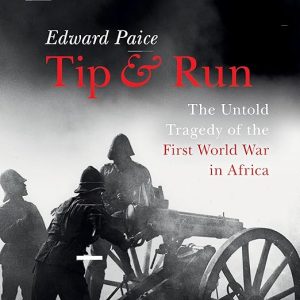
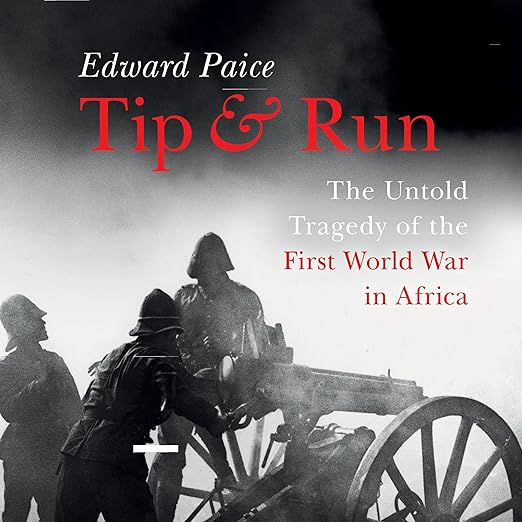
World War One occupies a peculiar place in popular historical consciousness, remembered primarily as a European catastrophe, a Western Front of mud and wire and stalemate. The East Africa campaign, which continued for two weeks after the Armistice was signed in Europe, rarely appears in that story. Edward Paice’s Tip and Run is a sustained, serious attempt to put it there.
I came to this one circuitously, through fiction. The book’s synopsis mentions the real events behind the Bogart film The African Queen and William Boyd’s Booker-shortlisted novel An Ice-Cream War, and I had recently reread Boyd’s novel. The connection was irresistible. What I found in Paice’s account was something considerably darker and more consequential than either the film or the novel had suggested.
The Myth of the Small Colonial War
In August 1914, British military planners expected a brief, contained engagement to eliminate German naval bases in East Africa. What unfolded instead was a four-year campaign across an area five times the size of Germany, involving forces from multiple continents, ending in devastation that one campaign historian described as a war of extermination and attrition without parallel in modern times. Paice’s central contribution is to insist on the scale of this catastrophe, not just for the soldiers, but for the civilian populations caught in between.
The expense to the British Empire was enormous. The human cost was greater. But the true subject of Paice’s book is the devastation of the region itself: crops destroyed to deny them to the enemy, animals slaughtered, forced labor imposed on local populations, famines and epidemics that followed the armies through the bush. This is what the myth of the small sporting colonial war conceals, and Paice is meticulous in exposing it.
Von Lettow-Vorbeck and the Logic of Not Losing
The German commander Paul von Lettow-Vorbeck is the figure who holds the military narrative together. His strategy, keeping his small Schutztruppe force mobile, living off the land, forcing the British to commit overwhelming resources to contain him, was tactically brilliant and strategically irrelevant. He never won a decisive engagement but refused to be caught, and surrendered only after the European war had ended. The British pursuit of him is in some ways the central absurdity of the campaign: enormous resources, enormous suffering, enormous displacement, in service of neutralizing a force that posed no strategic threat to the war’s outcome.
Jonathan Keeble narrates with the authority this kind of account requires. One reviewer finds the writing style dry despite acknowledging its completeness, which is a fair warning: Paice is a thorough historian, and thoroughness occasionally slows the narrative. At just under twenty hours, the runtime reflects the book’s comprehensiveness. This is not a title for listeners who want a brisk, action-forward account.
Fiction Versus History
The cultural connections Paice traces, to The African Queen, to Shout at the Devil, to the Young Indiana Jones films, are both charming and illuminating. They show how thoroughly this campaign was processed into entertainment and how thoroughly its actual costs were lost in that processing. The book is, in part, an argument that fiction has been doing the memory work that history should have done, and doing it inadequately. For WWI listeners who have read extensively on the Western Front or Gallipoli, this offers a genuinely unfamiliar angle on a war they think they know.
Who Should Listen, Who Should Skip
Listen if you have a serious interest in World War One, colonial history, or the military history of East Africa. Enthusiasts of the period who feel they know the war well will find Paice’s account substantially expands the picture in directions they will not have expected.
Skip if you want a fast-paced narrative with a clear heroic arc. Paice’s strength is comprehensiveness rather than storytelling momentum, and the nearly twenty-hour runtime assumes a listener prepared to invest in the subject.
Frequently Asked Questions
Does Tip and Run cover the story behind The African Queen, as the synopsis suggests?
Yes. Paice traces the real events and figures that inspired the Bogart film, as well as William Boyd’s An Ice-Cream War and Wilbur Smith’s Shout at the Devil. These connections are woven into the account rather than treated as a separate appendix.
Is the book more focused on military strategy or the human cost of the campaign?
Both, but Paice is particularly insistent on documenting the civilian suffering, crop destruction, forced labor, and famine, that the military narrative tends to obscure. This is his most significant contribution to the historiography of WWI in Africa.
How does Jonathan Keeble’s narration hold up over nearly 20 hours of military history?
Keeble is one of the more capable voices in British narrative history audio and manages the book’s density well. His pace and authority help sustain attention across material that can run technical. The occasional reviewer who finds the writing dry should note the narration is not the source of that quality.
Does the book require prior knowledge of World War One to follow?
Basic familiarity with the causes and main theaters of the war is helpful but not strictly required. Paice provides sufficient context for the East Africa campaign to make sense on its own terms, though readers with broader WWI knowledge will appreciate the comparative dimensions more fully.