Quick Take
- Narration: Elnathan John, himself a Nigerian novelist and satirist, brings insider credibility and genuine warmth to this text. His familiarity with names, languages, and registers gives the audio a quality a technically proficient outsider narrator simply could not replicate.
- Themes: Colonial formation, Islamic jihad and empire, the limits of self-determination
- Mood: Dense and rewarding, with moments of genuine narrative excitement as empires rise and fall
- Verdict: Formation is the clearest and most engaging entry point into Nigerian history available in audio, essential listening for anyone trying to understand how Africa’s most populous nation came to exist.
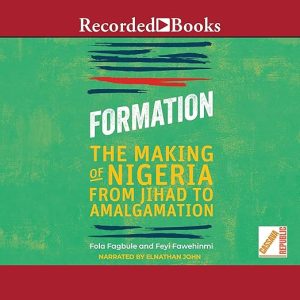
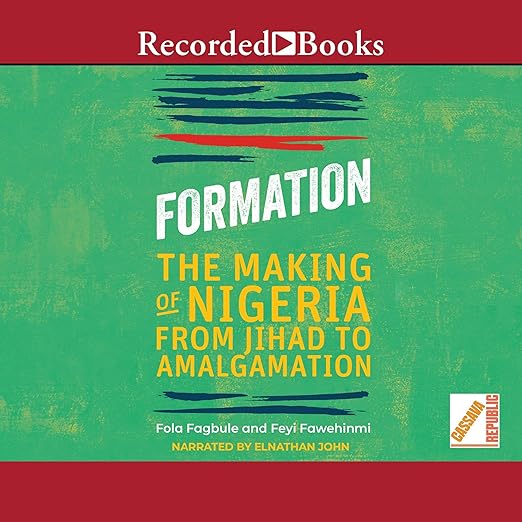
I started Formation on a Tuesday afternoon with a two-hour window and finished it over the following week in every spare gap I could carve out. That is not what I expected from a thirteen-hour political history of colonial West Africa. The subject matter promised worthy but potentially dry scholarship; what Fola Fagbule and Femi Fawehinmi actually deliver is something much closer to a narrative of human ambition, religious transformation, and the specific kind of tragedy that comes from watching people make choices they cannot know will cost them everything.
The book opens in 1804 with Usman Dan Fodio’s jihad along the Niger river, a starting point that immediately signals what distinguishes Formation from most colonial histories of Africa. Fagbule and Fawehinmi are explicit about this: they refuse the standard frame that treats 1914, the year of amalgamation under British administrator Frederick Lugard, as the originating moment of Nigeria. Instead, they reach back a full century to show the political and religious structures that were already complex, already contested, already being won and lost before a British boot touched that soil. This reframing is not just academic positioning, it genuinely changes what the story is about.
The Figures History Has Flattened into Myth
One of Formation’s most useful qualities is its rehabilitation of figures who have been reduced to either myths or footnotes. Usman Dan Fodio, Madam Tinubu (a Yoruba slave trader whose moral complexity the authors handle without flinching), and Samuel Ajayi Crowther (the Yoruba linguist who became the first African Anglican bishop, whose story is both remarkable and deeply painful) all receive sustained attention that moves them, as the synopsis accurately puts it, from myth to reality. Funmilayo Ransom-Kuti appears near the book’s end, mother to Fela Kuti, activist, suffragette, and her presence anchors the narrative in a way that connects the pre-colonial past to the twentieth-century struggles most listeners will have some awareness of.
Elnathan John’s narration is genuinely important here. John is not a professional audiobook narrator, he is a novelist (Born on a Tuesday) and one of the sharpest satirists writing about Nigeria today. His familiarity with the names, languages, and registers of the various communities Fagbule and Fawehinmi describe gives the audio a quality that a technically proficient narrator without that cultural fluency simply could not replicate. He does not perform these names; he knows them. That difference is audible.
Where the Density Asks Something of the Listener
Formation is avowedly, as the authors themselves say, popular history rather than academic text. But thirteen hours covering three hundred years of complex political transformation across dozens of distinct ethnic and religious communities means the listener does need to stay engaged. The middle sections, tracking the simultaneous rise of British commercial influence in the Niger Delta through palm oil politics and the internal fragmentation of the Oyo Empire, are the most demanding. Fagbule and Fawehinmi handle them well, but listeners who have no prior framework for the geography of pre-colonial West Africa may find themselves occasionally losing the thread of who is fighting whom and why it matters.
This is not a flaw in the writing so much as a limitation inherent to the audio format for material that would benefit from maps and a timeline. The authors’ clarity of prose means the argument stays accessible even when the specific names are hard to track, but a print or e-reader edition with supplementary materials would serve the navigation better.
What Makes Formation Distinctive Among Colonial Histories
The book’s core intellectual contribution, that Nigeria’s formation cannot be understood as merely the product of colonial interference, that the pre-existing political structures and internal contradictions of the various nations involved shaped what amalgamation actually meant, is both compelling and important. It does not excuse British imperialism or minimize its violence and distortions, but it insists on the full agency and complexity of the people who were there before and during the colonial period. For readers who have encountered the breezy version of African history in which colonialism arrives into a political vacuum, Formation is a corrective that never feels like a corrective. It just feels like a better story.
Who Should Listen / Who Should Skip
Anyone with curiosity about modern Nigeria, African political history, or the mechanics of colonial formation will find this one of the most rewarding history audiobooks available on its subject. Listeners who need light engagement or a single clear protagonist will find the cast of characters and competing timelines demanding. At 4.7 stars across 46 ratings, a genuine sample rather than a statistical artifact, Formation has found its audience, and that audience’s enthusiasm is warranted.
Frequently Asked Questions
Does Formation require prior knowledge of Nigerian or West African history to follow?
Some baseline geography helps, but Fagbule and Fawehinmi write explicitly for readers who do not already know the subject. They introduce each major figure and political entity with enough context to follow the argument. Listeners who come in completely cold may want to keep a rough map of West Africa nearby for the first few hours.
How does Elnathan John’s narration compare to a professional studio narrator on this kind of dense historical material?
His insider knowledge gives him a clear advantage on names, pronunciations, and the tonal shifts between the book’s different registers, analytical, narrative, and elegiac. He is not as polished as a studio-trained narrator in terms of breath control and pacing, but the authenticity he brings more than compensates.
Does the book cover events after the 1914 amalgamation, or does it stop at colonial formation?
The book’s scope runs from 1804 to 1914, as the subtitle indicates. It ends at the moment of formal amalgamation. Figures like Funmilayo Ransom-Kuti appear as connective tissue linking this history to the twentieth century, but Formation does not extend into post-colonial Nigerian history.
Is Formation co-authored, and does that affect the consistency of the analytical voice?
Yes, Fola Fagbule and Femi Fawehinmi share authorship, though Fagbule tends to receive top billing. The co-authorship does not produce the seams that can sometimes make collaborative histories feel uneven. The analytical voice is consistent throughout, which suggests either strong editorial integration or closely aligned intellectual frameworks.