Quick Take
- Narration: Teri Schnaubelt delivers Stoner’s dense analytical prose cleanly, with a measured cadence that suits the academic weight of the material.
- Themes: geopolitical power, authoritarian consolidation, post-Cold War order
- Mood: Measured and sobering, rigorously analytical
- Verdict: Stoner’s reassessment of Russia’s real sources of power is exactly the kind of rigorous, data-grounded analysis that punditry rarely produces and essential context for understanding two decades of Russian foreign policy.
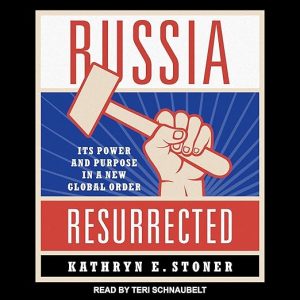
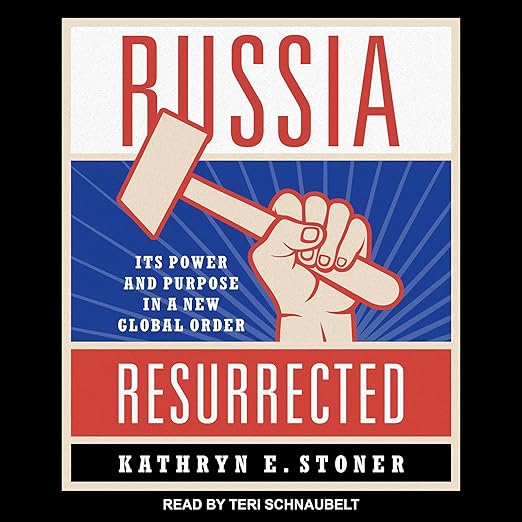
I came back to Russia Resurrected after Russia’s full-scale invasion of Ukraine had already reordered how most people think about the country’s ambitions. The book was published in 2022, and reading it in that context felt like watching someone who had been quietly, methodically right. Kathryn Stoner’s argument, that Russia’s cards are better than conventional analysis suggests and that we have been systematically misreading its power, had already been vindicated by events even as she was making the case.
This is the kind of book that a certain kind of reader will find genuinely useful: analytically precise, unwilling to settle for the received wisdom that Russia is simply a declining power punching above its weight. Stoner, a Stanford political scientist, argues instead that the traditional metrics of GDP, population health, and military size miss something essential about how Russia actually projects influence.
Our Take on Russia Resurrected
Stoner’s central move is to expand the frame for measuring power. Russia ranks behind the US and China on conventional metrics, but it has managed to seize Crimea, prop up the Assad regime in Syria, interfere in elections across the Atlantic alliance, and position itself as a disruptive force in virtually every major geopolitical conversation. Stoner marshals data on political consolidation, economic restructuring, and Putin’s particular style of personalistic autocracy to argue that Russia has developed a different kind of power, one that operates through leverage, information, and the willingness to accept costs that liberal democracies resist.
The section on domestic politics is particularly sharp. Putin’s regime, Stoner argues, faces virtually no organized opposition, not because Russians are uniquely submissive, but because the conditions for organized opposition have been systematically dismantled. That analysis predates the Navalny years and his death, which gives it an eerie prescience.
Why Listen to Russia Resurrected
Teri Schnaubelt handles the material with the kind of careful attention that political science writing demands. Stoner’s prose is analytical rather than narrative, which can make academic audiobooks feel punishing. The reader needs to hold complex arguments across long stretches without the propulsion of storytelling. Schnaubelt avoids the trap of monotony by varying emphasis intelligently, landing the structural moments without overselling them. It is professional work on a difficult text.
Multiple reviewers credit Russia Resurrected with providing more clarity on Putin’s goals than hours of broadcast commentary. One calls the introduction alone more clarifying than hours of expert panels. That tracks with my experience: Stoner’s framework is genuinely useful rather than merely descriptive, giving the listener tools for interpreting subsequent events rather than just information about past ones.
What to Watch For in Russia Resurrected
The book was published in 2022, which means events since then, including the full-scale Ukrainian invasion, the mobilization of the Russian economy for war, the extent of Western military aid to Ukraine, and Russia’s evolving relationships with Iran and North Korea, are not addressed. This is not a criticism of the book but a practical caveat: Stoner builds a rigorous analytical framework, and listeners will need to apply that framework to developments she could not have anticipated. The argument ages better than most because it is structural rather than tactical, but readers should go in knowing the post-2022 landscape will require their own inference.
There is also a clear authorial perspective here. Stoner is arguing against the underestimation of Russia, and the book is structured to make that case. The argument is well-supported, but listeners who prefer purely descriptive political history rather than analytical argument should know what they are getting.
Who Should Listen to Russia Resurrected
This is essential listening for anyone who wants to understand the structural underpinnings of Russian foreign policy rather than its day-to-day tactical moves. It is particularly valuable for listeners who felt that the Western punditry consensus, that Russia is weak, declining, and overextended, never quite explained the evidence in front of them. Graduate students and policy professionals will find the analytical framework rigorous and applicable. General listeners with a serious interest in geopolitics will get more out of this than most airport-bookshelf Russia titles. Those looking for a narrative history of Putin’s rise or a journalistic account of specific events will find this somewhat dry but intellectually rewarding.
Frequently Asked Questions
Does Russia Resurrected address the 2022 invasion of Ukraine?
The book was released in June 2022 and does not cover the full-scale invasion in depth. It provides the analytical framework for understanding Russian power that makes subsequent events legible, but listeners should supplement with more recent sources for post-2022 developments.
Is this book appropriate for general readers or aimed at specialists?
Multiple reviewers specifically note it is accessible to non-specialists. Stoner writes analytically but avoids jargon, and one reviewer calls it essential reading even for the non-expert.
How does Stoner’s argument differ from conventional Russia analysis?
She challenges the premise that Russia is simply a declining power playing a weak hand well. Instead she argues Russia has developed distinct forms of leverage through information, willingness to absorb costs, and personalistic autocracy that conventional power metrics miss entirely.
Is Teri Schnaubelt’s narration suited to political science material?
Yes. She reads with measured clarity rather than dramatic affect, which is exactly what dense analytical writing requires. The performance does not make the material feel lighter than it is, but it does make it accessible.