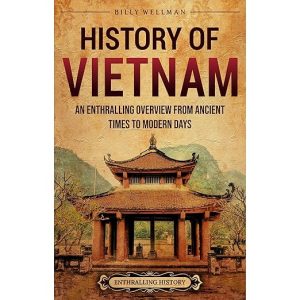
Quick Take
- Narration: Virtual Voice narration is functional for this kind of survey history, though it irons out the emotional registers that this material, particularly the war sections, genuinely warrants.
- Themes: Colonial resistance, Cold War division, economic transformation
- Mood: Brisk and informational, occasionally charged with the weight of the subject
- Verdict: A compact, well-structured overview of Vietnam’s arc from ancient kingdom to economic powerhouse, best suited to listeners new to the subject.
Vietnam is one of those subjects where the American listener’s frame of reference is both a starting point and an obstacle. Most of what we know, or think we know, about Vietnam is shaped by a single decade of a very long history. Billy Wellman’s survey is structured with this problem in mind. The book’s opening question, asking how a nation ravaged by centuries of foreign rule became one of the world’s fastest-growing economic powers, is a genuine reorientation. It asks you to hold the war, the entire war, as an episode within a much longer story rather than as the story itself. For listeners whose mental map of Vietnam begins and ends at a particular decade of American involvement, this reframing alone is worth the three hours.
At 2 hours and 59 minutes, this is a short audiobook. That runtime should be understood before purchase: this is a primer, not a comprehensive history. What Wellman does within those three hours is more intelligently structured than the brevity might suggest. He organizes the material around a central transformation narrative, tracing how Vietnamese identity was forged through successive occupations, more than a thousand years of Chinese dominance, French colonialism, Japanese wartime occupation, and then American military involvement, before arriving at the surprising postwar pivot to market capitalism within a nominally communist state.
The Ancient Foundations Most Surveys Skip
The section on ancient Vietnamese kingdoms and Chinese domination is where this audiobook earns some genuine credit. The centuries of Chinese rule that produced a distinctly Vietnamese identity, one that absorbed Chinese administrative influence and Confucian ethics while consistently pushing back against assimilation, is the foundation for everything that follows. Most Western accounts of Vietnam begin in 1954 at the earliest. Wellman goes back considerably further, and this makes the later material more legible. The fierceness of the resistance against the United States is not an aberration; it is an expression of a pattern that runs back to the Trung Sisters in the first century CE and has expressed itself again and again across two thousand years of national history.
One reviewer who said the book was difficult to get into at the start but pulled together well toward the end was probably reacting to this opening section. The ancient material is necessarily more abstract, without the vivid personalities and immediate stakes of the modern period. But it does the necessary foundational work, and listeners who stay with it will find the modern sections considerably richer for having that context.
The Virtual Voice Limitation on Difficult Material
The Virtual Voice narration requires a specific note. Several readers on Audible have commented that they found the AI narration acceptable or even unnoticeable once they were engaged with the content. That is plausible for sequential factual material at a survey level. When you are listening to straightforward historical summary, the absence of human emotional inflection is less disruptive than it would be in a memoir or a narrative history with dramatic set pieces.
Where it does cost something is in the war sections. The passages covering the American military campaign, the bombing of the Ho Chi Minh Trail, the civilian toll of the conflict, these carry a moral and emotional weight that a synthetic voice does not convey. The content is there; the affect is not. For a listener primarily interested in the historical facts and the economic transformation argument, this may not matter. For a listener expecting the gravitas the subject deserves on its most painful passages, it will.
The Economic Transformation as the Central Argument
The strongest section of the audiobook is its treatment of the post-1975 period. The story of how Vietnam, a country that had been at war for most of the preceding century, pivoted from a collectivist Soviet-style economy to one of the most dynamic manufacturing and export platforms in Southeast Asia is genuinely counterintuitive and genuinely interesting. Wellman explains the Doi Moi reforms of 1986 clearly and connects them to Vietnam’s current position as a major US trade partner, a relationship that would have seemed surreal to anyone living through the 1960s. This section justifies the audiobook’s central framing and makes the full historical arc cohere in a way that a war-focused account never could.
Who Should Listen, Who Should Skip
The right audience here is someone with minimal background in Vietnamese history who wants a structured overview before watching a documentary, traveling to Vietnam, or reading a more substantial treatment like Neil Sheehan’s A Bright Shining Lie or Frances FitzGerald’s Fire in the Lake. Listeners already familiar with the broad outlines of Vietnamese history will find little that is new, though the economic framing of the post-unification period remains a useful perspective regardless of prior knowledge. At three hours, this audiobook functions best as a before or an after, either as preparation for a deeper engagement with Vietnamese history, or as a capstone that provides the long arc after you have already inhabited the individual stories through other reading. Either way, it earns the time it asks for.
Frequently Asked Questions
Does this audiobook cover the Vietnam War in detail, or is it more focused on the broader historical arc?
The Vietnam War is covered, but in proportion to the book’s overall scope, which spans from ancient kingdoms to the present day. The treatment provides context and consequence rather than operational detail. Listeners wanting a deep examination of the American military involvement specifically should look to longer, more focused works.
Is the Virtual Voice narration noticeable throughout, and does it affect the listening experience on difficult historical material?
Several reviewers noted they adapted to it quickly for factual survey content. The limitation is most apparent in emotionally weighted sections such as the war and occupation periods, where human narration would provide inflection the synthetic voice cannot. For a brisk informational listen, most readers find it acceptable.
At under three hours, how much depth does this audiobook actually provide?
It provides orientation and framework rather than depth. Think of it as a structured chronological map with a clear central argument about national transformation. Reviewers consistently describe finishing it quickly and then wanting to read further, which seems like the intended function.
Does the book take a political position on the Vietnam War or on the current Vietnamese government?
The framing is broadly analytical rather than polemical. The book acknowledges the complexity of the communist-capitalist hybrid that governs Vietnam today without either celebrating or condemning it. The economic transformation argument is presented as a historical observation rather than a political endorsement.