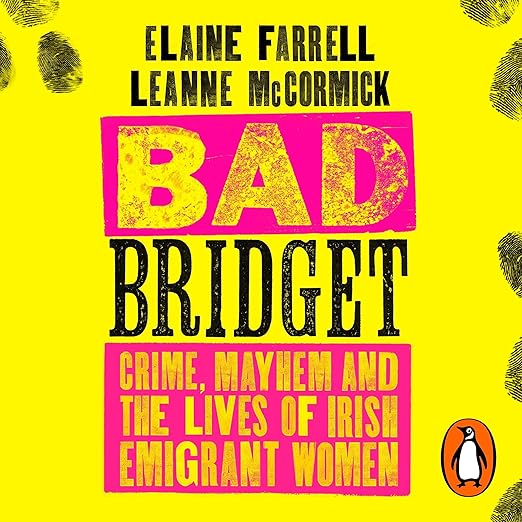
Two names sit on the copyright line of this record and only one of them reaches the byline. Elaine Farrell and Leanne McCormick wrote Bad Bridget together, the description says so plainly and the copyright notice repeats it, and the author field on this audiobook credits Farrell alone. That is the first thing wrong with the page and it is not the strangest. The reader slot is empty, and the running time reads Not Yet Known on a title whose release date has already passed.
The Voice Moving Between Lives Has No Name
The subject is genuinely strong, and the description does not undersell it. Ireland in the nineteenth and early twentieth centuries sent a wave of emigrants to North America, and among them were large numbers of young women traveling on their own. Some found trouble on what the copy calls an astonishing scale: Irish women outnumbered Irish men in prison, a person could be locked up for stubbornness, and a killer named Lizzie Halliday was described by the New York Times as the worst woman on earth. Out of the frying pan of an impoverished homeland, into the fire of vast North American cities. That framing is doing real historical work rather than decorating a crime shelf.
What the record declines to tell you is who reads any of it. The narrator field is empty. The running time says Not Yet Known. The release date printed on the page is July 2, 2026, which has already come and gone, so a buyer is being offered a Penguin Audio production with its two most basic audio facts still blank. That pattern usually means a listing built ahead of the file and never revisited, and the consequence is practical rather than cosmetic. On a book assembled from dozens of separate lives, the voice moving between them is the entire experience, and this page will not name one.
One Reader Writes Authors, Plural
An October 2023 entry, five stars, calls the book brilliantly written and researched, and lands on what makes the subject stick: an eye-opening account of Irish women who left Ireland hoping for something better and often found the opposite. That is the tone the material earns. The cases here are not sensational set pieces but ordinary catastrophes, and the research behind them is what turns a list of court appearances into an argument about what poverty, isolation and a hostile legal system will do to people who arrived with nothing and no one.
A March 2024 entry, also five stars, is more useful than its brevity suggests. It describes these cases as a few drawn from a much larger portfolio of wrongdoing and misfortune, calls the result an absorbing study well researched by the authors, and says it is waiting for their next book. Note the plural. A reader who has actually been through the material refers to authors, and to a book those authors will write together next, which is exactly what the copyright line states and exactly what the byline on this record does not. When reception corrects the metadata, the metadata is the thing that is wrong.
A Parcel Arriving Is Not a Performance
Every written verdict visible here predates the audio edition. All five were filed before the July 2026 date on this record, several of them by years, which means the 4.1 average and its 107 ratings describe a book rather than a recording. A January 2024 entry makes the point without meaning to: it carries four stars, its headline announces a big long book of 300 pages, and its entire body reports that a sister sent it. A page count is print apparatus that cannot cross into audio, and a parcel arriving is not a performance.
The most substantive objection on the page comes from a November 2025 entry graded three stars, which credits the storytelling and the sociological slant before noting that the cases become a bit repetitive after a while. That is the honest structural risk in any book organized as a sequence of lives, and it sharpens in audio, where you cannot skim a case that resembles the last one. A second three-star entry, from February 2025, put the book down unfinished for a related reason, wanting more from stories that nonfiction had already fixed in place.
The shelving is worth a note as well. A work of social history sits here under mystery, thriller and suspense with a True Crime tag, which the description's own closing sentence half-justifies, though it will still route the wrong buyer. Anyone arriving from the thriller aisle meets prison records, workhouse arithmetic and a sociological argument instead of a plot. The promotional layer compounds it: the Sunday Independent calling the book a captivating account, the Irish Examiner calling it impeccably researched, the New Statesman calling it rich in detail, and a bare Number 1 Bestseller banner naming no list and no market. Every one of those notices was written about a printed edition.
Waiting for the Record to Supply a Runtime
Anyone with a serious interest in Irish or Irish-American history should hear this, and so should listeners who read migration history for the individual case rather than the aggregate. The book's method, building an argument out of named women and documented charges, is the kind of history that survives being read aloud, because each case arrives with a person attached. Family historians tracing nineteenth-century emigration will find the institutional detail immediately useful, and anyone who followed the authors' podcast on the same subject already knows the register.
Hold off if you need a finished product page before you commit, because this one is missing the two facts that decide an audiobook purchase. Hold off too if you want narrative true crime with a single case and a resolution, since the structure here is cumulative by design, moving from one documented life to the next with no spine to follow through them. Listeners sensitive to accounts of sexual exploitation, child endangerment and executions should know the copy names all three categories openly. Anyone who needs a runtime before buying is simply going to have to wait for the record to supply one.
The Short Version
- Subjects: Irish emigration to North America, women in nineteenth-century prisons, poverty prosecuted as character
- Tone: Sober and case-driven, with genuine cruelty handled plainly
- Bottom line: Social history worth hearing, on a listing that will not yet say who reads it or for how long.