In Brief
- Narrator: A single reader for a writer whose entire method was compression, which means every sentence arrives at the same weight unless the performance varies it.
- Subjects: War reporting, celebrity and self-mythology, craft learned on deadline, an American abroad between the wars
- Tone: Vivid, blunt and unexpectedly funny
- Bottom line: The best route into Hemingway the working reporter, as long as you want dispatches rather than a life story.
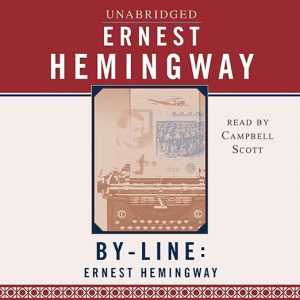
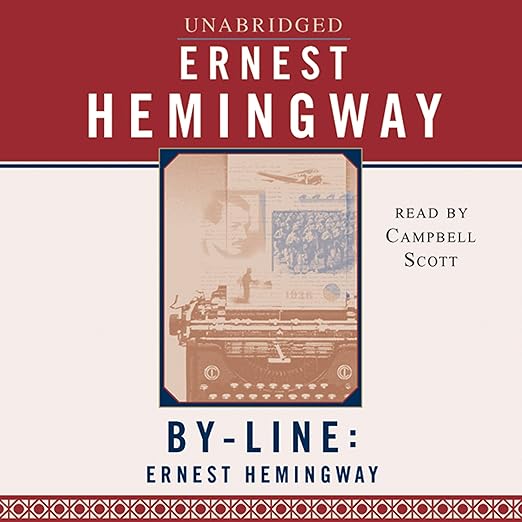
Newspaper copy filed between 1920 and 1956 rarely reaches an audiobook catalog at all, let alone fifteen hours of it. Simon and Schuster Audio published this collection on June 1, 2007 with Campbell Scott reading, and what he reads is Hemingway on deadline rather than Hemingway at the desk: dispatches for the Toronto Star, pieces for Esquire, Colliers and Look, eyewitness accounts of the Spanish Civil War and World War II, a first safari, a running argument with bullfighting. The copy calls it a personal glimpse into the world behind the popular fiction. More precisely, it is thirty-six years of a working reporter's output laid end to end.
When the Headline and Dateline Disappear by Ear
Three things on the record do not match what the record contains. The title displayed here reads Byline while the description spells it By-Line, hyphen and all, which is a small discrepancy with real consequences for anyone searching. The genre fields shelve the file under biographies and memoirs and also under literature and fiction, though what it contains is journalism and correspondence rather than invention. And the tag reads Diaries and Correspondence, which promises private papers, when the description itself says articles and letters and the articles are plainly doing the heavy lifting. A compilation spanning thirty-six years was assembled by somebody, too, and no editor or compiler appears in any credit field on the page.
The reading job here is one most collections never face. Every item was written as a self-contained piece for a specific publication in a specific year, and on the page each one arrives with a headline, a dateline and white space around it. By ear all of that scaffolding disappears. A listener drops out of a war dispatch and into a fishing story with nothing but a pause to mark the seam, and the recording has to carry the distinction that typography used to carry. Sample across a boundary between two pieces rather than a passage inside one, because how cleanly that transition is signaled will shape fifteen hours of your experience.
Fifteen Uninterrupted Hours and a Self-Deprecating Obituary Joke
The range is the sell, and one October 2014 response inventories it better than the marketing copy does: the Spanish Civil War, the beach on D-Day, a first bull fight, a safari and the plane crashes that followed it, marlin fishing between Key West and Havana. That entry also names the price of admission honestly, describing a man's man with all the associated habits and inclinations, and asking that they be weighed against the era he wrote in. You are getting the adventures, and you are getting the person who went looking for them.
What emerges over the full span is something the individual pieces cannot show. A January 2023 five-star describes following the stories in order and watching a reporter turn into a Renaissance man while the world reorganizes itself around him, and singles out the funniest thing in the book: a self-deprecating account of reading his own obituary after false reports that he had died in a plane crash on safari. That is the argument for hearing this as a sequence rather than dipping in. The evolution of the prose is a plot, and fifteen uninterrupted hours is the only format that lets you watch it happen.
Professional Distance Dressed Up as a Private Diary
Some of the guidance in the written column cannot cross into this format at all. A June 2013 five-star opens by regretting a purchase of the small pocket edition and urging buyers to find the hardback instead, then praises watching a writer compress what he saw into pithy news copy and singles out the pieces on the taking of Paris. The reading advice is sound and completely useless here, since an audio file has no trim size. It is a reminder that a good part of the reception on this page was formed on paper, by people choosing between print editions rather than deciding whether to listen.
Four stars, September 2020. That response opens by conceding its subject can be something of a jerk, then applies the two rules it holds journalists to, getting the facts right and not being dull, and awards decent marks on both. Take the concession seriously before you commit. This is prose from the 1920s through the 1950s written by a man entirely of his moment, and the attitudes it carries arrive with no modern cushioning around them. Nothing on the listing warns you about that.
Marketing language oversells the intimacy here as well. Phrases like a personal glimpse, combined with that correspondence tag, suggest letters home and private confession. The bulk of what you get was written for an editor, to a word count, for money, and intended to be read by strangers the following week. That professional distance is genuinely interesting, but it is not the same product as a diary, and buyers arriving from the memoir shelf should reset their expectations before the first piece ends.
Reportage at Its Best, No Biography Included
Reach for this if you like reportage as a form and want to hear it practiced at a very high level by somebody who never stopped treating it as work. An October 2024 five-star gets the appeal into two sentences, noting that the reports cover many decades and that the descriptions carry enough clarity to put you in the room, then calling the result history come alive. Readers of the novels will find the raw material of the fiction lying around everywhere, unprocessed, which is its own pleasure.
Give it a miss if you want a biography, because nobody here is standing outside the subject to explain him. Give it a miss too if you need the historical context supplied, since these pieces assume readers who opened their newspaper already knowing who was fighting whom. Anyone who arrived for the novelist is going to meet a noticeably different writer in these fifteen hours, and that difference is the whole reason to spend them.
Is this audiobook a memoir or a collection of journalism?
Journalism, almost entirely. The description promises a glimpse into the life, but the contents are filed articles and letters written for newspapers and magazines over thirty-six years. Any autobiography in it is incidental, arriving through what the assignments happened to be rather than through reflection after the fact.
How is the audiobook organized across its running time?
Chronologically, from 1920 through to 1956, moving publication by publication as the assignments changed. That order is the main pleasure of the thing, since following it lets you hear a young wire correspondent turn gradually into a famous man being paid handsomely for his opinions.