Seducing Readers Behind His Own Flawed Eyes
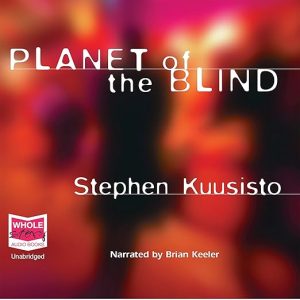
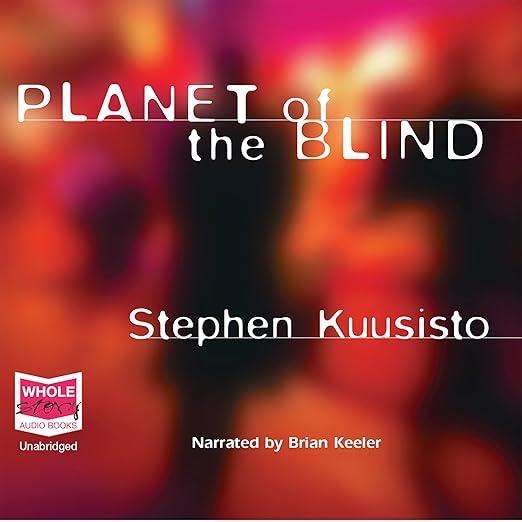
Stephen Kuusisto spent his childhood doing something that required extraordinary effort and was entirely invisible to everyone around him: pretending he could see. This audiobook, narrated by Brian Keeler across five hours and forty minutes, is the memoir of that performance and of what it cost. Born legally blind in an era when blindness carried social stigma, Kuusisto's mother chose to raise him as a sighted child, and so began a daily practice of normalcy that shaped everything about how he moved through the world. He memorized streets, rode a bicycle, held his face toward spaces and things he could not actually perceive. Planet of the Blind is the account of that performance and, eventually, of what it cost him to finally stop performing.
The 4.4 rating across 110 listeners reflects a genuine literary reputation. This is not simply a disability memoir in the issue-book sense; the reviewers who called the prose lovely and who described Kuusisto as seducing readers to step behind his flawed eyes are responding to something real. One reviewer called it a top-notch memoir in the literal sense, placing it in a category of writing that achieves something beyond testimony. Kuusisto is a poet as well as a memoirist, and that dual formation shapes every sentence. Keeler's narration is the vehicle through which that language reaches the listener.
Keeler Refuses to Flatten the Lyrical Rhythm
The audiobook earns its place in the disability memoir category not because it covers new ground thematically but because of how precisely Kuusisto renders the inner experience of living in a body the world has decided to misread. The distinction between legal blindness and total blindness, which one reviewer said reshaped their entire understanding of visual impairment as a category, is not a footnote in Kuusisto's account; it is structurally central. His blindness was a matter of degree, of gradation, of one eye that could be painfully forced to perceive something in particular conditions while the other could not. The performance of normalcy was possible precisely because the reality was neither fully sighted nor fully blind.
Brian Keeler's narration choices serve the prose well. The text moves between the immediate sensory world of Kuusisto's childhood and the retrospective intelligence of the adult memoirist, and Keeler handles those shifts with care. He does not flatten the lyrical passages into a more comfortable realist cadence; he allows them their rhythm, which is what they require. At five hours and forty minutes, the audiobook is long enough to establish an immersive relationship with Kuusisto's voice but not so long that the intensity of the material becomes wearing.
The memoir form in audio has particular strengths here. Kuusisto's project is partly to make visible what was hidden, to let the reader see with him through the eye that barely functions, and audio narration serves that project in ways that silent reading does not quite replicate. You hear the sentences in the order they were meant to arrive, and the rhythm of that arrival shapes the understanding. Keeler understands this and treats each sentence as a unit of experience rather than information.
The Book Moves at the Pace of Perception
The book is set primarily in the 1950s and 1960s, when the social framework around disability was significantly different from today. Some of the institutional attitudes and family decisions Kuusisto describes will be difficult to hear, not because the writing is gratuitous but because the historical reality it records was genuinely harsh. Listeners who are themselves visually impaired or who have close relationships with people who are may find certain sections particularly resonant, but also potentially difficult. The emotional weight is distributed throughout rather than concentrated in a single climactic sequence.
Kuusisto's prose is dense and sometimes demanding. This is not a memoir that moves at the pace of plot. It moves at the pace of perception, which is the right pace for what it is trying to do, but listeners who prefer narrative momentum to sensory accumulation may find the early sections slower than they want. The payoff for staying with it is significant, but it does require patience in the opening chapters.
Alongside Nancy Mairs and Georgina Kleege
Readers drawn to literary memoir, to writing that takes the texture of perception as seriously as the architecture of narrative, will find Planet of the Blind one of the more rewarding audiobooks in its category. It belongs alongside other disability memoirs that have achieved genuine literary recognition, books like Nancy Mairs's Waist-High in the World or Georgina Kleege's Sight Unseen, in the sense that the writing itself is an argument for the significance of the experience being described. Keeler's narration makes it an excellent audio experience for listeners who want to give the prose the full attention it asks for.
This audiobook is not for listeners who want inspirational disability narratives that follow a conventional arc of struggle-toward-triumph. Kuusisto's account is more complex than that, more interested in the texture of daily reality than in the dramatic structure of overcome. But for listeners ready to meet the book on its own terms, it is one of the more genuinely illuminating memoirs available in audio format. The writing earns the attention it asks for, and Keeler's narration means you never have to earn that attention against the performance; the performance is always in service of the prose, which is where it belongs.
Quick Take
- Narration: Brian Keeler narrates Stephen Kuusisto's memoir with a lyrical sensitivity that honors the poetic quality of the prose, a strong match for a book whose language is as important as its subject.
- Themes: Disability identity, the performance of normalcy, coming to terms with physical reality
- Mood: Lyrical, unflinching, and quietly extraordinary
- Verdict: Stephen Kuusisto's memoir is one of the more beautifully written accounts of disability experience in contemporary American nonfiction, and Brian Keeler's narration gives its language the space it deserves.