- Narration: Christine Padovan narrates this NASCAR biography with clear, respectful authority that lets the subject's charisma come through the prose without overstating it.
- Themes: Charisma and mortality, NASCAR's growth era, the cost of living fast
- Mood: Admiring but honest, with a gathering shadow that listeners know is coming even as the book celebrates what Richmond was
- Verdict: A carefully researched audiobook biography that gives Tim Richmond the serious treatment a complicated, brilliant career deserves.
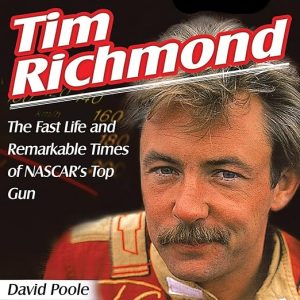
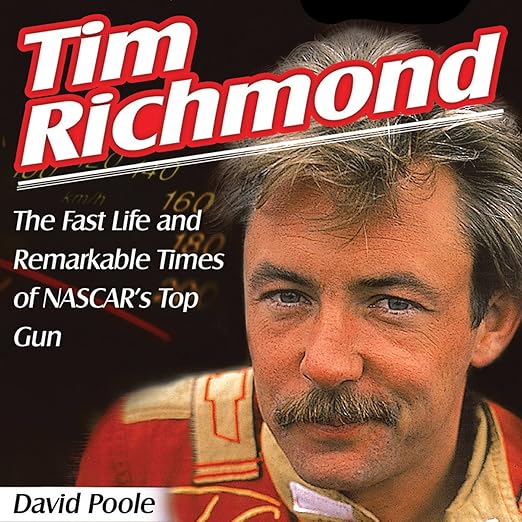
Tim Richmond is one of those figures who gets mentioned in NASCAR conversations with a kind of reverence that suggests everyone involved wishes the story had ended differently. David Poole's biography, offered here as an audiobook narrated by Christine Padovan, approaches that reverence honestly: it does not explain it away or pretend it is unearned, but it also refuses to make Richmond into a simple legend. At just under six hours, this listen covers a life that burned hard and ended too soon, and it does so with the thoroughness of a journalist who clearly spent real time with sources who knew Richmond and who understood what they had lost.
The Kyle Petty quote that opens the synopsis, that Richmond was a stranger in time, is the right frame for the whole biography. Poole uses it to set up the central tension: Richmond was simultaneously ahead of the trends in a sport about to explode in popularity, and a throwback in temperament and style, pushing every lap like he was hauling moonshine through the Carolinas with a revenuer on his bumper. That combination made him magnetic and, ultimately, uncontainable.
Poole traces the arc carefully: Richmond from Ashland, Ohio, not from the South, with no racing background until age twenty-one, making a splash in the Indianapolis 500 as a rookie and then moving into NASCAR's Winston Cup Series with the kind of natural talent that stunned people who had grown up in the sport. The book is honest about the difficulty of that path, and about what Richmond had to prove to a culture that was not built for someone like him. His Hollywood ambitions, his genuine crossover appeal, his unusual relationship with both male and female fans, all of it is handled with specificity rather than generality.
One reviewer described being glad to finally find a book about Richmond's all too brief life and noted that he may have been Dale Earnhardt's greatest rival. That comparison carries weight in NASCAR circles, and Poole earns the right to make it by establishing what made Richmond's driving so distinctive: the willingness to push harder than the car or the situation strictly required, a quality that produced brilliance and risk in equal measure.
Padovan Balances Fluency With Fan Authenticity
Christine Padovan handles the material with the right touch. Racing biography has a specific challenge: the vocabulary of the sport, the names, the track specifics, the mechanical references, need to be delivered with enough fluency that non-fans do not feel excluded, while fans need to feel the narrator understands what she is talking about. Padovan navigates that well. Her pacing is considered without being slow, and she gives the more personal passages, Richmond's Hollywood aspirations, his relationships, his final months of increasing isolation, the kind of deliberate weight they need.
Another reviewer described the audiobook as a fascinating behind-the-scenes biopic and mentioned having met Richmond in person in the early 1980s at a fan club meeting in Daytona. That personal reference suggests the book captures something real about who Richmond was in public as well as on the track. A third reviewer came to the book through Days of Thunder, the film widely said to be based on Richmond's story, and found the biography more illuminating than the dramatization. All three of those entry points speak to the range of listeners this audiobook reaches.
The Terms Changed Without Warning
The biography does not flinch from the tragedy of Richmond's final years. A man who thrived on the affection of his audience spent his final months almost entirely shut off from that world, and Poole handles that period with restraint and respect. The specific circumstances of Richmond's illness and the controversy around his return to NASCAR in 1987 and 1988 are treated with the care they deserve, neither sensationalized nor minimized. For listeners who come to this audiobook knowing only the legend and not the details, these sections carry genuine weight.
What Poole does best is establish Richmond not as a cautionary tale but as someone who made a specific kind of choice about how to live, and whose tragedy is not reducible to those choices. The description of racing every lap with the throttle wide open and the wheels burning rubber at almost every turn is not just metaphor. It is a character portrait of someone who understood the terms of his own life and accepted them, at least until the terms changed without warning.
An Extraordinary Talent Meets the Limits of Time
NASCAR fans who want the full story of one of the sport's most compelling figures should make this audiobook a priority. It is also well suited to anyone interested in American sports biography generally, particularly stories about athletes who existed at the intersection of stardom, tragedy, and historical timing. If you came to the story through Days of Thunder or through general awareness of Richmond's name without knowing the details, this audiobook fills that gap with journalism rather than legend-making. Skip it if NASCAR is genuinely not your context and you need that context to find a sports biography compelling. For everyone else, this is five and a half hours of careful, honest work about someone worth knowing. Richmond's story is ultimately about what happens when an extraordinary talent meets the limits of time, and Poole tells it without softening or mythologizing, which is the right choice for a subject who deserves to be understood rather than simply celebrated.
Does the Tim Richmond audiobook require any prior knowledge of NASCAR to appreciate it?
Basic familiarity helps, but Poole writes with enough context that listeners new to NASCAR can follow the story. The book works as much as a portrait of a person and an era as it does a racing chronicle, and the personal elements are accessible without specialist knowledge.
How does Christine Padovan's narration handle the racing-specific vocabulary in this audiobook?
Padovan navigates the technical and cultural vocabulary of NASCAR with fluency and confidence. She gives the more personal passages appropriate weight, making the shift between race history and personal story feel natural across nearly six hours.
Is this audiobook suitable for listeners who only know Tim Richmond from the film Days of Thunder?
Absolutely. Several reviewers came to the audiobook through Days of Thunder and found it more illuminating than the dramatization. Poole's journalism fills in what fiction necessarily simplified or altered, giving those listeners a much fuller picture of who Richmond actually was.