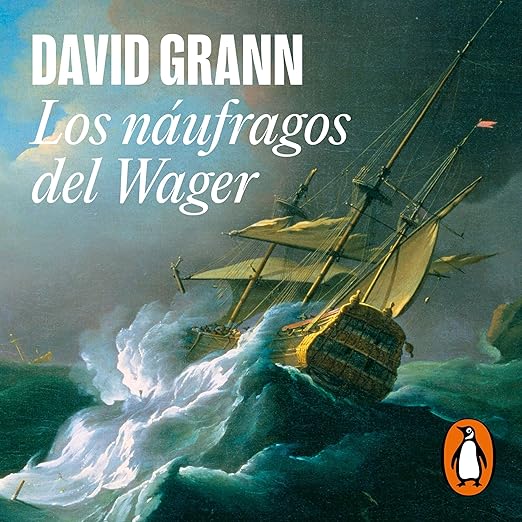
In January 1742, thirty starving men arrived on the coast of Brazil with a story that should have made them heroes. Six months later, a second group stumbled ashore in Chile with a very different version of the same events. David Grann's audiobook The Wager reconstructs what actually happened aboard and after the wreck of the HMS Wager, a British Royal Navy vessel lost near Patagonia during the imperial war against Spain. This edition is narrated in Spanish by Julio Caycedo. I came to it already familiar with Grann's reputation from his earlier narrative nonfiction, and The Wager confirmed everything I had come to expect: the precision of a journalist working at the level of a novelist, and an uncanny ability to make events from three centuries ago feel immediate and genuinely urgent.
The basic shape of the story is extraordinary: a shipwreck, a deserted island, the slow disintegration of naval hierarchy, competing accounts of mutiny and murder, and a court martial that became one of the most discussed legal proceedings of its era. Grann piles detail onto detail without ever losing the thread, and Caycedo's narration gives the material a particular texture, crisp, direct, and built for the kind of maritime adventure prose that Grann writes so well.
The Feeling of Reading Conrad
What distinguishes Grann's approach from straightforward shipwreck history is his sustained attention to the problem of narrative itself. The Wager is not just a story about what happened; it is a story about how the men who survived constructed their accounts of what happened, and how those constructions served their immediate interests. The court martial becomes a theater of competing truths, and Grann handles the ambiguity with rigor rather than convenience.
The book works through the class conflict aboard the ship with particular care. The officers and enlisted men experienced the same disaster in fundamentally different conditions, and those differences shaped not just their survival strategies but their moral choices. One Spanish reviewer described the book as generating the feeling of reading Conrad, which captures something true about the texture of the prose and the darkness of the material.
The critical consensus cited around the book's reception places Grann in a category of narrative nonfiction writers who have created their own subgenre: history and journalism and something close to literary suspense, all folded into the same pages. The Wager is perhaps his most complete expression of that approach.
Caycedo's Narration Is the Reason to Choose This Edition
Julio Caycedo's narration in Spanish is the reason to choose this particular edition. The voice brings the right combination of authority and forward momentum, sustaining the narrative's considerable length without the pacing ever feeling slack. The maritime vocabulary and period-specific language, which can become an obstacle in histories of this kind, feel natural rather than archaic in Caycedo's handling.
The nine-hour-plus runtime covers an enormous amount of ground: the wreck itself, the months on the deserted island, the separate voyages back to civilization by the two factions, the court martial, and the broader historical context of British imperial ambition and the moral debates of the early Enlightenment. Grann never loses sight of the individual men caught inside these large forces, and that human specificity is what keeps the audiobook from becoming a dry recitation of events.
For Spanish-language listeners in particular, this edition offers access to one of the defining narrative nonfiction books of recent years in a format that matches the source material's quality.
Aimed Squarely at Hispanophone Listeners
The book's deliberate pacing in its early sections, establishing the naval context and the characters of the key men before the disaster unfolds, requires patience. Grann is building a scaffolding of understanding that pays dividends once the ship goes down, but listeners who prefer immediate action may find the opening chapters slow to develop.
The moral ambiguity that defines the book's center is one of its genuine strengths, but it also means the narrative does not deliver the clean resolution that disaster stories often promise. Grann is honest about what the historical record can and cannot tell us, which means some questions remain open at the end. That intellectual honesty is a feature, not a flaw, but readers who prefer definitive verdicts may find it unsatisfying.
The Spanish-language edition is aimed squarely at Hispanophone listeners. English-language readers should seek out the English narration. This edition is specifically notable for the quality of Caycedo's performance and its accessibility for Spanish-speaking audiences who may have encountered the book in press but not yet in audio.
The court martial at the book's center is one of the most sustained pieces of legal and moral analysis in contemporary narrative nonfiction. Grann shows how both factions, the men who arrived in Brazil and the men who arrived in Chile, constructed their testimonies not just as self-defense but as competing bids for historical meaning. The question of who counts as a mutineer and who counts as a loyalist was always, in this trial, a question about which story would survive.
A Meditation on the Slipperiness of Truth
This audiobook belongs in the library of any listener who appreciates narrative nonfiction at its most rigorous, the kind where the research is invisible but the precision is everywhere. Maritime history enthusiasts will find the detail extraordinary. Spanish-language listeners looking for a substantial, serious audiobook that delivers both intellectual stimulation and genuine narrative suspense will find exactly that here.
Skip this edition if you need the English narration, or if you prefer history told as a series of clear facts rather than as a meditation on the slipperiness of truth. If you are willing to spend nearly ten hours with one of the finest narrative nonfiction writers working today, narrated in Spanish with real skill, The Wager is worth every minute.
Is The Wager audiobook narrated in English or Spanish?
This edition of The Wager audiobook is narrated in Spanish by Julio Caycedo. English-language listeners should seek out the English-narrated edition.
Do I need to know the history of the HMS Wager before listening?
No prior knowledge is required. Grann builds the historical context carefully, introducing the naval setting and key figures before the disaster unfolds, making the audiobook fully self-contained.
Is The Wager audiobook suitable for listeners who do not usually read history?
Yes. Grann writes narrative nonfiction in the literary sense, prioritizing story and character alongside historical accuracy. Listeners who enjoy true crime or adventure memoir will find the material accessible and propulsive.