At a Glance
- Read by: The file carries a single reader credit for a book that swaps between expedition writing and software history every chapter, so the sample worth playing sits at a chapter break.
- At its heart: The invention of online gaming, expedition as a second career, inherited proximity to spaceflight
- Vibe: Brisk and cheerful, closer to a long dinner story than to confession
- Short version: Excellent on how an industry got built and on what money can buy, thin on what any of it cost him.
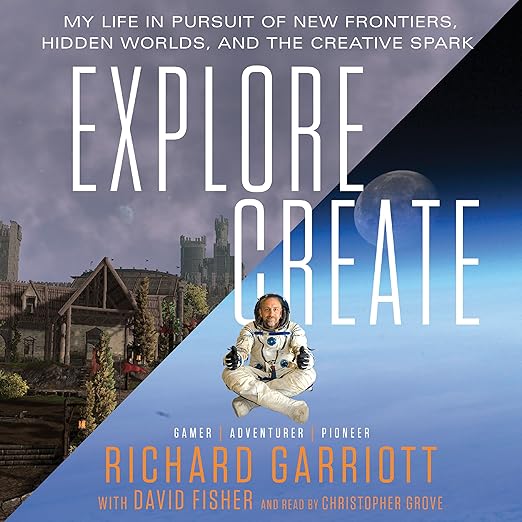
Inventory is not quite the right word for what the publisher's description does here, but it is close. Gaming pioneer, Explorers Club member, Titanic diver, Antarctic meteorite hunter, and in 2008 one of the first private citizens to buy a ride into orbit: the copy for this audiobook catalogs what Richard Garriott has done and never once says what sort of book he has made out of any of it. Nine hours and twenty-one minutes is a long stretch to spend with a list of achievements. The good news, which the seller never quite gets around to mentioning, is that the book is not a list.
The Same Compulsion Behind Two Different Careers
Somebody writing in February 2017 supplied the single most useful fact about this book, and the publisher's copy mentions it nowhere. The chapters alternate. Each one is either an Explore chapter or a Create chapter, the two kinds run in roughly equal number, and the sequence is thematic rather than chronological. That is the whole architecture, and knowing it changes the listening completely. Without it, the jump from the bottom of the Atlantic to the internals of a software company reads as a memoir that cannot hold a thread. With it, the same jump reads as an argument: the compulsion that builds imaginary worlds and the compulsion that goes looking at real ones are being proposed as the same compulsion.
Whether you accept that argument is the real question the book poses. Garriott's claim on the reader's attention rests on two very different careers, and the copy presses hard on the first, crediting him with inventing the multi-player online game, coining the word avatar for a player's online self, and membership in every gaming hall of fame going. Those are the publisher's superlatives rather than the author's, and a listener should hold them loosely. What survives the marketing is more specific and more interesting: somebody who was in the room when an industry was being invented, who kept the receipts, and who then spent the proceeds on the Titanic wreck, Antarctic ice and a seat to orbit.
Grove Must Serve Two Very Different Deliveries
The alternating structure creates an unusual problem for a single reader, and Christopher Grove holds the only credit on the file. Expedition writing and software-industry history want completely different deliveries. One wants space around the sentences and a willingness to let cold and pressure and risk sit there; the other is technical, fast, full of company names and dates and the specific comedy of people arguing about code. A reader who settles into one register will flatten the other, and the chapters swap every twenty minutes or so. Sample across a chapter boundary rather than inside one. That transition is the only test that tells you anything about this recording.
A reader who graded it four stars in April 2019 gives the most clear-eyed account on the listing of what is actually inside. The inventory runs to the software company Garriott co-created, the game franchise that made his money, the online version that followed, the later project, and the elaborate haunted house. Then comes the quiet part: this is an account of an extremely privileged life, built on genuine talent and a great deal of luck in equal measure. That verdict is right, and it is also the reason to listen rather than a reason not to. Garriott does not hide the advantages. His father was an astronaut and the description leads with the fact.
Two Names for the Same Byline
Small things on this record do not line up. The byline reads Richard Garriott while the publisher's own description introduces him as Richard Garriott de Cayeux, so the file and the copy disagree about the author's name in the first sentence a browser sees. It matters less for a famous person than it would for an unknown one, but a listener searching for related work will find different results depending on which version they type. Nothing else in the metadata contradicts the description, and the mismatch is easy to explain as an abbreviated credit rather than an error.
Somewhere in the later chapters, according to an entry filed in July 2021, the book starts asking readers to come and find the author on social media. That is an ordinary enough gesture in print, where a handle sits on the page and can be copied. Spoken aloud into a pair of earbuds it becomes an address nobody can act on, and the invitation lands as a small dead end each time it arrives. Worth pairing that with the date on the file. This recording went up in January 2017, so its account of the private space industry, an industry that has changed beyond recognition since, is a snapshot rather than a status report.
A Generalist Who Refuses to Specialize
Anyone who came up inside early computer gaming has an obvious claim on this, and so does anyone interested in how a hobbyist industry turned into a commercial one while the people running it were still learning what they had built. Beyond that constituency, the book suits listeners drawn to the figure of the generalist: somebody who refuses to specialize, treats a fortune as equipment rather than as a destination, and goes looking at the Titanic, Antarctica and low earth orbit because all three were available. Nine hours is a fair price for a life assembled on that principle, and the alternating structure keeps either half from wearing out its welcome.
Listeners who want a memoir that goes inward should choose something else. The Explore chapters describe risk without much dread and the Create chapters describe failure without much cost, and the book never sits still long enough to examine either. Anyone allergic to the wealth on display will find plenty to be annoyed by, since the expeditions are expensive and the description says outright that the gaming fortune paid for them. Come for the industry history and the expedition reporting; the interior life is not on offer, and Garriott does not pretend it is.
Does the audiobook require any knowledge of Richard Garriott's games?
None is assumed. The listing describes him as a pioneer of the online gaming industry who gave the online avatar its name, and the book builds outward from that. Listeners who played those games will recognize more, but the expedition material carries its own weight for everyone else.
Does the 2008 spaceflight dominate the second half of this audiobook?
The copy handles it as one item among several, alongside diving to the Titanic wreck and hunting meteorites in Antarctica. Given that the chapters alternate between exploration and creation across nine hours, expect the flight to occupy a chapter or two rather than to dominate the second half.